Trump looks to flex power at Xi, Putin summit after midterm loss
Published in News & Features
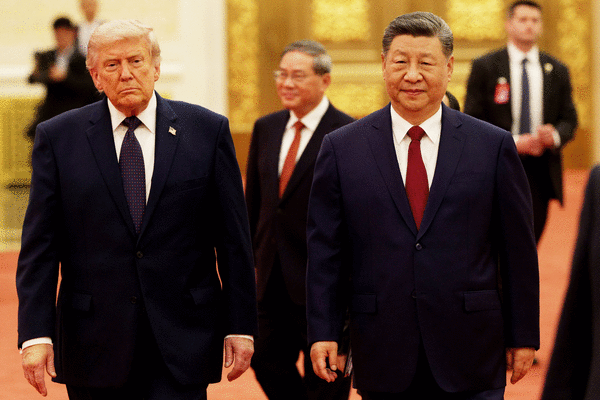
WASHINGTON — Donald Trump is arriving at an unprecedented summit meeting with Xi Jinping and Vladimir Putin politically weakened at home, yet perhaps even more eager to flex his power abroad.
The U.S. president has suffered twin blows in recent weeks that threaten to cloud the gathering of the world’s largest nuclear powers: Republicans’ crippling defeats in the U.S. midterm elections and the scandal that cost Jensen Huang his job leading artificial intelligence chipmaker Nvidia Corp.
The election result highlighted domestic anger over the war with Iran, and the higher fuel costs it caused. Trump has sought to deepen relationships with his Chinese and Russian counterparts despite their differences over the conflict.
Trump’s critics have been emboldened, including China hawks who say he’s cultivated too close a relationship with Xi. Huang’s ouster, following the revelation of his affair with a suspected Chinese spy, heightened scrutiny of his ties to Trump as well as his role as the AI industry’s most vocal advocate for selling advanced chips to China.
The Republican leader’s efforts to curry favor with his Russian counterpart, and criticize Ukrainian President Volodymyr Zelenskyy, have also drawn criticism.
All of that may complicate Trump’s bargaining position when he sits down with Xi and Putin on the sidelines of the Asia-Pacific Economic Cooperation leaders’ summit in Shenzhen, China, as well as his one-on-one talk with the Chinese leader.
But Trump’s weakened position in Washington may simultaneously be pushing him toward an arena where he has more control: high-stakes diplomacy with foreign powers.
Facing down the prospect of lame-duck status, the president’s predecessors have often pivoted to foreign policy as a chance to remind America’s allies and rivals that they’re still commander-in-chief, said Kurt Tong, a former U.S. ambassador for APEC.
“The president will undoubtedly be seeking to use this trip to reassert leadership, authority, demonstrate his statesmanship capabilities and essentially show off on the international stage,” said Tong, now at The Asia Group, a Washington-based consultancy.
The U.S. president is expected to use the three-way meeting to discuss the war in Iran. He told reporters Monday that he’d also discuss his “favorite subject Ukraine,” contrary to guidance provided by a senior administration official who briefed reporters on condition of anonymity.
“Ukraine’s losing,” Trump said at the White House before his departure in comments that dealt another blow to Zelenskyy’s efforts to convince the U.S. that Kyiv has Russia on the back foot.
Trump added that Putin could be “a lot tougher” but “I think he’s backing down a little bit” in the conflict. He also reiterated that he believes the Russian leader would like to end the war.
China’s Foreign Ministry confirmed Monday the trilateral will take place on Thursday following an earlier White House announcement.
The meeting could bolster China’s standing as a global power while also giving Trump an opportunity to project strength abroad as he grapples with low approval ratings and the prospect of investigations by a Democrat-led Congress.
Trump has said he wants to discuss denuclearization with the two leaders, an issue he has sought to tackle with them since his first term, without success. China has long resisted trilateral talks around nuclear arms, as its stockpile is far smaller than the U.S. and Russia’s.
Still, a meeting between Trump and Putin is likely to set off alarm bells in Kyiv and Western capitals, handing the Russian leader a chance to shape any negotiated peace deal on favorable terms for Moscow — without Ukraine present to determine its own future.
The president has taken a defiant tone in the wake of his electoral loss, elevating hardliner Stephen Miller to the role of White House chief of staff and threatening to block Democrats’ agenda. That’s an indication leaders in Asia are unlikely to see a chastened U.S. president on the world stage.
The president has also indicated the Huang saga was unlikely to change his efforts to cultivate his relationship with Xi. A senior administration official said the president had no intention of raising the issue with his Chinese counterpart, suggesting the focus would be on economic cooperation.
On Monday, Trump indicated that he wouldn’t mind seeing Huang return to his role as Nvidia CEO, telling reporters it “certainly isn’t a bad idea.” He also said national security was not put at risk, repeating that Nvidia was only ever allowed to sell “obsolete” chips to China.
Commerce Secretary Howard Lutnick, who has faced accusations of delaying export controls and shielding Nvidia from restrictions on advanced chip shipments to China, is expected to join Trump in Shenzhen, according to the White House.
U.S. Trade Representative Jamieson Greer is also planning to make the trip as are Treasury Secretary Scott Bessent, Secretary of State Marco Rubio and Miller, the White House said.
Trump’s agenda includes a stop in Manila to meet with leaders of the Association of Southeast Asian Nations summit before his meeting with Xi and Putin.
Xi and Trump’s prior meetings this year were high on pomp and circumstance but low on substance, and White House officials have not forecast major breakthroughs on trade or other policy priorities during his next summit. A “30 billion for 30 billion” reciprocal tariff-reduction deal agreed in principle at previous summits is still being hashed out.
“All the signals coming out of the White House are that this trip is a courtesy call,” said Edgard Kagan, a former U.S. ambassador to Malaysia now at the Center for Strategic and International Studies.
Beijing may be more interested in highlighting Xi’s role as the chair of APEC than Trump’s attendance. “They don’t want Trump to step on Xi’s overall message of leadership,” Kagan added.
Washington and Beijing are expected to focus on the yearlong trade truce between the world’s top economies that is set to expire in January. It’s unclear if a new extension will be hashed out at this meeting. In December, Xi is set to attend the Group of 20 summit in the U.S.
The pact was initially struck in Busan, South Korea in October 2025, where both sides agreed to suspend additional 24% levies while leaving a 10% rate in place. China also agreed to allow the export of some rare earth minerals essential for everything from fighter jets to electric cars — a commitment the U.S. says hasn’t been implemented fully.
The president is also set to meet the leaders of the Quad alliance, which includes the U.S., Japan, India and Australia, in Manila in the group’s first leader-level meeting since Trump’s return to office.
The group, formed to counter China’s growing influence in the Indo-Pacific region, is likely to touch on the war in Iran, which has led to global oil supply disruptions in the wake of the closures in the Strait of Hormuz.
The U.S. and its allies have agreed to jointly identify and protect artificial intelligence technologies and supply chains considered vulnerable to China, the Financial Times reported over the weekend. In a statement released Sunday, the State Department said the U.S. and nine other countries will seek to safeguard technologies and systems essential to AI supply chains, without naming China.
Chips controversy
AI and business deals are also expected to be on the agenda. Despite the president’s comments, the meeting could be further strained by the fallout from the Nvidia scandal.
Huang’s downfall at the company he founded will deprive Trump of a travel partner who accompanied him on his last China trip and attended the state dinner with Xi at the White House two months ago. China has called the spying allegations a “smear.”
Some Republican lawmakers have pressed Trump to take a more aggressive stance toward Beijing, including greater export controls to curb the flow of semiconductors to China.
Speaker Mike Johnson told reporters at the Capitol that there is “a developing consensus in Congress” about tightening curbs on sending advanced models to Chinese customers.
One option would be widening curbs to capture subsidiaries majority-owned by already-sanctioned firms — the so-called 50% rule that has been suspended until January is regarded by some in Washington as the key to closing a major loophole.
Greer told CNBC he did not expect export controls to come up during the APEC trip, noting that while the Chinese may raise the issue, it’s a matter of “internal affairs.”
“Conversations about economic security and export controls are not things we negotiate with the Chinese,” Greer said.
—With assistance from Derek Wallbank, Lucille Liu, Michelle Jamrisko and Meghashyam Mali.
©2026 Bloomberg L.P. Visit bloomberg.com. Distributed by Tribune Content Agency, LLC.





Comments