The age of hyperscale data centers has arrived in Colorado. Regulations are still lagging
Published in News & Features
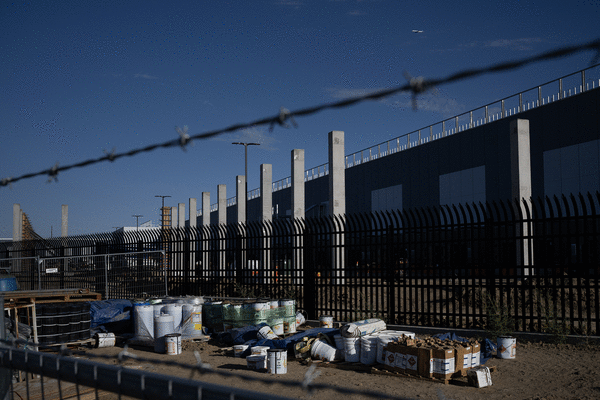



Arrests and scuffles with police. Shouts of “shame.” Litigation, petitions and public comment sessions stretching past midnight. This is how Coloradans are reacting to the arrival of large-scale data centers in the Centennial State.
Smaller data centers have operated in Colorado for years, tucked into unassuming office parks and downtown skyscrapers. But a new era of hyperscale data centers made for the age of artificial intelligence has begun in Colorado and — despite near-universal pushback in the communities where they are planned — more developments are underway as governments and regulators struggle to keep up.
“This has moved so fast, the data center demand is so incredibly strong and powerful that it’s really caught local governments like us off-guard,” Aurora mayor Mike Coffman said. “There’s a feeling of vulnerability right now. It came so fast, so hard, it’s forced me to push back – and I’m pretty pro-business.”
Four large data centers are in the planning phases or under construction in Colorado, several of which are competing to become the state’s largest. Combined, their max power needs could equal those of more than 819,000 homes — or 16 times the amount of power used by Denver International Airport.
The development comes despite a patchwork of regulations, moratoriums and local opposition that has slowed — though not stopped — industry growth.
In Aurora, plans for a 500-megawatt facility next to a neighborhood are moving forward, despite the mayor’s pledge to stop it at all costs. If built, the facility’s power needs could outstrip the city’s entire residential use. In Weld County, a successful petition drive sought to stop an artificial intelligence data center planned there, but it’s unclear whether a ballot measure could halt the project. In Colorado Springs, the City Council voted to put off a vote on a data center until the spring, but the developer said he plans to continue working on the project in the interim. If built, the data center would be the largest power user in the city, by far.
There is no standard definition of “hyperscale” data centers, but the term is generally used to describe large facilities that use lots of power and often the computing power needed for artificial intelligence. The Colorado utility regulators writing new rules for large electrical loads (like data centers) are looking at facilities that draw at least 50 megawatts, though they are considering lowering that threshold to 20 megawatts for new customers. A megawatt of power can power approximately 1,100 homes, according to Xcel Energy.
Local governments remain the primary regulators of data centers big and small in Colorado. The state lacks broad regulation of the industry, prompting city councils and county commissions of a variety of political persuasions to pass their own rules or enact moratoriums. Larimer County is seeking public comment on a proposed ban on hyperscale data centers, defined as any facility that would draw more than 30 megawatts of power. Brighton in late October enacted a moratorium weeks after residents learned of a 2.5 million-square-foot data center proposed for the Adams County town. The company later withdrew its application. Denver, Arvada, Commerce City, Pagosa Springs, Boulder County and Jefferson County are some of the more than one dozen local governments that enacted a temporary moratorium on data center development.
The topic has drawn the attention of governor-elect Phil Weiser, who said at an event in October that his first legislative priority would be a bill to “put guardrails on data centers,” though he did not support an all-out ban.
“Communities need to be listened to,” he said. “These data centers shouldn’t be shoved down the throat of communities.”
Opposition to data centers is not always about the specifics of a project, said Jason Green, whose company Raeden is building a 50-megawatt facility in Colorado Springs. Instead, developers feel like they are defending against the broad swell of growing hostility against the industry — and the artificial intelligence technology it fuels — as a whole.
“There isn’t a data center project in the U.S. that in some form isn’t caught up in the referendum of data centers,” said Green, who has worked in the data center industry for more than 25 years.
That broader conversation is also playing out in discussions about potential statewide legislation regulating the industry, said state Sen. Cathy Kipp, who sponsored a failed bill in the last legislative session to regulate data centers. The issue is not about left or right politics, she said, but about regular people bearing the costs to their quality of life from projects that make huge amounts of profit for wealthy companies.
“People see these very wealthy companies coming in, building whatever they want, taking our precious resources and people are saying, ‘Why should we support this?'” she said. “It’s no longer left or right, it’s up and down.”
Data center capital of the state?
When Amy Wiles bought her home in Aurora in 2020, the realtor told her that the open fields abutting her neighborhood would eventually become a small, walkable cluster of shops and restaurants on the eastern edge of Colorado’s third-largest city.
Wiles never got her neighborhood coffee shop. Instead, the land became home to the state’s largest data center. And Wiles, now a city councilmember, has found herself deeply embroiled in the debate about how local communities should regulate the booming, unpopular industry.
The ward she represents sprawls across the city’s northeast corner and has a lot of attributes data center developers value: large parcels of undeveloped land, relatively easy access to power and water resources, proximity to an urban core and — an increasing rarity on the Front Range — a lack of a moratorium against data center development. Wiles tried twice to pass a moratorium, but didn’t have enough votes. The pause is necessary so the city and council can study best practices for regulating data centers and implement rules, she said.
“Instead, we’re literally building the airplane in flight,” Wiles said.
Without the moratorium, Aurora is slated to become home to several large-scale data centers.
Construction began in 2023 on the 160-megawatt data center by Wiles’ home — owned by Virginia-based Quality Technology Services — and it is already operating. In 2025, Denver-based Vantage Data Centers submitted an application to build its 500-megawatt facility, which spurred a contentious battle between the city, the company and residents of the neighborhoods next door, including a new senior housing community.
Two other data centers have started the planning process: a 500-acre data center campus that is part of a larger development called Aerotropolis Logistics Center and a 1.5 million-square-foot facility that is part of a broader development called the Fulenwider Master Plan. Publicly available planning documents do not show how much power or water the facilities would use.
The controversy over the Vantage facility spurred a change of mind for Coffman, Aurora’s Republican mayor. In August, Coffman cast the tie-breaking vote that killed Wiles’ first attempt at a data center moratorium. Two months later, he fully supports a moratorium on new data center development so the city can craft regulations and is determined to do anything to stop the project from being built next to homes.
Coffman said the Vantage project became a symbol of what data center companies should not do: build next to a residential community while giving residents little notice. Homeowners will lose value in their new houses — the biggest investment they’ll ever make, he said.
“I’d be angry, too,” Coffman said.
If the council can’t pass a moratorium, he will attempt to bring the Vantage project to a vote. He acknowledged that he didn’t know if he had the legal grounds to stop the project with a council vote, but said it would at least tie the developers up for a bit. He said he was open to Vantage’s recent suggestion that it would try to build the facility at a different site away from neighborhoods. (Vantage did not make a representative available for an interview over two weeks.)
In addition to the moratorium, Coffman will seek an end to city tax breaks for data centers. The city in 2023 gave QTS a tax break worth up to $19 million over 12 years if it creates and maintains 15 jobs with minimum salary requirements, according to city spokeswoman Jennifer Soules. Vantage in 2025 inked a deal worth up to $39 million over 10 years as long as the company creates 50 jobs with minimum salary requirements. The city also granted the Aerotropolis project sales and use tax discount worth up to $13 million.
“I don’t want other data center applications coming in under the existing rules because they are just too weak,” Coffman said. “I don’t want to be the data center capital of the state.”
Two projects in limbo
Large data center projects on opposite ends of the Front Range remain in limbo as local opposition seeks to stop them and local governments ponder next steps.
In Weld County, opponents of a data center project proposed by Global AI last month collected more than 30,000 signatures for two petitions: one that would put the county’s approval of the project to a vote of the people and a second that would require all future data center developments and expansions to be approved by voters in a county-wide election.
Weld County Commissioners in September greenlit the data center, which the artificial intelligence company plans to operate with tech giant Nvidia and an Arabic-language AI model backed by the Saudi sovereign wealth fund. In its first phase, the data center will use 35 megawatts of power, but will scale up as more power becomes available. A company spokesman disputed reports that the facility would grow to 1 gigawatt — the equivalent of 1,000 megawatts — and said that is the goal for the company’s entire network of data centers, not the Weld County facility alone.
The future of the project and the petition drive is hazy.
Global AI is seeking an agreement with Greeley to annex the property, which would render the petition challenging Weld County’s approval moot, said Patricia Garcia-Nelson, a Greeley resident and an organizer with environmental advocacy group GreenLatinos Colorado. The petition requiring a countywide vote for any data center would not apply to Global AI because it is already underway, she said.
“At this point there are a lot of questions around what the city of Greeley is going to do,” Garcia-Nelson said.
The project is also in legal limbo after a competing developer, Broe Real Estate Group, sued the county alleging it erred in approving Global AI’s permits. The real estate group owns a neighboring parcel that it intends to turn into a mixed residential and commercial development. The real estate group singlehandedly funded the petition campaigns opposing the data center through a committee called Protect Our Water and Energy Resources, though it built a controversial data center of its own in Georgia.
Global AI, through a spokesman, declined an interview request.
In Colorado Springs, the 50-megawatt Project Taurus data center under development by Raeden is on hold after the city council in September decided to postpone its vote on the project until April. The company aims to transform a former Intel chip factory located in an office and industrial park that borders some homes into a data center to serve military contractors’ AI needs, said Green, Raeden’s cofounder.
The city council decision followed a day-long public meeting that periodically devolved into yelling and during which police took four people into custody. Opponents of the project are worried about its location, noise and power usage.
While it waits, Raeden will finalize an agreement with the city-owned electric utility and continue preparing for next steps, Green said.
But he’s frustrated. He’s attended dozens of meetings with city officials, local residents and opponents of the data center. He’s listened to concerns, he said, and made changes to the site plan to assuage those concerns. The company posted an extensive FAQ page on its website to help answer community questions. But some people cannot be convinced that he is not lying, he said.
Much of the discussion feels less like a debate about the merits of his specific project and feels more like a referendum on the data center industry as a whole, Green said.
“We are 100% bolted straight into this world of angst about data centers,” he said.
Less popular than fracking next to a school
On a recent overcast day, environmental and community advocates unfurled dozens of pages of signatures that stretched dozens of feet across the platform outside of the Colorado Public Utilities Commission’s offices on Colfax Avenue.
Over the course of a month, a coalition of nonprofits had gathered nearly 5,000 signatures for a petition urging the commission to adopt stringent regulations for large data centers that connect to the state’s largest power provider. The PUC is tasked with ensuring that power companies — many of which operate as monopolies in their market — provide reliable and reasonably priced services that align with state values.
The petition asked the PUC to adopt rules that protect Xcel Energy’s other customers from paying for data centers’ needs and ensure the centers’ power needs don’t create more greenhouse gas emissions by extending the life of power plants that rely on fossil fuels.
“This proceeding is about more than one tariff and more than one data center,” said Alfonso Espino, a community organizer in Denver’s Globeville and Elyria-Swansea neighborhoods, where a company recently built a controversial 16-megawatt data center. “It is about whether Colorado will repeat a familiar model of development in which private companies receive the benefits while the public absorbs the costs, or whether the state will establish clear rules before another generation of communities is forced to organize after the damage has already been done.”
The rally outside the building came days before the PUC began its days-long deliberations over those rules, which will become the most far-reaching regulations of the data center industry in the state. The rules will dictate how much data centers and other large-load customers will pay for power and how utilities will handle the cost of any upgraded or added infrastructure they need.
The process to make the regulations is complicated and involves dozens of parties. On the first of five days of hearings on the matter, it took more than six minutes for the 38 attorneys weighing in on the process to introduce themselves and the parties they represent, which range from Walmart to Google to the city of Denver to conservation groups.
The PUC plans to hand down its decision before the end of the year, according to commission spokeswoman Megan Castle. But its regulations might not be the only far-reaching rules in the state for long.
Lawmakers are expected to pursue several data center-related bills in the coming legislative session, which begins Jan. 11. Kipp, a Democratic state senator representing Larimer County, said she will continue her pursuit of regulations for the industry. State lawmakers for three consecutive years tried and failed to pass legislation incentivizing or regulating data centers.
The tides of public opinion have shifted significantly in the months since her previous bill failed in the last legislative session, Kipp said. Data centers are now so broadly unpopular that she expects a different tone of conversation. Instead of debating how to balance incentives for the industry with regulations, the conversation will likely focus on whether to regulate or impose a sweeping moratorium, she said.
“I don’t see a bill with monetary incentives passing the legislature,” she said.
A survey of 1,389 Coloradans in September found that opposition to data centers is broad and intense. The vast majority of those surveyed opposed a data center in their town, county and in the state as a whole. More than half said they would support a ban on data centers in their community, the survey found.
“After 20 years of polling Coloradans on a wide range of issues, we’d argue the oil and gas industry would have an easier time defending a fracking well 100 feet from a school than an AI company would have defending a new data center,” the polling firm, Magellan Strategies, wrote in its report.
Kipp will reintroduce a bill similar to the version she brought toward the end of last session, which included transparent reporting and clean energy requirements for data centers drawing more than 30 megawatts. She expects others will bring more restrictive bills.
“Last year, we were the loony left people and now we’re the center,” Kipp said. “And we haven’t changed our position.”
Large data centers under development
At least four large data centers are under development in Colorado. The first phase of the QTS facility is already complete, and the remaining three have yet to begin construction. All four facilities will use closed-loop cooling systems, which use significantly less water than data centers that use evaporative cooling to keep their computer banks from overheating.
QTS (Aurora)
—Owner: Quality Technology Services (Virginia-based)
—Power needs: 160 megawatts
—Power provider: Xcel
—Water system: Closed loop
—Status: First building complete, construction continues
Trident Data Center (Aurora)
—Owner: Vantage Data Centers (Denver-based)
—Power needs: 500 megawatts
—Power source: Xcel
—Water system: Closed loop
—Status: Under consideration by Aurora City Council
Global AI (Weld County)
—Owner: Global AI (New York-based)
—Power needs: 35 MW for first phase, then will scale
—Power source: Poudre Valley Rural Electric Association
—Water system: Closed loop
—Status: Seeking annexation to Greeley
Project Taurus (Colorado Springs)
—Owner: Raeden (California-based)
—Power needs: 50 megawatts
—Power source: Colorado Springs Utilities
—Water system: Closed loop
—Status: Awaiting approval by Colorado Springs City Council
_____
©2026 MediaNews Group, Inc. Visit at denverpost.com. Distributed by Tribune Content Agency, LLC.






Comments