Threats to broadcasters hang over FCC nominee hearing
Published in News & Features
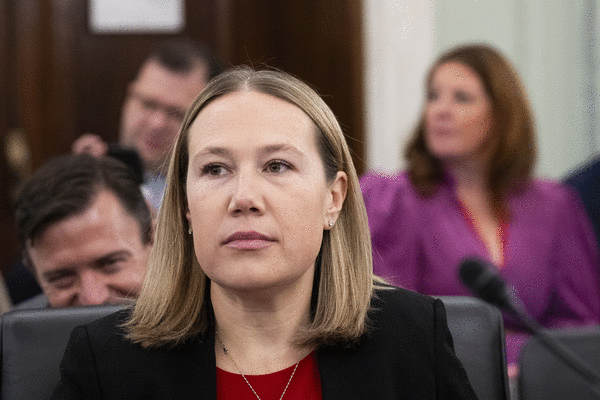
WASHINGTON — President Donald Trump’s Republican nominee to the Federal Communications Commission faced opposition Tuesday from Senate Democrats who fear the commission could be controlled exclusively by Republicans under Chairman Brendan Carr, who they vowed to investigate in the next Congress.
Appearing before the Senate Commerce Committee, nominee Danielle Thumann Severs limited her commitments to independence from Carr, including on regulating broadcasters based on their content decisions.
Much of the hearing focused on Carr and his threats to use the FCC to punish broadcasters he disagrees with.
Sen. Ben Ray Luján, D-N.M., said that he expects Carr will not last long in his position once Democrats take control of Congress in the new year.
“Mr. Carr, if you’re listening now, know you’re going to be in this body once a month, if not more, and in the House of Representatives as well, answering questions … so we can get to the bottom of the nonsense and the cover-ups that have been taking place,” Luján said.
The nomination of Thumann Severs, who currently serves as senior counsel to Carr, has led to consternation among Democrats due to continued vacancies at the FCC. The five-member commission is intended to have three members of the president’s party, including the chair, and two in the minority.
Currently Carr serves alongside fellow Republican Olivia Trusty and Democrat Anna M. Gomez, whose term expired earlier this year. Gomez may continue to serve through next year under the law if a replacement is not nominated and confirmed.
Democrats are concerned that if Thumann Severs were to be confirmed, the commission’s three Republican members could constitute a quorum on their own, allowing Trump to fire Gomez.
Sen. John Hickenlooper, D-Colo., said Senate precedent is to move pairs of one Democratic and one Republican nominee for the FCC and that he “strongly” believed the Thumann Severs nomination should have been paired with a renomination of Gomez in order to continue having “both parties at the table.”
“A bipartisan FCC is essential to avoid things like large-scale media consolidation [and] I think also, more fundamentally, to protect a free and diverse press [that] serves everyone,” Hickenlooper said.
In addition to urging Trump to renominate Gomez, Democrats underlined the need for a second Democratic member of the commission.
Hickenlooper highlighted Thumann Severs’ close work with Carr, who Democrats and some Republicans have been critical of for comments about using the FCC’s public interest standard against television stations airing programming Carr disagrees with.
Thumann Severs’ work at the FCC currently focuses on the Wireline, Public Safety and Homeland Security, and Consumer and Governmental Affairs bureaus, rather than the Media Bureau.
Committee Chair Ted Cruz, R-Texas, has also been critical of Carr’s comments. On Tuesday, he listed the FCC’s request for ABC-owned stations to submit early license renewals alongside earlier incidents in which he said Democrats encouraged the weaponization of the FCC against conservative voices.
“The First Amendment places important limits on the government’s ability to regulate speech,” Cruz said. “The FCC possesses significant regulatory authority over communications, so there is always a risk that it could weaponize its authority against Americans with whom it disagrees.”
Thumann Severs committed to Cruz that she would base licensing decisions on “the law and the record” and not use the FCC’s authority to “pressure or punish” broadcasters for protected speech.
However, when Sen. Edward J. Markey, D-Mass., questioned Thumann Severs on whether the FCC could punish broadcasters the president disagreed with, Thumann Severs repeated one of Carr’s arguments in discussing the FCC’s role.
“Broadcasters are subject to public interest obligations as part of the public trustee model in exchange for the licenses that they hold,” she said. “As part of those public interest obligations, they are subject to many different rules and requirements, and the FCC is charged with enforcing and investigating the public interest standard against broadcasters.”
Under repeated questions from Markey about Carr’s previous remarks, Thumann Severs said she would base her decisions “in the facts and the law and the record.”
Luján also asked Thumann Severs to name issues where she had disagreed with Carr or Trump. While she said her decisions would be her own, she declined to name any examples of disagreement.
Other opposition
In addition to questions about Carr, Democrats asked the nominee about the FCC’s E-Rate program, which provides low-cost connectivity for schools and libraries, and the Universal Service Fund, which funds the E-Rate program and other programs.
Thumann Severs said that she believes the E-Rate program has been successful and that the FCC has a statutory obligation to provide some kind of discounted service to schools and libraries. But she was less forthcoming on whether the FCC could shut down the program as it currently exists without congressional approval or whether the program should be restricted only to rural areas.
Late last month, Democratic members of the House Energy and Commerce Committee, led by Communications and Technology Subcommittee ranking member Doris Matsui, D-Calif., sent a letter to Senate Majority Leader John Thune, R-S.D., and Cruz urging Gomez’s renomination with any move to confirm a Republican nominee.
“Commissioner Gomez has shown the experience and judgment to continue that work,” the members wrote. “We therefore ask that the Senate pair any new Republican nominee with her renomination to a full term, consistent with the bipartisan design Congress built into this agency.”
On Monday, the Leadership Conference on Civil and Human Rights also sent a letter to committee leadership urging a delay on the hearing and any vote on Thumann Severs’ nomination until Gomez can be renominated.
“Independent agencies should not be extensions of presidential will: their leaders should exercise independent judgement based on their expertise and statutory mandates,” the group wrote.
Cruz did not indicate Tuesday when the committee might vote on Thumann Severs’ nomination, and no markup has yet been announced by the committee of hers’ and those of three others for two posts at NASA and one at the Transportation Department who also testified.
©2026 CQ-Roll Call, Inc., All Rights Reserved. Visit cqrollcall.com. Distributed by Tribune Content Agency, LLC.





Comments