Haiti police, Salvadoran troops destroy house of 400 Mawozo gang leader
Published in News & Features
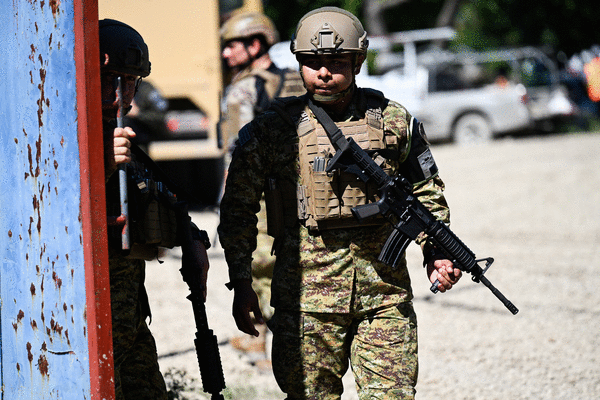
A Haiti National Police drone task force backed by Salvadoran soldiers destroyed a house used by one of Haiti’s notorious gang leaders early Sunday, killing several gunmen inside, several sources confirmed to the Miami Herald.
The operation targeting the head of the 400 Mawozo gang, Wilson Joseph, better known as Lanmò San Jou, is the latest attack in an intensifying campaign to wrestle control of the country’s capital, Port-au-Prince, from the terrorizing grip of the powerful Viv Ansanm gang coalition.
The house was struck at about 2:30 a.m. Sunday by the task force, which uses explosive drones operated by Haitian police officers with the support of private security contractors. While task force members moved on the ground inside the gang stronghold, four helicopters provided aerial support. Two of the choppers were operated by the task force and the other two by Salvadoran troops, a source with knowledge of the operation said.
At the time of the attack, Joseph was not inside the house, which had been under surveillance. But his gunmen, possibly as many as 20, were inside and were killed, two sources said. It’s unclear if Joseph owned the house or had seized it, as frequently is the case with leaders of Haitian gangs that control large swaths of the West region that includes Port-au-Prince, as well as parts of the Artibonite and Central Plateau.
The strike comes days after another prominent gang leader, the head of the “Boston” gang, Mathias Saintil, died following a drone strike in Port-au-Prince’s Cité Soleil slum. No less than seven drones were deployed on Thursday in gang strongholds, leading to the deaths of several gang members and civilians in and around the capital.
This is the second time a house associated with a prominent gang leader has been destroyed by the task force, which operates out of the prime minister’s office and is supported by the private Security firm Vectus Global, founded by former Navy SEAL and Blackwater founder Erik Prince.
In January, the task force blew up at least two homes belonging to feared warlord Jimmy Chérizier, a former police officer turned gang leader better known as Barbecue. A leading figure in Viv Ansanm, Chérizier also was not home when the attack occurred.
Rubio says chain of command needs to be clear
Sunday’s strike against 400 Mawozo marks a significant escalation in security forces’ campaign against Haiti’s criminal armed groups, which has intensified since four Salvadoran aviation technicians deployed under the United Nations-authorized Gang Suppression Force were ambushed in a gang-controlled area on Oct. 18.
The ambush was carried out by members of the Chen Mechan gang, with reinforcements from 400 Mawozo, according to several sources.
The men have not been heard from, and their disappearance prompted El Salvador President Nayib Bukele to deploy some 2,500 troops to Haiti in what he described as a search-and-rescue mission.
U.S. Secretary of State Marco Rubio on Sunday told journalists that El Salvador is providing its own airlift and its mission separately from the U.S.-backed gang suppression mission. The Salvadorans are in Haiti as part of a bilateral agreement between El Salvador and Haitian officials “to go after the gangs that kidnapped their forces that were there,” the secretary of state said, speaking to journalists at the Homestead Air Reserve Base.
Bukele, Rubio acknowledged, called President Donald Trump to make him “aware of what he was doing, and the President understood why he was doing it. But we’re not necessarily — we’re not actively involved in that effort.“
The vast majority of the Salvadoran troops are operating outside the GSF command structure, and instead report to their own Salvadoran commander on the ground in Haiti. This has made for a complicated security environment while raising concerns about coordination and the scope of the Salvadoran troops’ presence in Haiti.
Rubio said the United States. has raised concerns about the chain of command needing to be well established as to not undermine the mission of the international armed forces.
“We’ve raised this point, not because it’s a criticism, just as an observation,” he said. “We have to make sure that there’s deconfliction going on. What you can’t have is Gang Suppression Force running into Salvadoran soldiers and shooting at each other because they think the other side are gang members. So that’s why you’ll need a deconfliction mechanism. You’ll need a lot of strong coordination because they’re operating alongside one another.”
In recent days, Haitian Prime Minister Alix Didier Fils-Aimé has established a coordination cell under his oversight to help synchronize security operations among the five different forces, which also included Haiti’s small armed forces.
With overlapping operations, for example, the GSF has had to deconflict during its own ground operations to avoid conflicts with the drone strikes, which continue to raise concerns among human rights groups and within the United Nations over civilian casualties. Last week, several civilians, were killed when a drone strike led to the deaths of another prominent gang leader and several members of his Boston gang in Port-au-Prince’s Cité Soleil slum.
In response to the intensifying operations, Wilson has appealed to the United Nations and Haitian institutions including the National Commission for Disarmament Dismantlement and Reintegration asking for negotiations, setting Nov. 18, Haiti’s historic Battle of Vertières anniversary, as a proposed moment to open dialogue.
He says his request is not capitulation but rather an act of patriotic responsibility. In his latest letter, he argues that “Haiti’s future cannot be built solely on confrontations and military operations. The nation needs stability, reconciliation, human security and a genuine prospect for sustainable development.”
©2026 Miami Herald. Visit at miamiherald.com. Distributed by Tribune Content Agency, LLC.






Comments