South Florida US Attorney Reding Quiñones abruptly resigns. What's next?
Published in News & Features
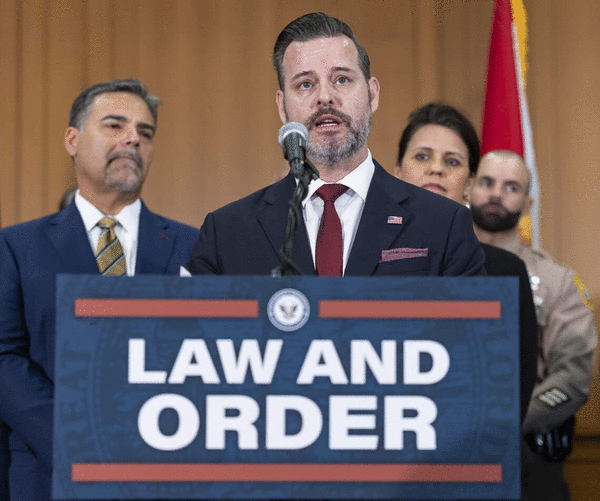
MIAMI — Jason Reding Quiñones resigned Friday as U.S. attorney for the Southern District of Florida, ending a tenure marked by turmoil within the Miami-based federal prosecutor’s office and controversy over its involvement in an investigation targeting perceived enemies of President Donald Trump.
Reding Quiñones offered no explanation for his abrupt resignation, which came just three days after midterm elections in which Republicans lost control of both the House and Senate. He did not respond to text messages seeking comment.
His resignation comes amid growing concern within Miami’s legal community over the politics surrounding the office, the departure of experienced prosecutors and the erosion of its traditional independence from political influence.
Dan Gelber, a former federal prosecutor and Miami Beach mayor whose law firm represents former CIA Director John Brennan in an investigation involving the office, offered a stark assessment.
“It’s been terrible to watch what’s happened to this office,” Gelber said. “Their morale is underwater. Their institutional expertise has been depleted.”
Gelber, who spent about a decade as a federal prosecutor in Miami, recalled an office that handled some of the nation’s most consequential drug trafficking, healthcare fraud and foreign corruption cases. He expressed hope that new leadership could restore its standing and refocus its resources on traditional law enforcement responsibilities.
Reding Quiñones made no mention of the controversies surrounding his tenure in his resignation announcement, instead reflecting on his years in public service.
“From serving our Nation in uniform to serving at the Department of Justice and on the bench, public service has been the honor of my lifetime,” he wrote. “But leading the U.S. Attorney’s Office in my home district has been especially meaningful.”
As previously reported by The Miami Herald, Reding Quiñones welcomed Joseph diGenova, a longtime Trump ally, to the Southern District of Florida to pursue an investigation targeting former CIA Director John Brennan, who served under President Barack Obama.
The investigation centers on allegations that Brennan and other former officials participated in a conspiracy against Trump, beginning with the investigation into Russian interference in the 2016 election and extending to later cases involving the president, including the classified-documents prosecution.
Brennan has denied wrongdoing, and his attorneys have accused the Justice Department of pursuing a politically motivated investigation intended to punish him for his government service and public criticism of Trump.
Gelber declined to speculate on how Reding Quiñones’ departure might affect the Brennan investigation before consulting others involved in the case. But he criticized the resources devoted to what he called a “non-case,” arguing that the investigation had diverted prosecutors from more important responsibilities.
Reding Quiñones publicly supported diGenova’s efforts to assemble a team of prosecutors. DiGenova took over after career prosecutor Maria Medetis Long was removed from the investigation, having concluded there was insufficient evidence to charge Brennan, according to The Miami Herald.
The investigation operated partly from the federal courthouse in Fort Pierce, where Trump-appointed Judge Aileen Cannon, who dismissed the classified-documents case against Trump in 2024, presides. Brennan’s lawyers accused prosecutors of attempting to steer the case to her courtroom.
The controversy unfolded amid significant staffing losses at the Southern District of Florida, long known for major drug trafficking and financial fraud prosecutions.
The Herald reported that the office, which once employed as many as 240 full-time prosecutors, had lost roughly half that number through retirements, resignations and firings. Some departures preceded Trump’s return to office in January 2025, while others followed the dismissal of prosecutors who had worked on investigations involving him.
The departures have raised concerns about the loss of institutional knowledge and the office’s ability to handle complex federal prosecutions, although experienced attorneys remain among its ranks.
Prosecutors also complained about equipment and resources being transferred from Miami to Fort Pierce to support the Brennan investigation.
Jeffrey Sloman, a former U.S. attorney in Miami, warned in an earlier interview with the Herald that the developments threatened the office’s reputation and its ability to recruit talented lawyers.
“Unless something changes quickly, it’s going to be hard to undo this damage,” Sloman said at the time.
Beyond the staffing losses, concerns have centered on political interference in prosecutorial decisions, particularly whether investigations involving Trump’s perceived adversaries are being driven by Washington rather than by career prosecutors evaluating the evidence.
Gelber contrasted the current environment with his experience handling public corruption cases, when he said political affiliation played no role in decisions about whom to investigate or prosecute.
“I prosecuted Democrats and Republicans, never even thought about their party, and obviously never took direction from the president,” he said. “If somebody had told me what to do, I ... would have resigned that day.”
He said the erosion of prosecutorial independence had become particularly pronounced during Trump’s second administration, contrasting it with the president’s first term, when more traditional conservative officials held senior Justice Department positions.
Gelber also criticized the use of criminal investigations to embarrass political targets.
“You’re not supposed to use the grand jury to embarrass someone,” he said. “You either indict or you shut up.”
The New York Times reported Oct. 9 that senior Justice Department officials had grown dissatisfied with Reding Quiñones’ management and questioned his ability to oversee the office’s operations.
According to the Times, officials working under Attorney General Todd Blanche believed Reding Quiñones was spending too much time in Washington rather than Miami. The newspaper reported that senior Justice Department official Aakash Singh removed him from the attorney general’s advisory committee to refocus his attention on South Florida.
The Times also reported that many career prosecutors were reluctant to participate in the Brennan investigation, prompting the recruitment of military lawyers and prosecutors from other offices.
Neither newspaper’s reporting establishes whether those controversies contributed to Friday’s resignation.
The departure also comes amid a broader reshuffling of the Trump administration following Republican losses in the midterm elections that cost the party control of Congress.
Trump has named Stephen Miller, a longtime adviser and architect of his hard-line immigration policies, to replace Susie Wiles as White House chief of staff, elevating one of his closest political allies as the administration prepares to confront an opposition-controlled Congress.
Other senior officials have also faced scrutiny, including Defense Secretary Pete Hegseth, whose leadership has drawn criticism on Capitol Hill. News organizations have reported discussions about his possible replacement, although the White House has pushed back against speculation that his departure is imminent. There is no established connection between those developments and Reding Quiñones’ resignation.
For the Southern District of Florida, the more immediate question is who will take charge and whether the Justice Department will nominate a permanent successor or rely on an acting U.S. attorney. Reding Quiñones did not identify a replacement.
The office’s first assistant could assume leadership while the administration considers its options. Washington could also choose to maintain interim leadership for an extended period, potentially giving senior Justice Department officials greater influence over the office’s priorities without immediately pursuing a Senate-confirmed appointment.
Whoever takes charge will inherit an office confronting questions about its staffing, morale and involvement in politically sensitive investigations.
A successor could reassess the resources devoted to the Brennan investigation and seek to rebuild confidence among career prosecutors, or continue the current approach under Justice Department supervision. Whether Reding Quiñones’ departure brings a change in direction remains uncertain.
Reding Quiñones, an Army reservist who previously served as a federal prosecutor and judge, thanked Trump and the office’s employees in his resignation announcement.
“I am grateful to President Trump for his trust and to the extraordinary men and women of the great Southern District of Florida for their dedication, friendship, and unwavering commitment to justice and the rule of law,” he wrote.
He said it had been “the privilege of a lifetime” to work alongside prosecutors and law enforcement officers, expressing pride in their accomplishments and gratitude for the opportunity to serve.
_____
©2026 Miami Herald. Visit miamiherald.com. Distributed by Tribune Content Agency, LLC.





Comments