Southern California coast braces for more flooding as El Niño's high tides break records
Published in News & Features
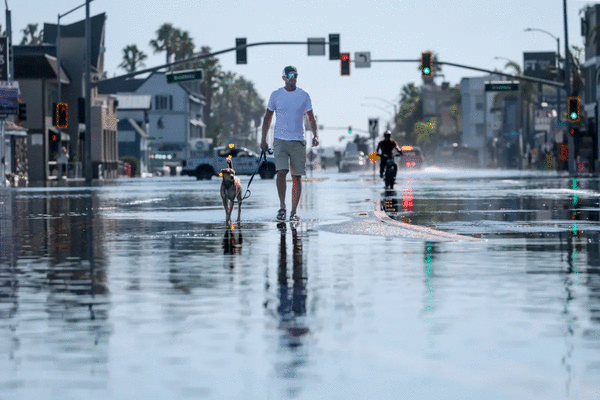
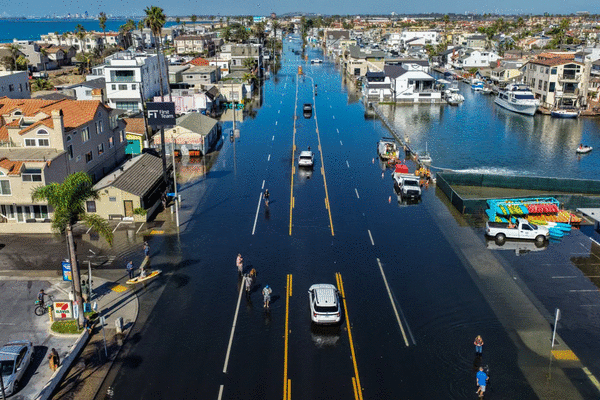
LOS ANGELES — Southern California coastal communities are bracing for more flooding Thursday and Friday as El Niño conditions keep water levels very high.
Unusually high tides that have brought flooding to low-lying areas in Southern California including Newport Beach and Long Beach may linger longer than initially predicted.
The National Weather Service on Wednesday extended flood advisories for all of Southern California’s coastal counties through 2 p.m. Friday, said Devin Black, a meteorologist for the weather service’s Oxnard office. They originally were scheduled to expire Thursday at 1 p.m.
Orange and San Diego counties, which were under a more severe flood warning through Thursday afternoon, will be downgraded to a coastal advisory through Friday afternoon.
The weather service has seen reports of “seawater over low-lying areas,” Black said, and “some structures have had shallow water up to the base of the building.”
The Balboa area of Newport Beach has experienced widespread flooding this week. Another hard-hit area is Sunset Beach, where several streets have been flooded and Pacific Coast Highway is closed. Caltrans plans to close PCH for a portion of Thursday as well.
On Thursday, Long Beach was most acutely affected and has been a main area of concern for weeks, Black said.
Tides are expected to approach 8 feet Thursday morning, then gradually subside into the weekend.
Some tides this week broke records: “They were definitely on the extreme end,” Black said.
Though tides were high across the region, “the angle and magnitude of the swells is a huge factor too,” Black said, so the risk to San Diego and Orange counties was higher as they were more exposed to a southwesterly swell.
For coastal communities, this could be the beginning of a long winter season. Even higher tides are expected around the Thanksgiving, Christmas and Martin Luther King Jr. Day holidays, and if a strong storm arrives during those times, it could result in even more severe flooding.
Something like that happened during the historic storm of late January 1983, which occurred during one of the strongest El Niños on record and battered the coast up and down California, damaging many piers. A strong storm arrived at precisely a time of the month when the tides were very high.
While the pace of coastal flooding may feel unbelievable to some, it was predicted months ago, during a town hall where Mark Merrifield, director of UC San Diego’s Center for Climate Change Impacts and Adaptation, warned that he expected “likely the highest sea levels ever recorded on the California coast associated with this event,” referring to the strengthening El Niño. “Flooding ... along the Southern California coast is likely to be a major issue for the winter season.”
Ocean temperatures have been affected not only by human-caused climate change but also an El Niño-fueled Kelvin wave that brings warmer water from the equatorial Pacific Ocean up and down the coast of the Americas, and a months-old marine heat wave unrelated to El Niño.
Scientists say this marine heat wave has caused seawater levels to rise 1.25 to 1.8 feet higher than they would just from the movement of the moon, Earth and sun.
©2026 Los Angeles Times. Visit at latimes.com. Distributed by Tribune Content Agency, LLC.






Comments