Macron has few bargaining chips as he keeps lid on violence
Published in News & Features
PARIS — French President Emmanuel Macron bet that a massive police presence could avoid a repeat of the violence that stunned the country on Oct. 17. He won that wager, but isn’t any closer to resolving underlying anger that’s fueled mass protests in France and shows few signs of abating.
Hundreds of thousands took part in the demonstrations across consecutive weekends, with turnout remaining high despite worries about further violence, Macron’s warning against action unless organized by labor unions, and poor weather.
The standoff leaves the government in a quandary, with calls growing for more spending on services when it’s under pressure from a fast-growing debt burden and surging borrowing costs, and with presidential elections on the horizon.
Student groups are continuing their call for further protests over what they say is the absence of concrete measures to address concerns about school conditions, needed funding, and the system for distributing university slots. Unions have called for a major day of strikes and protests on Nov. 5.
“We’re not giving up on anything,” Manon Moret, secretary general of student union UNEF, told reporters during the protest in Paris. “On the demands of young people, the €10 billion, and the issue of selectivity” in university placements.
But France doesn’t have the budget leeway to mount a dramatic financial response. While it dodged a downgrade by Moody’s Ratings on Friday, it’s struggling to reduce its yawning budget deficit ahead of the April election, and has seen borrowing costs jump as investors demand higher premiums to buy its debt.
A closely watched gauge of bond risk rose last week to levels last seen during the euro-area debt crisis. The spread between 10-year yields in France and Germany, the region’s safe asset, reached 178 basis points on Thursday, against 85 basis points at the start of September. It narrowed to around 154 on Monday.
Protest numbers
There’s been no let-up on the demonstrators’ side so far. Some 410,000 people took part in the weekend marches across the country, according to the Interior Ministry, compared with its estimate of 550,000 for Oct. 17. The left-wing CGT union put its estimate much higher, at about 800,000 for each day.
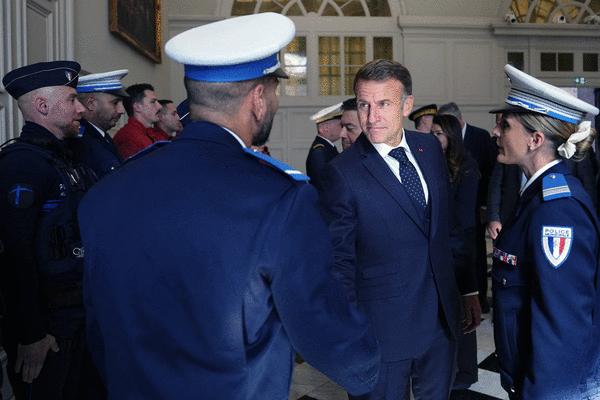
On Monday, Macron vowed to prevent a repeat of rioting and looting by maintaining a heightened security presence and tasking his government to respond to some of the protesters’ demands.
“We will continue to hold firm both on Saturday, on Nov. 5, and on the Saturdays that follow,” Macron said while visiting security forces in Marseille. “If together we do our job properly, this movement will calm down because we will have addressed legitimate demands and because order will be maintained.”
The government has indicated it may shift its position, at least slightly, this week. Prime Minister Sébastien Lecornu is scheduled to meet with student representatives on Monday after they’d been requesting a meeting for weeks. On Saturday, Finance Minister Roland Lescure floated the idea of advancing by a couple of months the annual increase in France’s minimum wage, which is indexed to inflation.
“Yes, we’re constrained financially,” Lescure said in an interview on Franceinfo radio. “But we’ve been creative.” He noted that the government had released strategic stocks of diesel and issued subsidies for high-mileage drivers to ease the pressure of high energy costs.
Macron’s government can at least consider how to convince protesters to stay home after the past weekend’s marches went ahead with far less violence than the week before, when authorities were caught flat-footed and demonstrations descended into chaos.
Rioters a week earlier attacked public buildings and broke into stores across the country, including in the capital, fought with police, and set fire to cars. Macron, the target of much of the anger, on Thursday acknowledged “planning failings and elements of surprise.”
As a result, the government deployed some 70,000 security officials on Saturday, including elite anti-terror forces. It also banned marches in several cities and forced demonstrators in Paris to take a route that confined them to the eastern edge of the city. A total of 1,435 people were arrested on Saturday, Nuñez said.
Next Saturday may be another test. At least one protest website has already called for another round of demonstrations on Oct. 31, while Union Syndicale Solidaires co-head Murielle Guilbert said she expected unions to call for new protests as well.
During the largely left-wing protests across France on Saturday, groups regularly shouted “Macron, resign!” The slogan also proved popular at the far-right National Rally’s congress in Orleans over the weekend. “Don’t worry,” party president Jordan Bardella said during a speech on Sunday. “He’ll be gone before long.”
Macron’s term ends in May, and term limits prevent him from running again in 2027.
A survey published in Le Parisien newspaper on Saturday showed that the National Rally’s candidate, Marine Le Pen, is firmly in the lead for that election, with far-left France Unbowed leader, Jean-Luc Mélenchon, in second place, ahead of various centrist contenders.
Speaking on Sunday, Le Pen basked in that advantage. “Everyone in France agrees with us; the battle is won over the assessment” of how France is doing, she said. “Our goal is to offer a real alternative, which is not a revolutionary act, but a natural cycle in democracy.”
Wider protests
Protests continued elsewhere in Europe during the weekend, too, over a range of issues including the cost of living, housing and education. About 100 people were arrested in central Barcelona, where protesters burned containers, vandalized shops, and threw stones at police.
Thousands marched in cities across Italy amid a heavy police presence, with scattered clashes reported. Albania’s capital of Tirana continued to be rocked by demonstrations against its prime minister. Tear gas, water cannons and rubber bullets were used by police as protestors threw stones and set fires.
—With assistance from Julien Ponthus and William Horobin.
©2026 Bloomberg L.P. Visit bloomberg.com. Distributed by Tribune Content Agency, LLC.






Comments