Masks, police, discipline. What UNC's deal with Trump means for campus protests
Published in News & Features
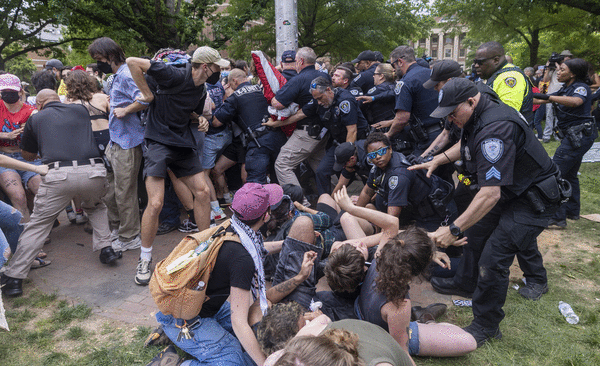
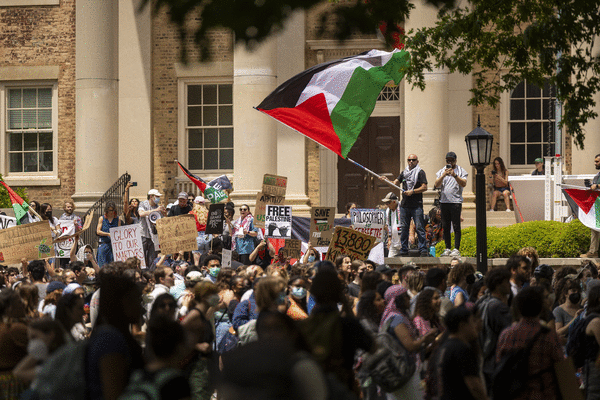
UNC-Chapel Hill’s new deal with the Trump administration — which protects UNC’s federal funding and closes federal investigations into the school — focuses heavily on measures UNC must take to combat antisemitism on campus.
Many of its provisions also touch on how UNC should respond to campus protests.
These requirements are “backlash” to the pro-Palestinian encampment that took root at UNC more than two years ago in response to Israel’s offensive in Gaza, according to Holden Thorp, who served as UNC’s chancellor from 2008 to 2013.
“It’s transparent that that’s the backdrop of this,” Thorp said.
The federal government requires that the school affirm that Jewish and Israeli students are covered by its anti-discrimination policies — and commit to applying those policies to campus demonstrations. The university has also promised to use “additional law enforcement resources when events or other factors warrant to protect Jewish and Israeli students.” The deal bans masks that hide people’s identity on campus.
Plus, it affirms that student groups engaging in “antisemitic discriminatory conduct” will face tough sanctions — and requires UNC to document and submit every discrimination complaint and the university’s response to the Department of Justice. That reporting must go back to Oct. 7, 2023, the deal says. The full agreement is available online.
For UNC’s top lawyer, Paul Newton, these provisions reflect how “Jewish and Israeli students are uniquely targeted across the country.”
“We do have a burden to make the University of North Carolina a safe place for them to come work and learn and enjoy a great education,” Newton said. “We would do that for anyone. If Palestinians were suddenly the target of near violence, we would also protect them.”
Newton said that although much of what’s in the deal reflects the university’s existing policies, it’s possible that some campus protocol will change as a result of the deal.
Mostly, it adds “administrative burden” in the form of a new compliance position and increased federal reporting requirements, Newton said.
Oct. 7 aftermath and the Trump deal
For Thorp, “Oct. 7 is one of the toughest things that’s ever happened to higher education in my lifetime.”
On Oct. 7, 2023, Hamas, which controls the Gaza Strip, killed approximately 1,200 people in a terrorist attack in Israel. In response, Israel has killed at least 74,000 Palestinians, according to Gaza’s Health Ministry.
Protests of Israel’s deadly war in Gaza roiled college campuses in 2024.
That required university leaders to ensure Jewish students felt safe and supported on campus, while still allowing students who sided with Palestinians to be heard, Thorp said. That was a near-impossible balancing act, and “no one’s reckoned with this,” he said.
But Thorp isn’t convinced this deal does that reckoning successfully.
“This isn’t going to solve the problem,” he said. “This is just allowing the problem to be a political weapon that can be used by the administration.”
Thorp called the agreement “a great deal” for UNC, but indicated there might be other dynamics at play in the deal’s requirements— especially given the delay between the high-profile protests in 2024 and this set of requirements in 2026.
“The administration knows that it’s politically potent and that it works as far the politics are concerned,” Thorp said. “So why would they let go of that?”
Defining antisemitism
Some faculty at Carolina are taking issue with the broad antisemitism requirements in the deal — especially in light of the Department of State’s working definition of antisemitism. The deal itself does not define antisemitism.
The State Department definition includes “targeting of the state of Israel,” “claiming that the existence of a State of Israel is a racist endeavor,” and “drawing comparisons of contemporary Israeli policy to that of the Nazis” as examples of antisemitism.
UNC students, Newton said, will still be able to protest Israel — as long as those protests “follow all the normal rules of time, place, manner, nonviolence, and they don’t destroy property.”
Anthropology professor emeritus Donald Nonini isn’t so sure.
He calls the deal’s requirements “a blunt instrument” that doesn’t differentiate between “serious antisemitic acts” and “observations by Jews and non-Jews alike about the misbehavior, and arguably criminal behavior, of the State of Israel towards Palestinians.”
Faculty member Erik Gellman tends to agree. Gellman, who is Jewish, said that “the agreement would have you believe that there’s a crisis of rampant antisemitism on campus, and I don’t think that’s true. I think it’s fabricated for a political purpose.”
UNC’s Hillel chapter did not respond to a request for comment about the measures around antisemitism in the agreement.
©2026 The News & Observer. Visit at newsobserver.com. Distributed at Tribune Content Agency, LLC.


Comments