France struggles to contain fallout from nationwide protests
Published in News & Features
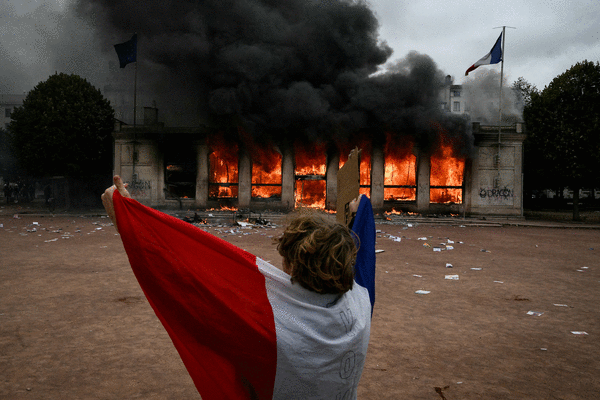
France is grappling with the aftermath of a weekend of widespread protests that descended into clashes between police and demonstrators and sparked some of the worst street violence the country has seen in years, with looting and landmarks set on fire.
The demonstrations drew more than half a million people to cities across the country on Saturday, but what started out as peaceful processions to complain about poor conditions in classrooms and hospitals and cost of living concerns soon deteriorated. Interior Minister Laurent Nunez said that more than 2,000 people nationwide had been arrested, including 855 in Paris.
Scenes of destruction spanned multiple cities, with hundreds of police and firefighters injured. The historic city hall in Limoges in central France was set on fire, gutting the 143-year-old building, while a tourist office was set ablaze in Lyon.
On Sunday afternoon, an unauthorized gathering was underway in Paris’s Place de la République, a day after the pedestal of its Marianne monument was covered with graffiti. Many scenes of violence were witnessed nearby on Saturday: a restaurant was broken into and burned, and the owner of a tobacco shop in the vicinity told BFMTV that looters had barged in with plastic bags to load up on cigarettes.
The clashes come at a critical time for the country, with a presidential election looming in April as President Emmanuel Macron’s term in office comes to an end. Discontent has been brewing across France over high living costs and students’ dissatisfaction over the education system.
Demands for more funding are at odds with an economy desperately needing to get a grip on a fast-growing and expensive debt burden. Concerns over the country’s finances are set to drag on into the election, with investor jitters lingering over what the front-runners have to offer, and no clear path out of the crisis.
Macron is due to give a televised address at 8 p.m. local time in the wake of the protests, after a meeting with various ministers.
Fallout from the weekend’s protests also sparked recriminations between political parties, exacerbating an already divided landscape. Marine Le Pen, the far-right leader who leads in polls ahead of the 2027 presidential election, directly blamed far-left firebrand Jean-Luc Mélenchon for stirring up the violence.
A spat between Mélenchon and Prime Minister Sébastien Lecornu also emerged on X as protests spiraled out of control, with looting in large cities such as Paris and Bordeaux.
Le Pen said Saturday in a post on X that “legitimate social demands” were “hijacked by the far left and the rhetoric of Jean-Luc Mélenchon’s members of parliament.”
Mélenchon blamed police provocation for some of the disorder and wrote on X that “those who share our struggle are not to be involved in looting or vandalism.” Macron also reacted on X, calling for looters and vandals to be “prosecuted and punished,” standing in support of the police.
The mayors of Paris, Marseille and Lyon have requested a meeting with the prime minister. Marseille’s Benoit Payan pointed to the inadequacy of the state’s plan for law and order on Saturday.
Damage from the unrest will cost “hundreds of millions of euros” to repair, according to Alexandre Bompard, the chief executive officer of grocer Carrefour SA and also the head of the French trade and distribution federation. He said in a Sunday interview on LCI that 1,500 storekeepers were affected, with about 20 of his own supermarkets looted.
Scenes of the Limoges town hall fire prompted a response from U.S. Vice President JD Vance, who linked the events to immigration and a lack of assimilation. “I pray that France, a beautiful country of amazing people, will stop this madness before more of its landmarks burn,” he wrote on X. President Donald Trump, without supplying evidence, said immigration was to blame, in a post on his Truth Social platform.
Italy
Saturday also marked a day of broader, uncoordinated demonstrations across Europe, with Belgium, Italy and Portugal among the countries affected.
Thousands took to the streets in Milan, Turin and Bologna, where clashes broke out, while a separate trade-union demonstration was held in Rome over wages and living costs. In southern Italy, truck drivers and farmers have also staged protests over high fuel and other costs.
In Milan, where about 5,000 people demonstrated, groups of mostly young, masked rioters fought police around Piazza Duomo — the main square at the heart of Italy’s financial capital — throwing paving stones and firecrackers and looting stores.
Carlo Varesi, 65, who has run Bar Madonnina near the Duomo since 1983, said rioters overturned tables and chairs as the clashes spilled into nearby streets. “I’ve seen a lot of demonstrations, some more violent than others, but I’ve never seen anything like this,” Varesi said.
Police said 28 people were arrested nationwide, including 12 minors, while 141 police officers were injured, according to Ansa newswires.
Prime Minister Giorgia Meloni on Sunday expressed solidarity with the law enforcement, saying organized groups had exploited demonstrations to seek clashes and create chaos. “Demonstrating is a right. Setting our cities on fire is not,” Meloni said on Saturday.
Belgium
Protests also took place in Belgium on Saturday, the latest in a series of demonstrations in the country in recent weeks. Some 150 people were arrested, Le Soir reported.
Unions have been staging strikes over proposed measures being discussed by the Belgian government, which is struggling to get its budget plan through its five-party coalition this month, while student protests have taken place in Brussels and the southern city of Liege over education cuts.
In Portugal, hundreds of tents populated Lisbon’s Rossio Square and Porto’s Praça D. João I on Sunday, with protesters saying they intended to continue their action indefinitely. No police intervention was reported overnight, according to public broadcaster RTP.
The demonstrations followed a police operation to clear a housing protest camp in Porto earlier in the week that organizers said left about 40 people injured. The protests have broadened into a national campaign over unaffordable rents, low wages and rising food and fuel prices.
Bank of Portugal Governor Álvaro Santos Pereira said on Oct. 7 that the country was not responding with sufficient urgency to the housing crisis, estimating a national shortfall of about 300,000 homes. “We are not building enough to address the problem we face,” he said at a press conference.
_____
(With assistance from Alberto Brambilla, Henrique Almeida and Suzanne Lynch.)
_____
©2026 Bloomberg L.P. Visit bloomberg.com. Distributed by Tribune Content Agency, LLC.




Comments