Latest roller-coaster death puts spotlight on safety restraints
Published in News & Features
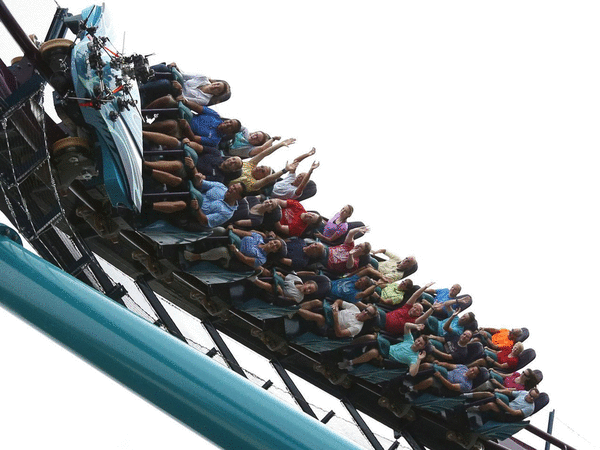
ORLANDO, Fla. — The horrific death of a man who flew off a ride at Six Flags Over Georgia this week has intensified focus on one of today’s most popular types of theme park roller coasters, which offers riders the thrill of brief moments of seeming weightlessness.
Experts say so-called hypercoasters — such as the one that Hassan Jihad Ibn Kariem died on after being thrown from his seat and landing below the ride — have a long record of safety, despite securing passengers with only a single bar restraint that clicks into place over a person’s lap.
Theme parks across the country moved quickly to temporarily close similar coasters — including SeaWorld Orlando’s Mako, which is quite similar to the Six Flags Goliath ride — after the tragedy. SeaWorld spokespersons said the decision was made out of an abundance of caution, but have not explained a process for the ride to reopen.
David Bertozzi, president of the National Association of Amusement Ride Safety Officials in Vero Beach, said he’s “as curious as anybody on what happened” in Georgia. Investigators have not yet released a report.
But Bertozzi added that roller-coaster enthusiasts keep demanding the biggest, fastest, most exciting coasters, and manufacturers and theme parks are willing to oblige.
“The thrill seekers want to push it right to the edge,” he said. “They want to come out of their seats. But at the same time, we have to step back and say we want to keep them in their seats.”
The trade-off: Using seat belts or shoulder harnesses would almost certainly keep riders more securely in place. But such restraints could lead to bruising or other injuries from the force of the ride. And the thrill of rising out of one’s seat would be lost.
“You can’t restrict a person completely, because then you hurt them,” Bertozzi said. “You have to be cautious.”
A National Safety Council report for the International Association of Amusement Parks and Attractions estimated a one in 15.5 million chance of serious injury or death on a ride at a fixed-site amusement park.
Still, when people visit a theme park, they expect to have a good time and not worry about being seriously hurt or killed, said Geoff Moore, an Orlando attorney whose firm handles catastrophic personal injury claims.
“No one should get on a roller coaster thinking ‘I might be killed’,” he said. “It begs the question whether there is a safer, more reasonable alternative than the current restraints that could’ve been used…There is nothing more important than rider safety.”
A hypercoaster is a ride with a drop of at least 200 feet, along with several other hills or “hops” that give riders the sensation of floating, or what enthusiasts call “air time.” Some roller-coaster thrills, like loops or corkscrews, employ g-forces to help keep riders in their seats, but the hypercoaster drops are deliberately doing the opposite.
There are about 100 hypercoasters around the world. The tallest is the Falcons Flight at Six Flags Quddiya City in Saudi Arabia, which rises to 535 feet and reaches speeds of 155 mph.
By comparison, SeaWorld Orlando’s Mako is 200 feet high and travels up to 73 mph. It is Orlando’s tallest and fastest roller coaster, according to the company.
The Goliath hypercoaster at Six Flags Over Georgia — which witnesses said 42-year-old Kariem was riding, although the amusement park has not acknowledged that — reaches a top speed of 70 mph and also rises 200 feet. It’s been operating for about 20 years.
Both coasters were built by Swiss company Bolliger & Mabillard, one of the most prolific manufacturers of hypercoasters.
When a passenger sits in the seat, what’s known as a clam-shell restraint is pulled over their lap and clicks several times into place. The restraint is locked in by several pin-and-gear mechanisms, so if one fails by not locking into place, there is a backup, said Martin Lewison, a roller-coaster expert and associate professor at Farmingdale State College in New York..
Sea World’s Mako also uses a hydraulic system in addition to the gear mechanism. The restraint bar connects to a hydraulic cylinder, and a control valve locks it into place preventing the bar from moving up during the ride.
A sensor system alerts ride operators that each restraint is properly locked at each seat before the ride can launch, Lewison said.
“How could this have happened? No one has a good answer,” he said regarding the Goliath tragedy. “They do this a million times a day. It could’ve been a catastrophic malfunction on several levels.”
Doug Perovic, a professor of forensic engineering at the University of Toronto and a lifelong roller-coaster enthusiast, agreed: It appears that Kariem’s pull-down lap restraint failed. That would suggest a mechanical component or electronic sensor flaw rather than faulty design.
Perovic added that as technology has improved, restraint designs have become less cumbersome, as riders want a less constrained and more thrilling experience. Less restrictive restraints also allow ride operators to quickly load and unload passengers and keep wait lines flowing.
“This type of incident is very rare,” said Perovic, adding that he would let his family ride Goliath once it has been put back into service. “When you think of the millions of rides that happen every day in all the parks [the U.S.], Canada, the whole world…this is such a minuscule probability of failure, of malfunction and of fatality. So they are very safe.”
Scott Smith, an associate professor of resorts, hotels and theme parks at the University of South Carolina, said hypercoasters such as the Goliath and the Mako have been in operation for more than 30 years and have an “outstanding safety record.”
Last year, 32-year-old Kevin Rodriguez Zavala died from impact injuries after riding the Stardust Racers coaster at Universal Epic Universe. His death was ruled an accident. Stardust Racers is not a hypercoaster.
Acknowledging the investigation into Kariem’s death has not been completed, Smith speculated the tragic accident could’ve been caused by a number of factors happening all at once: the rider did not meet the physical safety specifications, there was a mechanical error with the safety restraints, and the rider may have been trying “to reposition themselves” in their seat during the ride.
“But as I tell people all the time: The time you are most in danger of being killed or seriously hurt is in a car on the way to the amusement park,” he said.
©2026 Orlando Sentinel. Visit orlandosentinel.com. Distributed by Tribune Content Agency, LLC.
Comments