Just 8 years after Woolsey, a new fire ignites in its scar -- too soon for both residents and plants
Published in News & Features
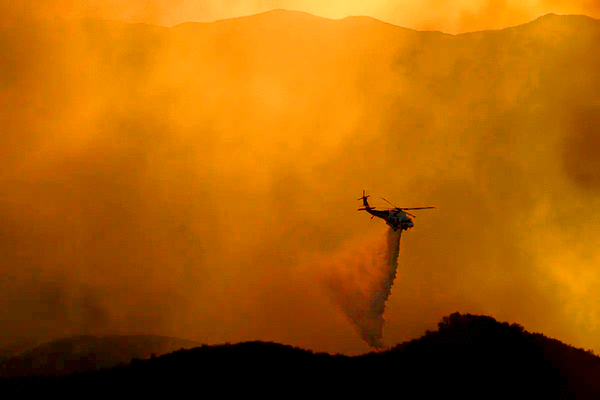
LOS ANGELES — The rugged shrub-filled hills where the Bryson fire ignited — triggering evacuations and putting Malibu residents on edge — burned just eight years ago, a painful reminder of the speed at which freshly scarred communities are finding themselves once again at risk.
The natural chaparral’s ability to quickly regrow has enabled such a quick fire return interval in the Santa Monica Mountains. But so many back-to-back ignitions are jeopardizing the ecosystem’s long-term viability — and making it even more fire-prone as invasive plants squeeze out native species.
Southern California’s native chaparral ecosystems are no stranger to fire. Many species use flames to regenerate. Island manzanita and chamise, for example, develop deep root systems that can survive fires on the surface and resprout from the base.
The seeds of some shrub species, like California lilac, are triggered to start growing by the heat of fire. Meanwhile, some ephemeral flowers, called “fire-followers,” can only be found after a blaze, when there aren’t any tall shrubs to steal the sunlight.
Within just a few years, the land can support fire again. After about a decade, the chaparral reaches nearly the same density as before the blaze, fire ecologists say.
Some areas of the Santa Monica Mountains — particularly along the coast, near Corral Canyon in Malibu — see fire every eight years on average.
The region where the Bryson fire broke out Thursday, however, sees fire roughly every 20 to 30 years. But the area last burned during the 2018 Woolsey fire, which killed three people and destroyed more than 1,600 structures.
Incredibly frequent fire, triggered by near-constant human ignitions, slowly chokes out native species. Chaparral are adapted to fire every 30 to 130 years — not every eight. The shrubs may reach full size around year 10, but it takes them two to three decades to fully mature and rebuild their bank of seeds underground.
With constant blazes, shrubs cannot replenish their seed banks fast enough and, eventually, there are few seeds left for the plants to grow from after fire.
What takes their place are often fast-growing invasive grasses.
These grasses dry out incredibly quickly and can regrow in months, not years. This process of invasive plants permanently replacing native species is called type conversion.
Some ecologists argue an intermix of invasive grasses and chaparral creates the most dangerous fire potential. The dry grasses are quick to turn a spark into a fire. The chaparral, meanwhile, burns hot, turning a small fire into an intense blaze.
©2026 Los Angeles Times. Visit at latimes.com. Distributed by Tribune Content Agency, LLC.





Comments