US imposes sanctions on Cuba state bank for working with Iranian bank
Published in News & Features
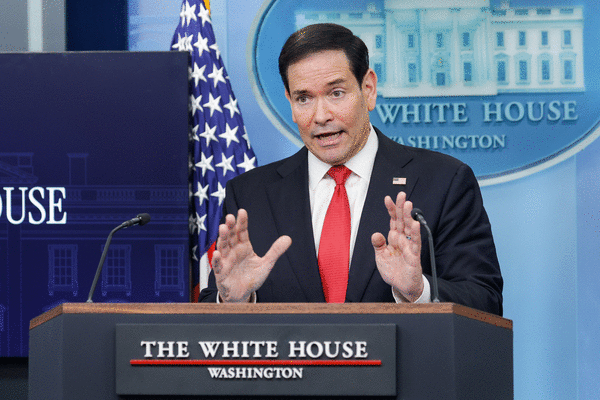
The United States imposed sanctions on Banco Internacional de Comercio S.A., a Cuban government-owned bank, Thursday, saying it has done business with an Iranian bank, Secretary of State Marco Rubio announced.
According to Rubio’s statement, the bank, known as BICSA, has been doing business with Iran’s Karafarin Bank—a bank under U.S. Treasury Department sanctions in 2020 — since at least 2022.
The State Department invoked a May executive order that allows sanctions against companies working in key parts of Cuba’s economy, including banking, to add BICSA to the Treasury Department’s blacklist of Specially Designated Nationals and Blocked Persons. Several Iranian financial groups were also added to the list on Thursday.
“Let me be clear: the Trump Administration will not tolerate a rogue state hosting hostile foreign military, intelligence and terror operations less than a hundred miles from the American homeland,” Rubio said in a statement. “We will continue to aggressively identify and eliminate the Cuban regime’s financial and security interconnections with Iran and other dangerous and hostile states and actors.”
Rubio said Cuba has for too long been allowed to operate as “an outpost for malign actors and terror groups,” including Iran, which he called “the world’s number one state sponsor of terrorism.”
Sanctions on BICSA complicate trade and foreign investment in Cuba, because some U.S. companies licensed to export food and goods to Cuba, along with several foreign companies and private Cuban businesses, have accounts with BICSA. The bank became crucial for foreign businesses after the first Trump administration imposed sanctions on Fincimex, a Cuban financial institution controlled by the military conglomerate GAESA. Foreign businesses that used Fincimex moved their dollar accounts to BICSA.
“This measure is going to affect many people,” said a Cuban American who exports products to Cuba and asked not to be identified. The person says the action against BICSA “contradicts” the Trump administration’s policy of pushing Cuba to open more of its economy to the private sector and foreign investors.
BICSA was founded in 1993 and has its offices in the Miramar neighborhood in Havana.
Because of the sanctions, any money or property BICSA has in the United States, or that is held by Americans, is frozen and must be reported to the Treasury Department. Foreign companies that do business with BICSA, or that work in Cuba’s energy, defense, metals and mining, banking or security sectors, could face sanctions themselves, the State Department warned.
Deadline to cut ties
In guidance released with the sanctions, Treasury said foreign companies and banks have until Nov. 14 to cut ties with BICSA.
Treasury urged foreign businesses to be careful. It warned that sending money or assets back to BICSA, or moving them to another country where the bank could use them, could put them at serious risk of sanctions.
U.S. citizens and companies have long been banned from doing business with BICSA because the Cuban government owns it, and that ban remains in place unless U.S. companies obtain a Treasury license authorizing the transactions. Treasury said such permission may cover humanitarian and diplomatic activities allowed under existing U.S. regulations on Cuba.
The sanctions on BICSA are the latest step in a Trump administration campaign to pressure Cuba’s government to change. Since President Donald Trump signed executive order 14404 in May, Washington has imposed sanctions on the military-run conglomerate GAESA, several mining and energy companies, the Ministry of Construction, Banco Exterior de Cuba, members of the Castro family and relatives of the country’s handpicked president, Miguel Díaz-Canel.
_____
©2026 Miami Herald. Visit miamiherald.com. Distributed by Tribune Content Agency, LLC.



Comments