Chicago Mayor Brandon Johnson again calls for taxes on big corporations as budget showdown looms
Published in News & Features
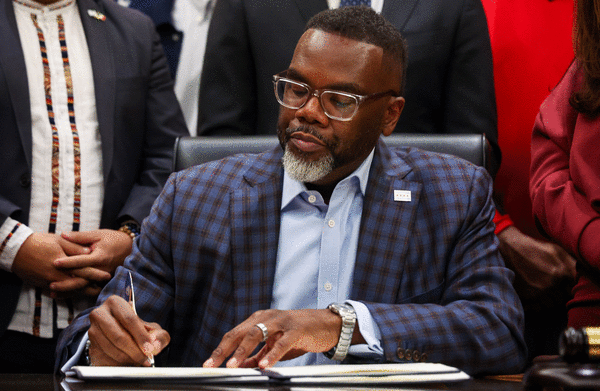
CHICAGO — With his city budget pitch for next year looming, Mayor Brandon Johnson on Tuesday again argued large corporations must pay more taxes to help Chicago balance its books.
Johnson remained tight-lipped on his specific budget plans during a City Hall news conference, but hinted he may also propose higher taxes on cloud computing software and social media companies.
He called on aldermen and state legislators to clear the way for his renewed tax-the-rich push — a sign he is once again willing to wage a high-stakes public fight as City Hall crafts a spending package. Johnson is expected to unveil his budget proposal on Oct. 21, starting the clock for him and City Council opponents to pass something before the calendar flips to 2027, when all their seats are on the election ballot.
The mayor returned to a familiar refrain as he said there is a clear choice ahead: Ask Chicago families to do more with less, or challenge corporations benefiting from federal tax cuts to pay “their fair share.”
“What remains to be seen is whether the corporate-aligned caucus will have the collective courage to choose the interests and priorities of Chicagoans, or choose to cower before the influence and campaign donations of corporations,” he said, a reference to the bruising battle that ended in December with aldermen passing a 2026 spending plan against Johnson’s wishes and without his proposed corporate head tax.
Johnson and aldermen face a $882 million budget gap for 2027, the mayor told reporters in early September.
In the last week, Johnson has met with groups of aldermen to discuss what key changes might balance the budget. The conversations have not included specific, detailed proposals, but Johnson has asked council members to present their own ideas and push Springfield for a bigger slice of state tax revenue.
The mayor’s administration also raised the possibility of implementing a new tax on package deliveries, according to several sources familiar with the discussions.
But for such a tax, Chicago would need special permission from state legislators to move ahead, a daunting obstacle given his past failures in the capital that likely puts a laundry list of his desired revenue-raisers out of reach. During his recent discussions with aldermen, Johnson said he would not rely on revenue from taxes not yet approved by Springfield, sources said.
The mayor failed to convince aldermen last year to support his marquee $33-per-employee monthly head tax on businesses with over 500 workers, one of the few corporation-aimed taxes the city actually has the power to implement.
Johnson, who has struggled to win support for his demands from the General Assembly and Gov. JB Pritzker, acknowledged Tuesday that his hands are tied. And he tried carefully to tie his long-running calls for higher taxes on the rich and corporations to city services that he said might otherwise be cut.
“Standing up in this moment in a bold fashion to protect working people, to make sure that trees are trimmed, that potholes are filled, that mental health support services are provided,” he said. “The people of Chicago have given me a mandate to do that, but the state of Illinois, of course, has preemption. It takes that authority away.”
The mayor also called on Springfield to restore funding to Chicago from its local government distributive fund to previous rates, a move he said would generate $264 million for the city.
The General Assembly will meet late next month and in early December for its fall veto session, where the Johnson administration could have one last opportunity to convince legislators to change laws and clear the way for otherwise preempted new taxes and fees.
As City Hall begins to iron out its next budget, it now faces a heightened challenge in fulfilling this year’s spending plan. The city planned to generate around $70 million by refinancing old debt to close an $85 million budget gap, but was only able to generate $36 million in savings, according to Johnson’s administration.
Comptroller Michael Belsky said the shortcoming was not tied to recent credit downgrades.
“The lower savings is unequivocally and directly related to higher-than-expected interest rates, driven by macroeconomic forces like the war in Iran,” he said in a statement. “What changed has been the market.”
The decision by Johnson opponents to rely on “speculative revenue projections” created the shortfall, mayoral spokesperson Allison Novelo said in an apparent reference to the City Council’s approval of a $90 million sale of old debt owed to the city and untested taxes on augmented reality advertising.
While Johnson has repeatedly said the two policies backed by a majority of aldermen have not generated revenue because they are unworkable, his council opponents have accused him of intentionally blocking their effective implementation.
The city remains on track to close its 2026 budget gap, in part because the administration is cashing in on $33.2 million in unpaid taxes by two of its biggest companies thanks to heightened enforcements, Novelo said.
_____
©2026 Chicago Tribune. Visit chicagotribune.com. Distributed by Tribune Content Agency, LLC.





Comments