NATO commander says Ukraine aid will deter Putin's Europe threat
Published in News & Features
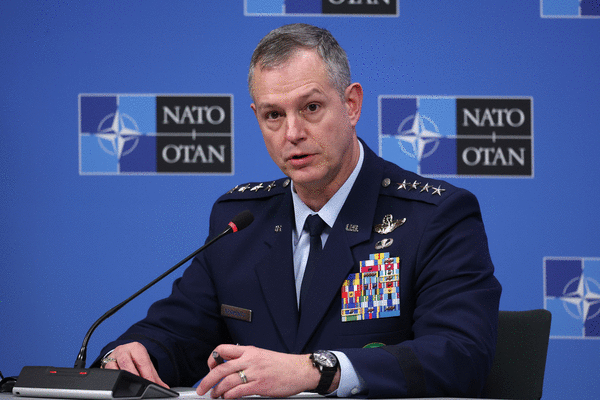
Europeans should increase support to Ukraine in response to Russian hybrid attacks, the head of NATO’s military operations told Bloomberg Television in Poland on Sunday.
“They’re trying to break our collective will,” said General Alexus Grynkewich, supreme allied commander Europe, commenting on the intensifying wave of Russian aggression against Europe, including incursions into NATO airspace, arson, sabotage and cyberattacks.
He pointed to Denmark and Germany, who increased support to Ukraine in the aftermath of hybrid attacks on their soil. “Those are appropriate responses that show Russia that the objectives that they’re seeking to attain are unobtainable,” Grynkewich said in Poland, where he was attending the Warsaw Security Forum.
The attacks have occurred as Russian President Vladimir Putin’s forces continue to take heavy losses in Ukraine. At the same time, the Ukrainians have imposed a growing economic cost on their enemies by carrying out numerous assaults on oil refineries and data centers deep inside Russia.
NATO still largely leaves it to individual countries to respond to such incidents. Germany, last month for the first time, officially blamed Russia for an attempted attack with an explosives-laden drone at Leipzig airport.
“I’m certainly not afraid to attribute it,” added Grynkewich, an American Air Force general who also leads U.S. European Command. “If a nation wants me to, I’m happy to talk about it.”
Although political forces critical of continued support to Ukraine are gaining power in Europe, with pivotal elections coming in 2027, Grynkewich said he believes they would be “subsumed” by the “centrality” of Ukraine to European security.
“I think it will become very obvious to them very quickly what the right thing to do is, and why it’s necessary for their own national security,” he said.
Grynkewich is in Poland to present his plans for how to defeat Russia quickly if it were to invade NATO territory amid heightened tensions between the military alliance and Russia.
Publicizing the “theory of victory” aims to deter Russia by laying out what would happen if it were to seize NATO territory, he said.
Drones and AI technology are woven into it, mainly supplementing advantages that NATO already has over Russia, such as F-35 fighter jets, he added.
Asked whether President Donald Trump’s deal with Putin for the U.S. to import diesel from Russia was detrimental to this effort, he said he was staying focused on military matters.
“Windows of opportunity come and go. We have to look for those windows of opportunity and seize them when they’re available,” he said about creating a dialogue toward ending the war between Ukraine and Russia.
On Sunday, Trump said that Russia and Ukraine had agreed to an “energy ceasefire” effective immediately. However, details were unclear. Ukraine’s President Volodymyr Zelenskyy said he supports the ceasefire if Putin does as well.
Turning to the war with Iran, Grynkewich expressed concern over the military repercussions of the contested Strait of Hormuz, “including the availability of fuel here in Europe that we would need to execute one of our defensive plans.”
Europeans have been reluctant to get involved in the strait, wanting to avoid getting drawn into a conflict that was not of their making.
He said high fuel prices also hurt European efforts to modernize their militaries, so there was a strategic interest for the continent in helping keep the Strait of Hormuz open. A “growing number” of European countries were helping, he said, declining to provide specifics.
“Several nations are doing that, some quietly, some some more publicly,” he said. “But I think it is important for all of us to recognize that we have to take that on.”
_____
©2026 Bloomberg L.P. Visit bloomberg.com. Distributed by Tribune Content Agency, LLC.




Comments