Cornell rape case: How parents can talk about it to kids
Published in News & Features
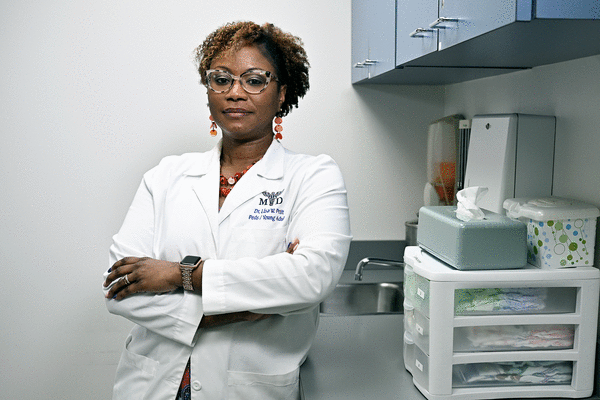
Dr. Lisa Petit talked with her 13-year-old daughter before she went to a sleepover. Matthew Braman talked with his 5-year-old son after other children wouldn’t let him on a swing set and one hit him.
Neither parent was talking about the alleged gang rape at Cornell University, at least not directly. But in the wake of the shocking case, they said, conversations about safety, bullying and looking out for yourself and others could serve their children both now and in the future.
“When you take away the very adult details of this case, it comes down to issues of consent, boundaries, being a bystander,” said Petit, a pediatrician in Catonsville. “And recognizing what you would want someone to do if you were the one being bullied. Or what if it was your sister?”
She and Braman, a therapist with a clinical interest in fatherhood and masculinity, say it’s never too early to talk to children in an age-appropriate way about the issues raised by the case of a 20-year-old Cornell student who recently filed suit alleging she was raped by seven fraternity members. She also accused one of the men of posting to a Snapchat group, alerting others to come in the room. None of the men have been charged in the case.
By talking to even very young children about asking for permission, accepting when someone says no, and finding the courage to intervene or seek help when a group is doing harm, parents can lay the groundwork that helps kids later in life, said Braman, a former Baltimore-based therapist who now runs his telehealth practice, Verve Psychotherapy, from New Jersey.
“Then they already have a solid foundation,” he said. “It’s about respect for oneself, respect for the common good, and speaking up for people who are vulnerable.”
The troubling Cornell case has spawned many a conversation, in real life and online. For parents in particular, it can be an uncomfortable one, dealing as it does with sex.
“Our inability to talk about sexual assault is related to not being able to talk about healthy sexual behavior,” said Amelia Rubenstein, a program and operations director of the University of Maryland Baltimore Center for Violence Prevention.
Rubenstein, a social worker who works with and advocates for youth affected by trauma, sexual assault and trafficking, said she’s noticed a meme circulating that flips the advice women often get on how to avoid being assaulted — such as not getting drunk or walking alone — to putting the onus on men: “Carry a whistle if you think you might rape someone,” the meme advises. “Blow the whistle until someone comes to stop you.”
“I think there is starting to be a shift from, ‘Let’s talk to our daughters about how to protect yourself,’ to ‘Let’s raise sons who would intervene in something like this,'” Rubenstein said.
The conversations should be tailored to the child’s age and awareness of the case, she said.
For parents of children under 8 who might have heard something about it, a parent might acknowledge generally that someone was hurt and people are working to help them, Rubenstein said.
For tweens, she said, parents could start by asking what their child has heard and make sure to correct any misinformation. The main message should be about the concept of consent, and how that is a “two-yes situation,” Rubenstein said.
“Keep it calm, because at that age, they can be anxious that something could happen to them,” she said. “Let them know, if you feel uncomfortable about something, you can always come talk to me.”
For teenagers, “definitely ask what they’ve heard,” said Rubenstein, herself a mother of three.
The talk should deal in specificities, she said: “What would you do? And not just, ‘tell an adult,’ but which adult would they be comfortable going to.
“Have them think it through,” she said. “What is it like to be the only person in a large group to say this is not cool?”
Petit said the case is alarming to parents.
“It makes you want to hold them tighter and wrap them in bubble wrap and never let them go out in the world,” said the mother of two girls and a boy, ranging from 13 to 18.
Petit said that in her experience, children won’t bring up such an uncomfortable subject on their own and parents need to take the lead.
“Don’t wait for the right moment,” said Petit, who offers resources, workshops and speaking engagements via her business, The Parenting Playbook.
She spoke to her younger daughter recently, in advance of a sleepover, to make sure she knew that if any gathering made her uncomfortable, such as if alcohol was available, she should trust her “gut” and call to be picked up. And all her kids have Uber accounts to give them a way out of a bad situation, Petit said.
“You have to parent for the world as it is,” she said, “rather than what you want it to be.”
Braman said his sons, even at ages 2 and 5, can begin to learn about concepts like sharing, setting limits and how to be a good friend and eventually a good man.
At Cornell that night, he said, “So many people were privy to what was happening and didn’t speak up.” He said he and his sons do nightly affirmations together, saying things like, “I have courage, and I can do hard things.”
The lesson, he said, is: “Let’s be brave not just for ourselves, but if we see someone else being bullied.”
_____
©2026 Baltimore Sun. Visit baltimoresun.com. Distributed by Tribune Content Agency, LLC.






Comments