USS Abraham Lincoln returns to San Diego after long combat deployment in Middle East
Published in News & Features
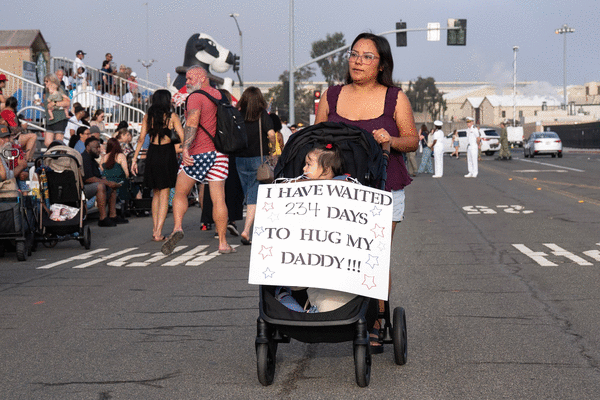
More than 10 months after sailing away from San Diego on what would turn into an arduous and twice-extended combat deployment — one that included launching some of the first attacks in the U.S.-Israel war on Iran, and spending 264 straight days at sea amid troubling reports of food shortages and low crew morale — the USS Abraham Lincoln returned home Thursday to Naval Air Station North Island.
The roughly 5,000-person crew of the Lincoln, known to many sailors as the “Abe,” was greeted by thousands of cheering family members who had traveled from all over the country to welcome home their loved ones under a hot afternoon sun at the military base in Coronado.
“We would have come in anywhere his ship was coming in,” said Lisa Bisson, who traveled from Maine with her family to see son Joseph return from his first deployment.
The Harris family came from Texas to see their sister and daughter, Maranda Samuel, who has had a full Navy career. They said Samuel’s first planned stop after she gets off the ship: McDonald’s for a double cheeseburger and fries.
Sometime next month, the family will spend one entire day celebrating every holiday Samuel missed while deployed, according to mother Delois Harris, beginning with Thanksgiving 2025 all the way through Samuel’s birthday in August.
While families gathered near the pier throughout the morning amid growing festivities, there was also a joyful atmosphere aboard the Lincoln as it motored toward shore.
A little after 10:30 a.m., with the ship about 7 miles west of Point Loma, the crew cheered as the carrier turned its bow straight for the harbor. Minutes later, two F-18 fighter jets buzzed by to honor the crew.
As the Lincoln entered the harbor — still out of sight of the waiting families — nearby vessels sounded their horns, and tugboats sprayed water to honor the ship.
As the Lincoln finally neared the naval air station, the aircraft carrier USS Carl Vinson sounded its horn in salute, and the Lincoln sounded its horn in return — a classic ritual.
According to officials aboard the Lincoln, 67 of the returning crew members were fathers meeting new babies for the first time.
The Lincoln is the flagship of a nine-ship strike group that’s made up of roughly 7,600 personnel. On Wednesday, U.S. Defense Secretary Pete Hegseth was flown to the aircraft carrier, where he awarded the Lincoln strike group a Presidential Unit Citation, the highest award for valor that can be bestowed upon an entire military unit. It’s an award reserved for units that display “extraordinary heroism” during combat against an armed enemy.
Tony Rojas, whose daughter, Analiese Rojas, was finishing her first deployment, which he confirmed had been difficult at times, said he was excited to learn that news Thursday.
“That’s going to follow her,” said Rojas, who traveled from his home in Merced. “I told her, ‘You’re going to get perks out of this whole thing.’”
The citation, which Hegseth read during his speech during an all-hands gathering aboard the carrier’s flight deck, commended the Lincoln carrier strike group “for extraordinary heroism against enemy forces … (and for having) planned and executed 40 days of combat operations and an ironclad maritime blockade against Iran in support of Operation Epic Fury.”
According to Hegseth’s reading of the citation, the Lincoln and its strike group “executed 3,693 combat sorties, delivered 1.37 million pounds of ordnance, launched 450 Tomahawk land-attack cruise missiles, shot down 77 one-way attack unmanned aerial systems, sank … 64 Iranian warships (and) destroyed 21 anti-ship cruise missiles.”
During his speech, Hegseth also acknowledged the difficulties that the strike group and its sailors had faced during the lengthy deployment, which was extended twice.
“I’m the one who signed that orders book twice to extend you,” Hegseth told the crew. “A, because of the incredible effectiveness you showcased on the battlefield, and the necessity. But also, B, the mission required it. And C, because President Trump had full faith that you would deliver on behalf of the American people. And you did.”
After setting sail from Naval Station North Island last November, the Lincoln was initially sent to the Indo-Pacific. But beginning in January, the Lincoln was ordered to patrol the Arabian Sea, which leads to the Gulf of Oman and the Strait of Hormuz, as part of a military buildup near the Middle East.
The Lincoln was heavily involved in the first wave of attacks when the U.S. and Israel began bombing Iran on Feb. 28. Early in the conflict, Iran announced that it had struck the Lincoln with missiles and drones. The Pentagon denied those claims.
Over the next several months, the Lincoln and the other ships from its strike group were also involved in the maritime blockade of the Strait of Hormuz.
Vice Adm. Marc Miguez, the commander of the Navy’s San Diego-based 3rd Fleet, told the Union-Tribune recently that the Lincoln and its escort ships withstood attacks from Iran that were more far-reaching than most people knew.
“What the USS Abraham Lincoln Carrier Strike Group did, no other carrier strike group has ever done,” Hegseth told the Lincoln’s crew during his speech Wednesday. “Ten thousand sorties, 23,000 combat flight hours, almost 4,000 combat sorties … And you did it without an aircraft mishap. I honestly have no idea how that’s possible.”
According to various reports over the past several months, including reporting by Stars and Stripes, life aboard the Lincoln was difficult during the deployment. It was anticipated the carrier would return to San Diego in May. Instead, its deployment was extended indefinitely, and at one point it went 264 straight days without a port call because there wasn’t a secure pier available in the combat zone.
One woman who spoke to the Union-Tribune on Thursday, who declined to give her name out of fear of retribution from the Navy, said her husband, who was on the ship, suggested she not look at social media about the deployment, and their conversations focused “on the positive stuff.”
Another woman who declined to be named for the same reason said she was grateful the deployment wasn’t extended a third time. She said she had seen news of supply concerns, but her husband told her that by the time the news spread, the trouble had passed.
“The news wasn’t fake,” she said. “It was delayed.”
Her husband told her that at one point there was “barely any food,” and he “would get a scoop of rice.” She said he told her they went a stretch without showers or doing laundry.
Rojas, the Merced father, said he and his family noticed a dip in his daughter’s morale as supplies of food and essentials ran low, and other problems plagued the ship. But he said his daughter and the rest of the crew received a much-needed boost when they finally learned they’d be relieved by another carrier and allowed to finally make a port call.
On Thursday, the Rojas family brought his daughter’s favorite snack — Hot Cheetos — and her dog, Fozzie, to greet her.
Amid the reported shortages of food and other living supplies, reports emerged that many crew members were having mental health issues, and some were having suicidal ideation.
In a letter to a lawmaker last month, acting Navy Secretary Hung Cao reported that there had been eight suicide attempts among the crewmembers of the Lincoln strike group.
U.S. Rep. Sara Jacobs, D-San Diego, attended Thursday’s homecoming, about a week after she and other members of Congress flew out to the ship and spoke to sailors. She said some told her of losing weight as food was rationed, as well as dealing with a lack of hot water and clean clothes.
“I think it was clear that the conditions they went through were beyond normal deployment conditions,” Jacobs said as the ship moved behind her through the bay.
“I think it’s clear that what happened is no fault of the commanders on board,” Jacobs said. “It’s that President Trump launched a war without the requisite planning to make sure that the service members he was putting into harm’s way would have what they need. That to me is a real indictment of this administration and of this war in Iran.”
Miguez, who took command of the San Diego-based 3rd Fleet in July, defended during a recent interview the Lincoln’s decision to forgo port calls, saying it was the right thing to do militarily. He also challenged reports about the severity of the supply-chain problem and said the crew’s morale was much higher than it had been described in media reports.
_____
©2026 The San Diego Union-Tribune. Visit sandiegouniontribune.com. Distributed by Tribune Content Agency, LLC.






Comments