Long-awaited 'Broadview Six' hearing could spark further scandal for US attorney's office
Published in News & Features
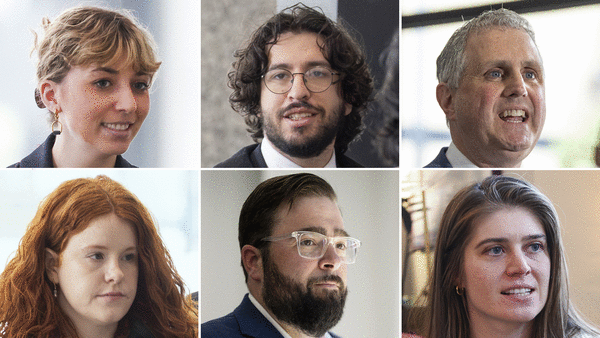
CHICAGO — Four months after the implosion of the “Broadview Six” case against Operation Midway Blitz protesters, a federal judge on Thursday is finally scheduled to hear arguments that could spark further scandal for a U.S. attorney’s office beset by allegations of vindictive prosecution and grand jury misconduct.
U.S. District Judge April Perry called for the 1 p.m. hearing after months of back-and-forth legal briefs over whether an inquiry is warranted into how the case was handled, which could lead to sanctions or even appointment of special counsel to investigate potential contempt charges.
The judge has a wide range of options at her fingertips, and she has given no public indication of what specific topics she wants to cover on Thursday.
Meanwhile, the case has sparked national attention and is expected to attract a horde of media to the Dirksen U.S. Courthouse, where an overflow courtroom has been set up to handle the crowd.
That intrigue got an added boost last week when the prosecutor at the center of the scandal, Sheri Mecklenburg penned a fiery resignation letter to U.S. Attorney Andrew Boutros claiming he “personally directed” her to seek felony charges rather than misdemeanors and then “publicly vilified” her in court by blaming her for the way the case melted down.
Mecklenburg’s attorneys, Sergio Acosta and Joel Bertocchi, have asked to intervene in the case should Perry decide that a hearing on sanctions is warranted.
Attorneys for the Broadview Six have believed since the get-go that the decision to indict the group of local Democratic activists — including then-congressional candidate Katherine “Kat” Abughazaleh and Oak Park Trustee Brian Straw — for allegedly impeding an Immigration and Customs Enforcement agent’s vehicle during a Sept. 26, 2025, protest was politically motivated amid pressure from President Donald Trump’s administration to make an example of them.
Boutros, who was first appointed in March 2025 by then-U.S. Attorney General Pam Bondi, has publicly denied bringing any cases for political reasons. In a filing explaining their position in August, prosecutors said that while mistakes were made, corrective measures have since been taken and there is no evidence of vindictive prosecution that would warrant further hearings or sanctions.
“This case involved irregularities during a time of immense pressure, upheaval, and emotion in the district because of Operation Midway Blitz,” prosecutors said in the motion, which as signed by Boutros and detailed how the office has already been publicly rebuked by the court and had experienced prosecutors put under intense “public and private scrutiny.”
While Boutros’ office has denied that Trump administration officials had any role in the decision to bring charges, they did acknowledge that a virtual meeting took place on Sept. 27, 2025 — the day after the clash outside the Broadview facility— with Justice Department officials, the Chicago U.S. Attorney’s office, and other federal law enforcement, during which a video of the incident was played.
Attorneys for the former defendants have also alleged Aakash Singh, a top deputy for U.S. Attorney General Todd Blanche, had a vested interest in the case, pointing specifically to a social media post by a top supporter of Singh’s on the day of the Broadview incident saying: “Dear Chicago U.S. Attorney Andrew Boutros… where are the arrests of Kat Abughazaleh and others?”
Meanwhile, the timeline that has emerged since all charges were dismissed shows the Broadview case was beset by controversy from its inception.
The grand jury originally refused to approve the indictment on Oct. 9, 2025, and a second session was called off by Boutros’ office after Mecklenburg reported that at least two jurors were excused from voting because they could not be impartial, court records show. Those jurors eventually returned for a third session on Oct. 23 and returned an indictment charging the defendants with a felony conspiracy.
After Mecklenburg withdrew in February due to an unrelated government assignment to Washington D.C., a new team of prosecutors first dismissed two of the defendants from the case, then abruptly dropped the felony conspiracy count and announced plans to go to trial on misdemeanors.
Boutros has said he made that decision in late April after he finally was made aware of Mecklenburg’s alleged misconduct in the grand jury, and his office has said that by dropping the felony, any issues in front of the grand jury were moot. Eventually, all charges were dropped days before trial, with Perry scolding prosecutors for violating the inherent trust placed in the office.
In her resignation letter, Mecklenburg claimed Boutros “personally directed” directed the seeking of a felony charge “over my objection that the case was better suited to misdemeanor charges.”
But the Department of Justice said that claim was “false.”
“Mecklenburg’s recommendation in writing to the supervisory chain of the U.S. Attorney’s Office included the section 372 felony as the strongest charge,” a DOJ spokesman said in an emailed statement Friday.
Another issue that Perry could choose to delve into is why Boutros was emailed an expedited copy of the original grand jury session — and whether he opened it. Boutros has claimed that he doesn’t remember seeing it in October 2025 and is “quite certain” he didn’t read it until some six months later, when the decision to drop the felony charges was being discussed.
But Mecklenburg’s motion to intervene stated she “expressly and immediately advised the U.S. Attorney and other members of the Front Office” after the grand jury returned a no-bill on Oct. 9, 2025, and that Boutros himself directed her to order an expedited copy of the transcript.
“She did so and promptly sent it to the Front Office, including the U.S. Attorney, as instructed,” Mecklenburg’s motion stated. “She did not try to hide anything she said or did in the October 9 grand jury session. … Indeed, at every turn Ms. Mecklenburg kept the Front Office informed of all developments in the case and followed its instructions.”
Attorneys for Broadview Six said in a response filed last week they fully support Mecklenburg’s motion to intervene because she has “substantial information” that relates directly to the issues at hand, including the “extraordinarily important revelation” about why the grand jury transcript was prepared and sent.
“In short, Ms. Mecklenburg — who is no longer subject to the threat of termination for providing information in this case — is now able to provide highly material evidence to the court that bears directly on the issues now before it,” the defense’s response stated.
____
©2026 Chicago Tribune. Visit at chicagotribune.com. Distributed by Tribune Content Agency, LLC.




Comments