Chicago renters' rights overhaul stalls again as sides seek compromise
Published in News & Features
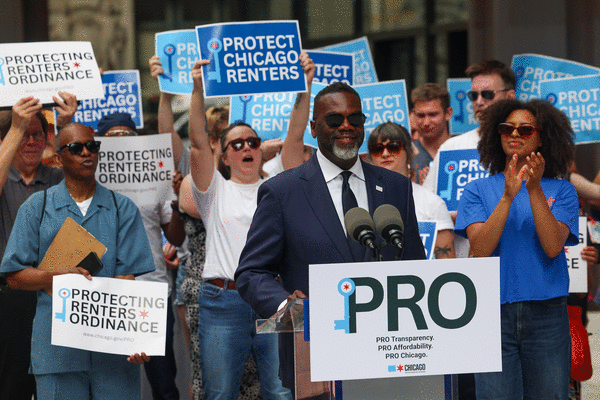
CHICAGO — The City Hall fight between Mayor Brandon Johnson and opponents has again stalled two ordinances aimed at overhauling Chicago renters’ rights as the sides try to strike a deal.
Aldermen pushing the respective packages announced Monday evening they would continue negotiations and cancel votes on both of them that had been scheduled for Tuesday morning.
“We believe we are getting closer to an agreement,” the joint statement from Alds. Gilbert Villegas, 36th, and Maria Hadden, 49th, said. “We want to give that process the time and space it needs to continue.”
The delay extends a battle over what could become City Hall’s most consequential legislation this year, sparked when Johnson joined tenant activists and progressive aldermen in May to push for a sweeping landlord-tenant bill.
Villegas and other Johnson opponents fired back weeks later with their own counterproposal, a measure that would give less power to renters, drawing criticism from tenant groups and winning a warmer reception from landlord and development organizations.
Key changes have been made to both ordinances since as the two sides race to be the first to win over a City Council majority.
Aldermen used a parliamentary maneuver to delay up-or-down votes last Wednesday, and Villegas pledged then that his measure would not be put before the council Tuesday.
“Tuesday, no. It just depends on how discussions potentially go or what actually takes place,” he told the Tribune. “It’s just a little premature still.”
But the Northwest Side alderman appeared poised to backtrack over the weekend when he filed notice that he would indeed call the ordinances for a final vote.
Villegas, chair of the City Council Zoning Committee, met with Progressive Caucus members over the weekend in a meeting aimed at compromise. But some progressive aldermen said the negotiations did not lead to immediate changes as Villegas warned them he already had a City Council majority and would move ahead on a vote Tuesday.
“He does not seem to be interested in any kind of compromise,” Housing Committee chair Ald. Byron Sigcho-Lopez said Monday.
Sigcho-Lopez called on Johnson to veto Villegas’ measure if it does not change.
Johnson’s veto threat has loomed over the ongoing negotiations. While Villegas could advance his legislation through the City Council with the support of 26 aldermen, he would need 34 votes to overcome a mayoral veto.
Asked Tuesday where compromise could occur, Johnson said he “set the table” when he introduced his ordinance.
“I’m grateful that people are coming to the table, to this incredible feast, to make the city of Chicago a more friendlier place for renters,” he said. “We cannot roll back the gains that were made 40 years ago.”
The mayor already backed off perhaps the most controversial part of his initial proposal, a plan to allow landlords to evict tenants or not renew leases only under narrow circumstances, or be required to pay moving fees as high as $10,000.
To varying degrees, both ordinances would create a new registry of all Chicago rentals, add city employees to enforce landlord-tenant rules and ban many so-called “junk” fees.
Johnson’s measure would create “more than 100 new rules” and make it impossible for landlords to properly charge tenants for business essentials, like background screenings, said Michael Glasser, president of the Neighborhood Building Owners Alliance. The test is now to see whether legislation makes it more or less expensive to provide housing, he added.
“A compromise that passes the test would hold bad actors accountable without punishing good neighborhood housing providers,” Glasser wrote in a statement Monday night. “You can’t make housing more affordable by making it more expensive to provide housing.”
One of the NBOA’s lobbyists, Adriann Murawski, told industry leaders last week they must remain focused on blocking Johnson’s proposal, even as she shared opposition to both pieces of legislation.
“I continue to believe there is a pathway for neither one to pass, and I think that would be a huge victory for the industry right now,” she said. “But the reality is… they do want to pass something.”
But while Johnson opponents have said the mayor’s bill is too extreme, tenant advocates continued to argue Tuesday morning that Villegas’ proposal does not go far enough.
His registry would not allow Chicagoans to see beyond the shell companies that mask the bigger owners of rental units, would improperly place enforcement powers in the Department of Buildings instead of the Department of Housing, does not outlaw enough fees and does not create the revenue needed to pay for the new policies, they said.
Ald. Rossana Rodriguez-Sanchez, 33rd, said Villegas’ ordinance even removes certain tenants rights while urging him to bring in tenant advocates in the final negotiations.
“There is no way in hell that we are going to allow an ordinance to pass that is going to take back rights that were so hardly earned and that are absolutely not enough,” she said. “The coalition needs to be at the table.”
____
©2026 Chicago Tribune. Visit at chicagotribune.com. Distributed by Tribune Content Agency, LLC.





Comments