South Florida pastor indicted in Haiti president's assassination goes on trial
Published in News & Features
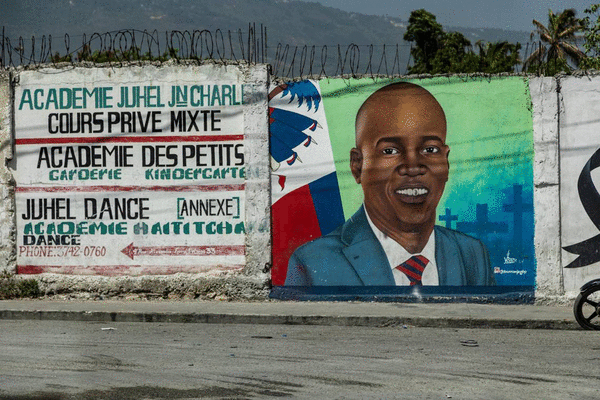
MIAMI — Jury selection began Monday in the Miami federal trial of a South Florida pastor who prosecutors say wanted to become president of Haiti through a violent overthrow of President Jovenel Moise.
Christian Emmanuel Sanon, who lived between Palm Beach County and Haiti, is accused of joining with others in a conspiracy prosecutors say took root in South Florida and involved other countries, including Colombia, Ecuador and the Dominican Republic. The plot culminated, prosecutors say, in the July 7, 2021, assassination of Moise in Haiti, after a squad of Colombian former soldiers stormed his residence in the hills above Port-au-Prince in the middle of the night.
Moise, who was in his second-floor bedroom, was shot a dozen times. His wife was seriously injured, while their two youngest children were unharmed.
More than a hundred potential jurors have been summoned to the Wilkie Ferguson Courthouse in downtown Miami.
Federal prosecutors say Sanon, 67, and his associates conspired “to launch, and participated in, a military expedition against Haiti” by hiring and sending a “team to the country to instigate a violent coup against its lawful leader, President Jovenel Moise.” The conspiracy charge carries a possible life sentence. Sanon also faces charges stemming from the illegal shipment of bulletproof vests to Haiti for the Colombian commandos prosecutors say were recruited for the operation.
Prosecutors argue that the South Florida group, in collaboration with key Haitians, wanted to replace Moise with a new president willing to hire them for lucrative security and infrastructure contracts.
Some of the suspects, including members of the Colombian team, were scheduled to have bond hearings on Monday. Among them is Joseph Felix Badio, 63, a former Haitian government functionary who has emerged as a central figure, and Samir Handal. Handal, who has been living in Miami, was arrested along with others a week ago after federal prosecutors decided to dramatically broaden their investigation into the plot and a grand jury returned a sixth superseding indictment in August.
Trial delay
Sanon, who was connected to AYITI2054, a Haitian political party, was initially scheduled to stand trial with four co-defendants: Antonio “Tony” Intriago and Arcángel Pretel Ortiz, the owners of Counter Terrorist Security and Counter Terrorist Security Federal Academy, collectively known as CTU; Walter Veintemilla, a Broward County financier; and James Solages, a Haitian American handyman who served as CTU’s representative in Haiti.
But Sanon’s case was severed on March 6, 2026, because of health reasons, and his trial was delayed. After a nearly nine-week trial, the other four defendants were found guilty in May of conspiring with former Colombian soldiers to assassinate Moise. Their sentencing has been delayed until early February 2027. All four face up to life in prison.
Sanon heads to trial alone
Sanon heads to trial on his own as prosecutors broaden the case to include individuals accused of financing the plot and supporting the logistical network around it.
Last week, U.S. authorities transferred 18 suspects from Haiti, including 17 former Colombian soldiers and Badio, the former Haitian government official who emerged during the earlier trial as a central figure in the plot. They are among 29 additional defendants named in the superseding indictment.
The expanded indictment asserts that the $343,000 traced to the financing of the scheme involved government loans, including COVID-19 pandemic relief funds, that were fraudulently obtained.
Sanon has not been charged with participating in the financial fraud and his lawyers have sought to have the references removed. They also argued that because the case has dramatically expanded after they spent two years preparing, he should be allowed to go to trial on the previous indictment or get a 30-day trial delay.
U.S. District Judge Jacqueline Becerra, who presided over the earlier trial, rejected the defense’s request for a delay, although she granted some of their requests on removing some of the additional allegations. She also scheduled a hearing for Tuesday before opening statements to hear arguments on the defense request to have three of the new charges dropped.
Prosecutors say they intend to prove that “Sanon recruited and gathered the group of conspirators who ultimately arranged President Moise’s assassination ... Sanon enlisted those individuals to provide material support to the conspiracy to kidnap or kill President Moise, and Sanon himself provided material support.”
That support included participating in the scheme; fundraising, mostly from recipients of pandemic-era government loans; arranging travel to Haiti and lodging for Sanon, Intriago and Solages and two dozen Colombian commandos. Sanon is also accused of obtaining an arsenal of weapons, ammunition and ballistic vests, culminating in the dead-of-night operation coordinated by his allies to storm Moise’s private residence.
Sanon’s trial is likely to turn on a more complicated question: How much responsibility does he bear for what happened to the 53-year-old Moise?
Evidence and witness testimony during the first trial showed the plot repeatedly changed, and Sanon’s allies began having conversations without him as they left him out of group chats on text.
The government’s cooperating witnesses testified about meetings in South Florida and text messages. Recovered messages showed that after a plan to kidnap Moise failed, the group began souring on Sanon and chose a new replacement for the Haitian president, Superior Court Justice Windelle Coq Thélot.
Sanon’s defense lawyers are trying to distance him from the plan to kill the president, saying he had nothing to do with it. They note he was not present when the Colombian commandos gathered at a mountaintop house hours before Moise was killed and left from there in a convoy toward the residence.
Long witness list
Sanon’s witness list includes two former prime ministers of Haiti, Claude Joseph, who was in charge when Moise was killed, and Ariel Henry, who had been tapped to replace Joseph by the president before his death. His lawyers, Humberto Dominguez and Zeljka Bozanic, also said they intend to call Michel Soukar, a Haitian political analyst.
Prosecutors Sean T. McLaughlin, Jason Wu and Altanese Phenelus have amassed a witness list of 58 individuals including cooperating witnesses already sentenced to life imprisonment, FBI analysts, forensics experts and former first lady Martine Moise.
Also on the list is Joseph Joel John. A former senator in Haiti who pleaded guilty and is hoping to get a reduction in his sentence, he flew to Miami to meet with Sanon and others about seizing power from Moise, who at the time was ruling without a parliament and the target of mass protests by opposition groups in Haiti.
At one of the meetings John attended, an FBI agent was present, testimony during the previous trial revealed. The agent did not immediately report the gathering, according to testimony.
Prosecutors now say that in addition to the individuals they previously identified at an April 2021 meeting in South Florida, including the owners of CTU, there was also another person, Bryon Rainer, who was previously unknown to them. They’ve since tracked down Rainer and charged him with financing-related offenses.
John testified about conversations in which Sanon spoke of organizing protests and having people storm the grounds of the national palace. But John also testified that the group moved away from Sanon in favor of the judge and that Sanon was not present at the mountaintop house.
In addition to conspiracy, Sanon faces lesser charges related to the shipment of bullet-proof vests on June 10, 2021, to Haiti. According to prosecutors that arrangement was done with the help of Frederick Bergmann Jr., a Tampa businessman and friend of Sanon who previously pleaded guilty and was sentenced to nine years.
Badio and others in court
Before the first trial, several co-defendants pleaded guilty to the assassination conspiracy or lesser charges, including Keegan Harricharan, 42, of Coral Springs, who was sentenced to 20 years after a money-laundering conspiracy plea. Harricharan admitted that he fleeced a COVID-19 government loan program in 2020, and the following year, he transferred $255,000 to Veintemilla to help fund the assassination plot.
At the same time prosecutors and defense lawyers will be questioning jurors, some of those recently transferred to Miami from Haiti will be involved in their own bond hearings.
Among them is Badio, who last week was the subject of a protest note by Haiti’s Superior Council of the Judiciary. The council argued that he and the 17 Colombians are under the authority of a Haitian investigating judge and could not legally be transferred to the U.S. without that judge’s authorization.
Critics note that Haiti’s judicial system had five years to bring the assassination case to trial, and though an investigative judge indicted 51 individuals, the appeals process turned into political theater with no resolution in sight.
_____
©2026 Miami Herald. Visit miamiherald.com. Distributed by Tribune Content Agency, LLC.




Comments