The birding boom has a smartphone dilemma
Published in News & Features
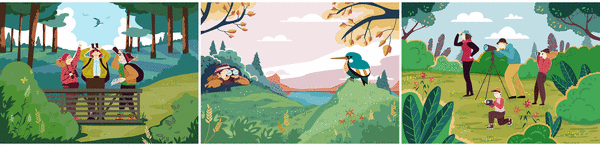
When I first met my husband, I was astounded that he could glimpse a bird flitting among trees 50 yards away and identify it with the confidence of someone looking at a field guide. “Cardinal,” he’d say, as we flew down the highway, after a flash of red appeared for a split second.
It seemed impossible. Was he making these identifications up? But in the fall of 2020, staring past my laptop and out of the window in Rhode Island, I realized I was developing this superpower too. It started with ducks.
Ducks are a perfect gateway into birding: They’re big and distinctive, and, for the most part, they stay put. I found an electrifying high in learning to spot them and getting their names right. By spring migration, I had progressed from buffleheads and mergansers to sparrows and songbirds. My husband, it turned out, wasn’t bluffing. You really can name a backyard bird from a quick, distant glance. It just takes months of learning bird families, behaviors, habitats, seasons and ranges. Or having the right app and about four seconds.
Birdwatching has boomed since the pandemic, with people returning to nature and looking for community. Predictably, this surge in interest has prompted a proliferation of technology designed to make the activity easier. And the tech, in turn, may be feeding the growing interest. The Cornell Lab of Ornithology reports exponential user growth across its suite of birding tools in 2025, including 9.6 million new users for Merlin, its bird identification app, nearly seven times the number of new users it reported in 2020.
Merlin owes part of its swell in popularity to Sound ID, launched in 2021, which has since gone viral as an entree into birdwatching. Tap the green microphone button in the center of the screen, and a GPS-linked database identifies the birds singing and calling within earshot, one by one. Sound ID can identify almost 2,500 species — a little more than a fifth of the known species on Earth.
A couple years into birding, I found the technology helpful for confirming my guesses, or giving me a jumping off point to identify a species. But one day I realized I was always bringing my phone along for my once-unplugged hobby: There I’d be, standing in the woods, reading about breeding ranges, tracking my route by GPS, making real-time updates to my “life list.”
As it turns out, I’m not alone in noticing that my phone has infiltrated my practice — and wondering how instant access to AI-powered data and analysis is changing the experience.
Optimizing for Access
Birding is one of many hobbies being made more accessible by technology. Stargazing, for instance, is built on learning the sky through star hopping: working one’s way from recognizable reference stars and celestial patterns to fainter, harder-to-spot objects. A decade ago, you’d need some degree of earned knowledge to take part. Today, a $499 telescope can identify a galaxy and send a photo to your phone in the process. “No knowledge of the sky is required,” noted one lifelong visual observer in Sky & Telescope, admitting their “first reaction was mild despair” before they went out and bought one.
Fitness apps like Strava — which offers a social sharing component and, since 2024, an AI coach — are helping users get consistent about their workouts as well as learn new exercises and improve their technique. For some, optimization can have costs: Research has linked fitness apps’ built-in social components to a higher likelihood of developing an “obsessive passion” for physical exercise and higher levels of stress in the long run.
Birding has been through tech-driven transformations before. Jennifer Lodi-Smith, a psychology professor at Canisius University in Buffalo who studies why people become birders, says the pastime surged after the publication of the first widely available field guide in 1934, then again with greater access to affordable binoculars after World War II. The 1970s and ’80s brought the heyday of rare bird alert hotlines, which allowed birders to call a phone number and hear a recording of recent, unusual sightings in their area. Each innovation made it easier for hobbyists to gain entry and knowledge.
Since I embarked on my birdwatching journey six years ago, my phone has become littered with apps: Audubon Bird Guide, BirdNET, iNaturalist, Merlin and eBird. They’ve undoubtedly made the hobby more accessible to me and other newcomers around the world. What could the drawbacks be?
I put the question to Michael Lombardo, a birder in New York who worked at Google and YouTube before quitting tech in 2023. Now, among other projects, he runs the McGolrick Park Bird Club in Brooklyn and writes a Substack about observing the natural world. “I love that these tools are getting people into it. I love that they’re educating people. But just like anything, it’s a really slippery slope,” he says.
Lombardo describes a recent birdwalk in Delaware, where he heard something calling in a marsh, a species of rail, perhaps. As his hand went for his phone, an 11-year-old birder he’d just met stopped him. “Don’t use it,” the kid advised. “It’ll become a crutch!” He’s right, Lombardo says.
Lombardo got into birding using iNaturalist, the citizen science platform that matches snapshots of anything in nature with an ID. He gradually worked Merlin and Cornell’s bird-listing app eBird into his practice. The app — where birders log or “list” the birds they’ve already identified — took 21 years to record its first billion bird observations, hitting that milestone in 2022. Its second billion observations took just three years. The gamified layer, with users’ tallies and leaderboards, is part of the draw for some newcomers.
After getting drawn into those features, Lombardo realized they were the opposite of what he wanted from birding. “The social-media-ness, the quantification of it all, becomes a thing,” he says, and that meddled with the “flow state” he originally loved in birding. “You just have this impulse to look at the number and be like, ‘How many species have I seen? How many birds have I seen?’”
Lombardo tells me his best birding experiences today are phone-free. Sometimes they’re even binoculars-free — a trend nicknamed “bare-naked birding.” (Clothing, yes; phone and binoculars, no.) Before he started using Merlin, he realized things stuck in his head more. “I had to notice the sound, and then I had to find the bird that was making it, and I had to connect those two. Those are the bird sounds that I remember most viscerally,” he says.
Desirable Difficulty
I sometimes struggle to pick a Carolina wren or robin out of the chorus in my Berkshires backyard. Merlin could do this for me. But after making an effort on my own, I’ve learned to tell them from the chickadees and nuthatches without seeing them. According to psychologist Nate Kornell, this is cognitive science at work: in particular, the concept of “desirable difficulty.” Kornell, a professor at Williams College, explains that “you learn more by making your task more difficult.”
When apps give us instant access to clear answers, we mistake fluency for expertise. It “causes people to think that they understand it very well, even if they don’t — and even if they won’t remember it,” he says. But, he adds, “there’s nothing wrong with having a hobby and not getting better at it.”
The relative ease of app-based birding has ruffled some feathers, Lodi-Smith says. “The people who came around before Merlin feel like you need to slog through and do it the hard way,” she says. “And I get that.”
For some birders, like birder and former Nature Conservancy field biologist Julie Zickefoose, it’s not about the slog: It’s about the level of trust being put in an app over a human’s earned expertise. “Having come up the old, hard way, learning bird songs and calls by chasing them down and constantly honing my craft, it’s a bit annoying to have people hold their phones up and tell me what’s calling when I’m leading a field trip,” Zickefoose says. “I don’t think they realize that Merlin is anything but the last word.”
Zickefoose spent this summer trying the app out. Seasoned enough to look at a Merlin Sound ID list and understand what’s missing, she found it opted out of identifying many calls, including those of juveniles and outliers it wouldn’t expect. “Sometimes it’s right. Often it’s dead wrong,” Zickefoose says. “I love the democratization of birding that happens with this app,” she adds. But she regrets its shortcuts, including taking away birders’ reason to open a field guide — an opportunity to attain desirable difficulty. “Humans with experience and knowledge are still needed.”
This is all the more true as climate and habitat changes mean ranges are shifting and hybridized species are forming. Apps can’t observe in the real world. Humans have to see these unexpected changes and report back. Cornell Lab Project Coordinator Alli Smith explained in an email that Merlin is “one of many tools that someone can use to learn how to identify birds, along with friends, books, bird clubs, social media groups, and other resources.” And yes, she said, it does sometimes get things wrong: Merlin identifies bird calls by analyzing visual representations of sound, called spectrograms. Many of these are unique, but some look almost identical. Very similar spectrograms may result in misidentifications.
Smith added that Merlin is an ever-evolving work in progress. It is largely powered, after all, by the data contributed to eBird from human birders around the world. It’s endearing to think about this global team effort. The way to make tools like eBird and Merlin Sound ID even more useful for birders, old and new, is to feed them.
But there needs to be a balance: If the new generation of birders relies on apps trained on the expertise of old-school human birders instead of developing our own, not only will our own learning curve flatten, but the learning curves of the apps we rely on will flatten too.
I have no plans to go full naked birding. But I will keep chasing desirable difficulty. And I’ll encourage friends who’ve fallen in love with birds to join me. After all, the apps helping so many new birders get started are only as good as the birders they learn from.
©2026 Bloomberg L.P. Visit bloomberg.com. Distributed by Tribune Content Agency, LLC.




Comments