Newsom administration proposes removing explorer John C. Fremont's name from state park, citing his violence against Native Americans
Published in News & Features
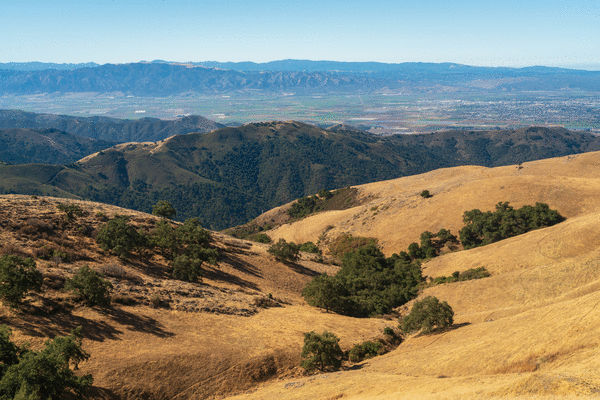
SAN JOSE, Calif. — Citing his violence against native tribes in the 1840s, Gov. Gavin Newsom’s administration is moving forward with a plan to remove the name of famed explorer John C. Fremont — a former U.S. senator for whom the Bay Area city of Fremont is named — from a state park on a prominent peak in San Benito County.
On Wednesday, officials with the California state parks department issued a notice giving the public 30 days to comment on the plan to rename Fremont Peak State Park as “tooyohtak State Park,” an Ohlone word meaning “place of the bumble bee.”
The latest example of Newsom’s “Re-examing Our Past Initiative,” the proposal comes after the Amah Mutsun Tribal Band asked Newsom in 2019 to make the change. The tribe noted that Fremont in 1846, along with explorer Kit Carson and about 60 other Americans, killed several hundred members of the Wintu Tribe near Redding, in an attack known as the Sacramento River Massacre.
The state park, about 45 miles south of San Jose near San Juan Bautista, opened in 1936 and sits atop a 3,173-foot mountain visible across Monterey Bay and from the Salinas Valley and southern Santa Clara County. It has several miles of trails, a campground and an observatory. John Steinbeck mentioned the peak in several of his novels. It was named for Fremont because he raised the American flag in the area in 1846 when California was still under Mexican control, nearly sparking a battle with Mexican soldiers who had assembled at the base of the mountain.
The proposal to remove his name is the latest example of efforts to change the names of geographical landmarks in California and other states in recent years because of controversies in the past involving the historical figures for whom they are named.
“We’re not trying to change history,” said Valentin Lopez, the former Amah Mutsun chairman who wrote a letter to Newsom asking him to rename the park. “We’re trying to correct history. They want to honor people who did massacres. There’s something morally wrong with that. It’s wrong to name peaks after people who committed such atrocities.”
State parks officials said they have held two online meetings about the potential name change, and after hearing more input from the public over the next 30 days through an online survey or emails to feedback.diablorange@parks.ca.gov, will present it to the California State Parks and Recreation Commission, a 9-member body appointed by Newsom, for a vote as soon as Dec. 3.
If the commission changes the name, state parks officials also are likely to design new signs and other materials at the park to continue to mention Fremont, his explorations of the American West and military career, but also his attacks on native tribes and the earlier history of native peoples in the region, said Amanda Blosser, cultural resources program manager for state parks’ Diablo Range District.
“We are trying to tell a more inclusive history,” she said. “His story is part of the place and part of the history. But there is a wider story to tell.”
Not everyone is in support of the name change.
“Fremont Peak is a landmark that is part of our identity,” said Peter Hernandez, a former San Benito County supervisor. “Just like Mount Hamilton in San Jose, or Mount Diablo in the East Bay or Mount Tamalpais in the North Bay. If you change the name, you change our identity.”
Fremont, who died in 1890, led five expeditions across the West in the 1840s and 1850s. He explored the Rocky Mountains, the Great Basin, the Southwest, and much of California, creating new trails. His discoveries led him to become famous at the time, known as “The Pathfinder.” His routes were copied into maps, used by thousands of people who came West along the Oregon Trail and over the Sierras in the 19th century.
He clashed multiple times with tribes, sometimes claiming in his memoirs that he attacked after hearing other settlers say they were planning attacks.
Fremont also founded the California Republican Party. He was one of the first two United States senators from California, in 1850, as it was admitted to the United States during the Gold Rush. In 1856, he became the first nominee for president of the newly formed Republican Party, running on an anti-slavery platform. He lost to Democrat James Buchanan. He later was an officer in the Union Army during the Civil War, and was fired by President Lincoln in 1861 for issuing an emancipation order in Missouri to slaves without Lincoln’s approval.
Lopez, of the Amah Mutsun tribal band, said he believes the city of Fremont also should change its name.
There are at least 18 towns and cities across the United States named after Fremont, along with four counties, a national forest, dozens of streets, including in San Francisco, the John C. Fremont Hospital in Mariposa County, and libraries, schools, even multiple plants he discovered.
“Unwinding Fremont’s name from California and other locations would be quite a task,” said John Bicknell, an Illinois-based author of ‘The Pathfinder and the President: John C. Fremont, Abraham Lincoln and the Battle for Emancipation.’
Bicknell said telling Fremont’s full story at parks would be preferable to removing his name.
“Judging figures on contemporary standards from the perspective of two centuries is almost always a mistake,” he said.
Other name changes have occurred in recent years.
In 2021, the Newsom administration changed the name of Patrick’s Point State Park in Humboldt County to Sue-meg State Park at the request of the Yurok Tribe, who noted that the previous namesake, Irish immigrant Patrick Beegan, had led a militia in the 1860s that attacked a tribal village and killed multiple people.
Squaw Valley Ski Resort changed its name to Palisades Tahoe in 2021.
Some attempts have failed after public outcry, however. In Mendocino County, the city council in Fort Bragg decided in 2020 against placing a measure on the ballot to change the name of the city to something other than the namesake of Confederate General Braxton Bragg.
In 2022, votes in San Francisco recalled three school board members after they voted to remove the names George Washington, Abraham Lincoln, and former U.S. Sen. Dianne Feinstein from city school buildings, claiming that they had committed various racist acts in their eras.
In 2015, President Obama changed the name of Mount McKinley in Alaska, the tallest mountain in the United States, to “Denali,” the traditional Athabascan name for the peak, meaning “the high one” or “the great one.” President Trump changed it back to Mount McKinley last year, honoring the Republican president who was assassinated in 1901.
“We are seeing groups that have been dismissed and ignored increasingly acknowledged,” said Larry Gerston, a professor emeritus of political science at San Jose State University. “History is living. What you see now is what you didn’t see before and what you may not see in the future.”
“Traditionalists say we are changing things too fast,” he added. “Are we repaving the past in such a way that we don’t remember the past? The answer to that question is a really difficult thing. It’s issue by issue.”
_____
©2026 MediaNews Group, Inc. Visit at mercurynews.com. Distributed by Tribune Content Agency, LLC.




Comments