Haiti hired Trump operative Roger Stone for $65,000 a month. Miami group wants to know what for
Published in News & Features
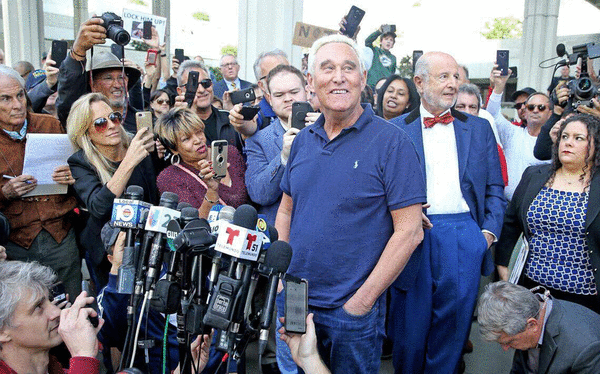
MIAMI — As Haiti struggles to absorb returning U.S. deportees even as it battles relentless armed gangs, surging kidnappings and deepening hunger, a Haitian American advocacy group wants to know why its government is paying a longtime Trump political operative and his Fort Lauderdale-based lobbying firm as much as $780,000 to represent it in Washington.
The Haitian American Foundation for Democracy, a Miami-based advocacy group, is demanding that Haiti’s transitional authorities explain why they hired Roger Stone Jr., for $65,000 a month to lobby on their behalf. The group is questioning both the spending priorities of Prime Minister Alix Didier Fils-Aimé‘s government, and the selection of Stone, a Republican strategist who has faced years of criticism for inflammatory comments about Black people, including former President Barack Obama.
A longtime confidant of President Donald Trump who has denied he is racist, Stone was convicted in 2019 of seven felonies, including lying to Congress and witness tampering. Days before Stone was to report to federal prison to begin a 40-month sentence, Trump commuted his sentence and later pardoned his one-time campaign adviser.
Earlier this month, Stone was hired by Haiti’s Ministry of Foreign Affairs and Worship through his Drake Ventures, the Fort Lauderdale lobbying firm he owns with his wife. The agreement runs until Sept. 2, 2027, according to a filing with the Justice Department under the Foreign Agents Registration Act. Stone did not respond to a request from the Miami Herald for comment.
“The contract renews automatically…and obligates Stone to do nothing more specific than ‘advocate on those issues the client deems necessary and appropriate,’” the Haitian American foundation said. “It does not mention Temporary Protected Status, deportations, or the safety of a single Haitian in the United States.”
The criticism comes as Haiti sees an increase in deportation flights from the U.S. — and the Haitian government remains mum while religious and immigrant rights groups in the U.S. organize candlelight vigils for those who have been detained, demand their release from Immigration and Customs Enforcement custody and lawyers continue to litigate the end of deportation protections in federal courts despite a recent Supreme Court ruling.
That ruling cleared the way for the Trump administration to terminate TPS, a humanitarian program that had allowed hundreds of thousands of Haitians to legally live and work in the United States without fear of deportation. Deportation flights to Haiti have now gone from once a month to once a week, usually on Thursdays.
“Five weeks after 350,000 Haitians lost their legal status and deportation flights to Cap-Haïtien resumed, the Haitian government found $780,000 for a lobbyist — and chose the one man in Washington who helped build the movement that is deporting our people,” said Patrick Gaspard, vice-chairman of the Haitian American foundation, who served as U.S. ambassador to South Africa and as a White House official in the Obama administration.
TPS and Obama
Haiti’s TPS designation was put in place by President Obama after the country was hit by a catastrophic earthquake in 2010. The disaster left more than 300,000 dead, according to the Haitian government, 1.5 million injured and another 1.5 million internally displaced.
The protection had been extended and redesignated several times. President Joe Biden extended it after Haitiian President, Jovenel Moïse was assassinated on July 7, 2021.
The slaying, which federal prosecutors say was partly plotted in South Florida, plunged the country deeper into chaos.
Despite the ongoing crisis, the country was dropped from TPS by Trump, who while campaigning for re-election falsely claimed that Haitians in Springfield, Ohio, were eating their neighbor’s pets.
Among the hundreds already deported to a country confronting one of its worst humanitarian and security crises in recent memory are individuals with criminal records and families traveling with U.S.-born children. More than half of Haiti’s population of 12 million are facing acute hunger.
More than 3,000 people have been killed by gangs this year, according to the United Nations, while nearly 1.5 million remain homeless. Forced to live in sordid encampments, women recently described to a visiting U.N. Secretary-General António Guterres about having to sleep on top of their children to protect them from being raped.
“Roger Stone has never spoken a word in defense of a Haitian migrant,” Gaspard said. “Haitians at home and in the diaspora deserve to know whether he is being paid to undo this policy or to make it easier.”
Contract terms troubling
The Haitian American advocacy group said terms of the contract are “as troubling as its choice of contractor.”
The agreement requires Haiti to pay Stone’s legal fees if he is drawn into any investigation or audit arising from the work, the advocacy group notes. “His liability to Haiti is capped at the fees Haiti has paid him. And the Ministry of Foreign Affairs of a sovereign nation has agreed to be sued, if at all, only in the courts of Broward County, Florida,” the organization added.
The group pointed to Stone’s history of inflammatory remarks about Black people. In the statement, they cite his 2016 removal from CNN and MSNBC and his suspension, the following year from Twitter after posts in which he called “Black commentators ‘stupid negro,’ ‘house negro,’ ‘Mandingo’ and ‘Uncle Tom,’” the group said in its statement. “In July 2020, on a Los Angeles radio broadcast, he was recorded describing the Black host interviewing him as ‘this Negro.’ ”
Stone later denied making the remark and defended himself in a statement, saying, anyone familiar with him “knows I despise racism.”
The Haitian American foundation notes that Haiti, which is also struggling to organize its first general elections is more than a decade, already pays lobbying firm Continental Strategy, headed by Trump’s former ambassador to the Organization of American States. Between the two contracts, the organization said, “the Republic is now paying at least $100,000 a month to two Trump-aligned lobbying firms while the Haitian state cannot pay its police, its teachers or its hospitals.”
The foundation said it has written to Foreign Minister Raina Forbin and Prime Minister Alix Didier Fils-Aimé, both of whom are in New York for the U.N. General Assembly.
The group is asking Forbin, who signed the contract with Stone, and Fils-Aimé six questions. Among them: Why there is no mention of TPS or deportations in the agreement; why the ministry chose a “promoter of the policies harming Haitians; whether it examined his record, and whether the Haitian government agency responsible for scrutinizing public spending reviewed the contract. The organization also asked why Haiti “accepted terms no competent lawyer would let a sovereign sign.”
The foundation says it plans to share the contract and the answers with members of Congress, who on Wednesday held a closed-door Senate briefing on TPS. The foundation also plans to monitor Stone’s disclosures under the Foreign Agents Registration Act, which requires firms to list every U.S. official contacted on the client’s behalf and payments received.
“This is not a question of politics. It is a question of whom the Haitian state represents,” said Jocelyn McCalla, a longtime Haitian rights advocate who serves as the Haitian American foundation’s executive director. “If the government has a case for this contract, let it make that case to the Haitian people. If it does not, it should cancel it.”
______
(Miami Herald staff writer Shirsho Dasgupta contributed to this story.)
©2026 Miami Herald. Visit at miamiherald.com. Distributed by Tribune Content Agency, LLC.





Comments