Playing both sides on fraud: Somali leader Omar Jamal's dual role in sprawling fraud case
Published in News & Features
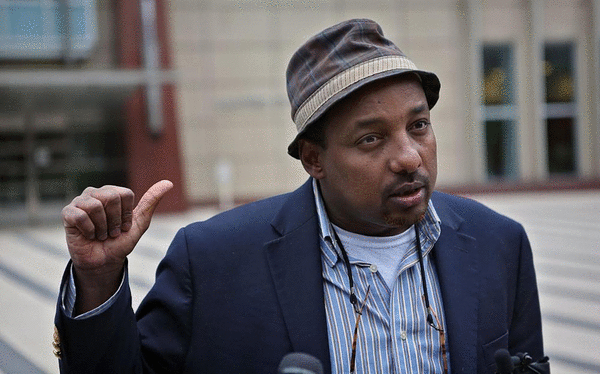
MINNEAPOLIS — For more than two decades, Omar Jamal has cultivated influence as a high-profile go-between — connecting politicians, regulators and law enforcement officials with members of Minnesota’s Somali community. Since 2020, he has also held a civilian job with the Ramsey County Sheriff’s Office.
That public standing and private access became lucrative during the Feeding Our Future fraud scandal.
Records obtained by the Minnesota Star Tribune show Jamal collected hundreds of thousands of dollars from at least six people convicted in the sprawling fraud scheme.
That group included Anab Awad, a Plymouth woman who later pleaded guilty to stealing $9.7 million from a federal child-nutrition program. Awad told FBI agents she paid Jamal nearly $100,000 after he invoked his law enforcement connections and promised to protect her from prosecution.
“I’m the boss, nobody’s coming to you guys,” Awad recalled Jamal telling her. “You’re safe.”
At the same time, Jamal was giving the FBI information about his clients.
Jamal met with the FBI at least three times before the fraud investigation went public in early 2022. In those meetings, according to notes taken by federal agents and obtained by the Star Tribune, Jamal implicated a dozen individuals or companies later indicted by the U.S. Attorney, including several who were his clients.
Aimee Bock, recently sentenced to more than 41 years in federal prison for her role in the Feeding Our Future fraud scheme, was one of them. She maintains that Jamal reported her to the feds after she balked at paying him an extra $33,500 for consulting with state regulators on her behalf.
Her lawyer, Kenneth Udoibok, called Jamal a “shakedown artist” in an interview with the Star Tribune.
Jamal’s dual role has not previously been reported. The records offer a behind-the-scenes look at how he turned his relationships into a profitable business, selling access and, according to his clients, promises of protection.
Jamal, 53, has not been criminally charged for his alleged role in taking payments from fraudsters, and the records do not prove Jamal committed a crime. Moreover, the accusations come from convicted fraudsters who may be motivated to discredit him. But canceled checks and invoices corroborate the payments, and FBI records confirm that Jamal was privately providing information about the fraud while accepting money from people involved in it.
Jamal agreed to an interview with the Star Tribune through his attorney, Patrick Boyle, but twice backed out. Boyle declined to address most of the Star Tribune’s findings. He wrote in an email that Jamal has “never worked for the FBI,” though he acknowledged that Jamal has worked with law enforcement agencies to arrange meetings and raise concerns affecting the Somali community.
The FBI and U.S. Attorney’s Office declined to describe Jamal’s relationship with investigators or say whether his information significantly advanced the Feeding Our Future investigation.
One federal law enforcement official involved in the case downplayed Jamal’s involvement in the probe.
“It was intelligence but not evidence,” the official said. “He didn’t have any value to us as a witness, as a cooperator. We were already onto them through the bank records.”
A Somali refugee himself, Jamal’s promises to Awad and others carried some weight in Minnesota’s East African community. After the terrorist attacks of Sept. 11, 2001, Jamal co-founded the Somali Justice Advocacy Center, helping immigrants find pro bono attorneys.
He quickly became the community’s unofficial spokesperson, cultivating relationships with media outlets, politicians and law enforcement agencies looking for access to Minnesota’s fastest-growing immigrant community.
“Omar Jamal is an information broker,” former Hennepin County Sheriff Rich Stanek said. “Which means you have to play both sides. And he was really good at playing both sides.”
By 2009, Jamal had become such a prominent figure that the president of Somalia appointed him to the prestigious role of first secretary to the United Nations.
Former U.S. Attorney Tom Heffelfinger said Jamal connected him with Somali leaders when the government was scrambling to tamp down domestic terrorism in the early 2000s.
“He liked to open doors,” Heffelfinger said. “And then he would tell people, ‘I’m a big muckety-muck with all of these law enforcement people.’ ”
Jamal has been shadowed by a standing deportation order since 2011, and he was arrested by immigration agents and jailed for a month last summer as the Trump administration ramped up its deportation crackdown in Minnesota.
Unlike many immigrants with deportation orders, Jamal was released. Days later, at a news conference, he praised conditions at the Freeborn County Jail and the people who worked there.
“I and the feds have been dealing with each other for the last 20 years,” Jamal said at the event. “Governments and institutions are not run by angels. They are run by humans. And we are all entitled to our own shortcomings.”
Jamal was 8 years old when his father, a captain in the Somali military, fled to Ethiopia after participating in a failed coup, according to a statement Jamal gave to a Canadian immigration court.
Jamal escaped to a refugee camp in Kenya and later spent time in England and Germany before immigrating to Canada in 1989, where he gained refugee and permanent resident status. But he left Canada soon after and finished high school in Kenya.
He moved to the U.S. in 1997 but immediately faced a big problem: Once another country accepts you as a refugee, the United States will not. So he changed his life story, switching his date of birth and clan affiliation and claiming he had never held permanent residency anywhere but Somalia, court records show.
Those lies caught up to Jamal in 2003, when a federal grand jury indicted him for making false claims on his asylum application. He was convicted on five of six counts, drawing one year of probation and a $500 fine instead of a potential five-year prison term.
The lasting consequence was to his immigration status: He was issued a final order of removal in 2011.
At the time, Jamal claimed he was targeted for being such a prominent Somali advocate. “If their aim was to pressure me and scare the hell out of me, it’s working,” he told the Star Tribune after his arrest in 2003.
Several former prosecutors and federal investigators said Jamal’s precarious immigration status could explain why he has spent years trying to help the government.
“He didn’t want to be seen by his community as being too close to the FBI,” said Ralph Boelter, special agent in charge of the Minneapolis office from 2007 until 2011. “And yet, because he had this immigration issue, I think he was mainly attempting to gain favor — purporting to assist the FBI in some way — so he could gain favorable treatment from the immigration authorities.”
Heffelfinger said Jamal never directly asked for assistance, but another former member of the U.S. Attorney’s Office said Jamal once offered to bring in a high-priority terrorism target in exchange for immigration help.
The former prosecutor, who asked not to be identified to discuss sensitive internal deliberations, said he rejected the deal.
Ramsey County Sheriff Bob Fletcher hired Jamal as a community service officer in 2020 to be a liaison with the Somali community. He earned nearly $70,000 in 2025.
Fletcher declined an interview request but provided an affidavit he submitted on Jamal’s behalf after he was detained by ICE in 2025. In the statement, Fletcher called Jamal a “committed community member” who has “provided valuable input on issues affecting immigrant and refugee communities.”
“I have never known him to pose a threat to public safety,” Fletcher said in the statement. “On the contrary, he has often acted as a stabilizing presence and a mediator in complex situations.”
In a 2025 interview, Jaylani Hussein, the executive director of the Council on American-Islamic Relations Minnesota, called Jamal a “polarizing figure” in the local Somali community. But CAIR officials and a dozen other local Somali leaders did not respond to requests to discuss Jamal for this story.
Jamal’s most prominent client was Bock, the woman convicted of masterminding the $250 million Feeding Our Future fraud scheme.
Records show Bock hired Jamal in May 2021 to negotiate a truce with the Minnesota Department of Education when it was trying to curb Feeding Our Future’s explosive growth. Bock told the Star Tribune she thought Jamal’s political and state government connections made him the right person for the job.
An invoice obtained by the Star Tribune shows Jamal was to be paid $150 per hour, and records show Jamal billed Feeding Our Future $48,000 in July 2021. Court records show Bock paid Jamal $10,000 by check, and an email from Jamal says she paid him another $4,500 in cash. Bock says, however, that she balked at paying Jamal the remainder of the bill and fired him.
“To my knowledge, he handled a couple meetings, some phone calls, nowhere near that volume of work,” Bock said in an interview from Sherburne County Jail.
In September 2021, two months after records show Bock failed to pay two-thirds of her bill, Jamal told FBI agents that Bock was running a criminal enterprise, and anyone who wanted to participate in the scheme was “required to pay Bock,” according to Jamal’s interview with the FBI.
The FBI raided Bock’s home and business four months later.
Awad, the Plymouth woman who said she paid Jamal for protection, told the FBI she connected with Jamal after launching two Minneapolis food distribution sites early in the pandemic. In summer 2021, she said, Jamal started pressuring her for cash.
He told Awad he was an FBI informant, flashed his Ramsey County Sheriff’s Office badge and demanded monthly payments to protect her from prosecution, according to notes from her interview with the FBI.
If she refused, Jamal said he’d turn her in.
Awad told federal investigators that she signed the consulting agreement with Jamal “through attorney Patrick Boyle,” Jamal’s attorney. Boyle declined to comment, citing attorney-client confidentiality.
Awad signed her first check to Jamal in August 2021. Her last payment came on Jan. 24, 2022, just four days after the federal raids.
A few months after Jamal received Awad’s final payment, Awad was on the Hajj, the annual Islamic pilgrimage, when she heard rumors that a federal indictment against her was looming. Awad called Jamal while in Saudi Arabia.
His advice: “Don’t come back, Anab,” according to the account of her FBI interview.
Awad’s attorney, Joe Dixon, declined to comment or make his client available for an interview.
After returning to the U.S., Awad was indicted in September 2022. She pleaded guilty to federal fraud charges two months later and, like many Feeding Our Future defendants, is awaiting sentencing. Records show she spent some of the fraudulently obtained money on a new pickup truck and property in Rosemount.
Awad told the FBI she believes Jamal turned her in after she stopped paying him. She said he once claimed to have blown the whistle on two other fraud operations “because they had refused to pay Jamal,” according to the report.
In his three sessions with the FBI in September and October 2021, when Awad was still paying Jamal, he named several other conspirators but never pointed a finger at her, records show.
Awad told federal investigators that Jamal “got paid by many women involved in the food program.”
State licensing records obtained by the Star Tribune show Jamal helped other organizations that were later implicated in fraud. He also secretly recorded a conversation between two conspirators who later pleaded guilty to fraud charges, according to one fraudster’s 2021 interview with the FBI.
It’s unclear if Jamal helped the FBI expand its probe or steered the government toward targets it had already identified. By the time he talked to investigators, a grand jury was already sifting through evidence against some of the conspirators.
The Trump administration began zeroing in on the massive scale of fraud in many of Minnesota’s social service programs last year, and it quickly singled out the Somali community as the culprit.
In emails to state officials, Jamal expressed concern about how his community was being both exploited and portrayed.
“I am overwhelmed about issues related to fraud in twin cities,” Jamal wrote in a 2025 email to the state Department of Human Services. “As you know East African communities are vulnerable to fraud and are often targeted by business owners to exploit their vulnerability due to lack of understanding with DHS system. I would like to see if I can schedule a meeting with some of the business owners for a quick session about the seriousness of fraud and the possible consequences of it.”
But in an email to a DHS manager earlier this year, he criticized an agency worker who had found problems at a Somali service provider in Minneapolis.
The manager accused Jamal of repeatedly harassing agency staff, noting he “made enrollment reps and leads on my team cry.”
Lori Shimon, a deputy director at the DHS, backed her manager, telling colleagues that Jamal “accuses every single person he talks to as being racist and discriminatory.”
DHS officials also noted Jamal, who previously communicated largely through his personal email account, had begun contacting regulators from his sheriff’s department account in an apparent attempt to “expedite things.”
In his email to the Star Tribune, Boyle said Jamal has already addressed the concerns of those DHS officials. He also reiterated Jamal’s long-standing claims of being a fraud fighter and proponent of honest government.
“According to Mr. Jamal, many current and former DHS employees would welcome greater public scrutiny of the department’s professional conduct,” Boyle said in the email. “He has also expressed the hope that the next governor will bring comprehensive reforms to DHS to strengthen accountability, transparency, and public confidence.”
But even after pointing federal investigators toward fraudsters in the Somali community, Jamal continued to advocate for immigrant businesses, including two later accused of committing fraud, according to emails and other records obtained by the Star Tribune.
In 2024, for instance, Jamal complained about the state’s treatment of Guardian Home Health Services, saying frequent site visits left officials “intimidated” and “filled with anger.”
This year, Guardian’s owner, Mohamed Omarxeyd, was criminally charged with bilking Medicaid out of $3 million. The case is pending. Omarxeyd declined to comment on his relationship with Jamal through his attorney, Joshua Johnson.
It is unknown whether Jamal was paid to advocate on Guardian’s behalf.
_____
©2026 The Minnesota Star Tribune. Visit startribune.com. Distributed by Tribune Content Agency, LLC





Comments