Officials called Alligator Alcatraz's 'box' a hoax. Detainees called it torture
Published in News & Features
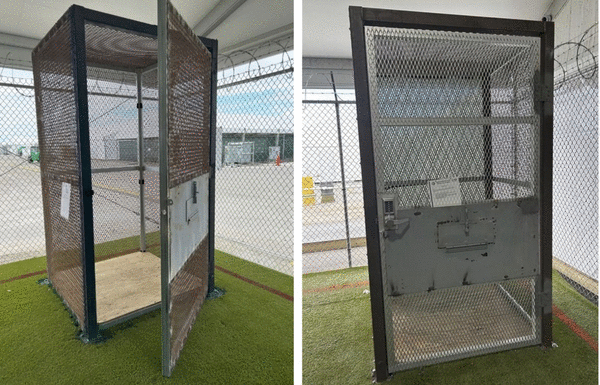
MIAMI — At a state-run detention facility known as Alligator Alcatraz, immigrant detainees had different names for the roughly 4 feet by 4 feet cages in which officers left men shackled for hours in the Florida Everglades.
The punishment cell. A dog cage. The punishment box. Lawyers called them the sun cages.
But outside the compound, Gov. Ron DeSantis’ office called claims of mistreatment “fabrications,” and the Department of Homeland Security said they were a “hoax.” No detainees were being punished, officials said, and the small boxes didn’t exist.
On Monday, the Department of Homeland Security’s Office of the Inspector General released a report from a surprise inspection in January that included the first photos of two cages roughly the same size as a porta potty. The facility closed permanently in June.
Detention center staff insisted it was a “calming area,” according to the report. The doors weren’t locked, the men weren’t shackled, and detainees could leave at any time. Some detainees even asked to be placed in them, they said.
“They’re lying,” said Daikel Dumont Rodriguez, who said he was placed in a cage, shackled, for about six hours after protesting officers beating a young man. “It was a concentration camp. They mistreated people there.”
The Miami Herald interviewed nine men previously detained at the Florida Soft-Sided Facility, dubbed “Alligator Alcatraz” by officials, and a lawyer for a tenth. Four detainees say they were locked in one of the cages as a punishment. Others say they saw the cages, as well as beatings and other forms of punishment.
Their testimony directly contradicts what the governor’s office has been saying for over a year – as well as statements officers provided to the Inspector General’s Office investigators in January.
The men described a system of cages across the facility, in which detainees were routinely locked as a form of punishment, often while shackled. They said some men were confined there for as long as 15 hours. While the report only described two “boxes,” they insisted that there had been more of the same size around the facility.
In a photo released by the Inspector General’s Office, the cage appears to be under a tent. Several men said that the cages were previously in direct sunlight before officers moved them.
“They don’t take the handcuffs off when you move to that section—the ‘box,’” said Walter Contreras, 24, who said he was locked in the cage twice. “They don’t remove them because their goal is to keep you subdued the whole time—you know, tormented.”
Some called it a form of torture, others said the whole experience of being in Alligator Alcatraz was “psychological torture.” It left them with paranoia and an inability to sleep. One man said he developed a stutter.
They said there was also a Special Housing Unit, in which some of them were left in slightly bigger cages for as long as a month, often without access to recreation or the bathroom for long periods of time. Some men were forced to relieve themselves in their cages. They referred to it as the “SHU.”
In December 2025, non-profit Amnesty International wrote in a report that confining men in small cages exposed to the elements could constitute torture under international law. “None of these fabrications are true,” said Molly Best, the governor’s press secretary, at the time.
All the men who spoke with the Herald said they witnessed officers beating detainees.
While the inspector general’s report concluded that the center complied with use-of-force standards, inspectors do not note if they reviewed incident reports. The Herald submitted a request in March for all use-of-force incidents at the facility from ICE, but the agency said it had none and referred reporters to the Florida Division of Emergency Management. That office has not responded to a request for documents.
Raimer Rodriguez, a 36-year-old Cuban immigrant, said he was beaten after detainees protested phones being disconnected on April 2. His wrist was fractured – and he said he was placed in the SHU with his injuries, screaming in pain for almost 44 minutes before being checked on by a nurse.
Seven days later, U.S. Rep. Debbie Wasserman Schultz visited the facility and asked ICE and the Florida Division of Emergency Management about the reports of other small cages.
“They explicitly denied the existence or use of the cages,” a spokesperson for her office told the Herald.
On Thursday, in response to a list of nine questions about the use of cages and punishment at Alligator Alcatraz, a spokesperson for DHS said: “These claims that there were ‘inhumane’ conditions at Alligator Alcatraz are categorically false.”
“Alligator Alcatraz was consistent with the same federal detention standards employed by previous administrations, including Biden and Obama,” read the emailed statement. “All detainee facilities are clean, and any allegations of inhumane conditions or excessive use of force are FALSE.”
After the Inspector General’s Office published its report Monday, DeSantis’ spokesman acknowledged for the first time that it had used small cages as “a confinement area for violent criminal aliens who have proven they cannot remain peaceful while awaiting deportation.”
“While it adheres to all federal standards for criminal confinement,” said Alex Lanfranconi, the governor’s head of communications, “we’d make it even smaller if we could.”
‘Let’s call it what it is: a dog cage.’
The makeshift tents were constructed in eight days. In total, there were eight housing tents, with rows of cages each holding 32 men stacked in bunk beds around a row of three toilets. The first four were labeled Alpha 1-4; the next set, Beta 1-4. The small cages were described as being in the recreation yard, or directly outside. The SHU was in another tent.
Alligator Alcatraz officially opened on July 1. Just three weeks later, the first report of the “box” was published by WLRN. A man from Nicaragua said he had been made to stand in it shackled for hours.
Not long after, Rebecca Sharpless, director of the Immigration Clinic at the University of Miami, heard a similar account from a young man shackled in the box.
“I have known many people who’ve been detained who have been the victims of excessive force, but I have never heard of a small box or cage being used in this way ever in the United States,” said Sharpless.
Alligator Alcatraz – a nickname coined by Florida Attorney General James Uthmeier, who first proposed the facility – was unlike any immigration detention center before it.
It was run by the state of Florida under the federal government’s 287(g) program, which allows local and state authorities to perform certain functions of ICE. Because it was never clear under whose jurisdiction the detainees fell, officers told inspectors in January 2025 that they did not know what standards of humane treatment to follow.
Asked about the report at a press conference on Thursday, Uthmeier said he had not read it.
“This sounds like more fake news activities,” he said.
It’s unclear at what point DHS officials received the results of the inspection, in which the Inspector General’s Office advised they immediately cease using any such cages. They documented 79 men held in the cage for periods ranging from minutes to two hours. While staff said men asked to be in there, one man was recorded as having “failed to comply with a lawful command,” according to the report.
“The use of such restrictive spaces is highly unconventional and does not align with standards for humane treatment,” investigators wrote.
A DHS spokesperson told the Herald in April that the facility met federal standards – months after it was inspected by the federal watchdog.
In the only response the Inspector General’s Office appears to have received, David J. Venturella, recently appointed the acting director of ICE, and Brian J. Cavanaugh, the under secretary for management at DHS, said that oversight of the detainees and their care was not in their jurisdiction. Instead, they argued, that fell to the state of Florida.
Stories of “the box” span the entire year of the facility’s lifespan – from July 2025 when it opened, to this spring months after the inspector general’s inspection.
Contreras, who came to the U.S. from Nicaragua to seek asylum in 2024, told the Herald he was detained at a check-in he had in Miramar this fall. When he first arrived at Alligator Alcatraz in March, the water had larvae in it. Men protested and were met with pepper spray, he said.
He said detainees launched a hunger strike — which DHS has also denied happened — and officers who thought he was an instigator put him in the box for about six hours.
“They’d douse you with pepper spray. They’d beat you if they had to,” he said. “And after that, they’d put you in there for six hours. Eight hours.”
He said he was then placed in the SHU for a month, where men were left without access to a bathroom so long that some relieved themselves in their cells. On another occasion, when detainees were protesting disconnected phone lines, he said he was again put in the box. He knew that congressional representatives were visiting, but nothing changed.
“This was a prison designed to psychologically break people so they’d leave,” he said.
Daikel Dumont Rodriguez, on a call this week from Krome North Service Processing Center, said that he was left in the box in shackles for about six hours after protesting a man being beaten by guards.
“They’d put you there temporarily—for four, five, or six hours—out in the sun. Sometimes they’d leave you there all night long,” he said.
The inspector general’s report noted that some men were kept in a Special Medical Unit, or SMU, as a punishment – in cages the same size as those described by some of the men as being in the SHU.
Five other men said they saw the small outdoor cages while they were there, but were never placed in one.
A 39-year-old asylum seeker from Venezuela said he saw men thrown in them for “arguing about human rights” with officers. He said all the cages were like animal cages, for parrots or dogs.
“There were people who would get desperate,” he said. “Don’t think it’s easy being stuck in a dog cage—because let’s call it what it is: a dog cage. An animal cage.”
A 55-year-old man from Colombia, who asked to only be identified by his first name Fabian for fear of retribution, spent a month and a half in detention at Alligator Alcatraz, before he was ultimately transferred to California, released, and came back to Miami.
He asked a cellmate who was put in the cage how he could sleep in the box. The man said he would lay in a fetal position – or sleep sitting up.
“There was no other way for you, inside, to get any rest while enduring that kind of torture,” said Fabian.
In March, Italo Moya arrived at Alligator Alcatraz, and said he spent three weeks in the facility. He said a young man was beaten. The water was dirty. They were given other men’s dirty clothes to change into, he said, including sometimes soiled or bloody underwear. And the cages in the recreation yard terrified him.
“It was always there,” he said. “I was terrified of that cage, terrified. The constant pressure that they made us feel, it was horrible. Truly I would not wish it on anyone.”
He described being kept in a dark room before he was to be transferred, where the only light entering came from the door where the officer stood. A man across from him said he was being held there as a punishment, but didn’t know why. An officer from Venezuela told him she was quitting, because she couldn’t bear to see how “cruelly” people were treated, he said. Moya was pursuing asylum, and says he was wrongfully deported to Chile, leaving behind his son and wife. He developed a stutter after his time in detention, and has constant nightmares.
“I can still hear the chains they used to rattle at night to keep us from sleeping,” he said.
His father was a pastor, and in Chile – and then later in Orlando – he sang in a church. Sometimes, while in Alligator Alcatraz, he would pray and sing to calm down his cellmates, mostly Christian hymns. Officers tried to move him to another cell, but the other men begged them not to, saying his song and prayer put their minds at ease.
“Your faithfulness is great, your faithfulness is incomparable,” he sang into the cages. “No one is like you, blessed God.”
©2026 Miami Herald. Visit at miamiherald.com. Distributed by Tribune Content Agency, LLC.






Comments