University of Michigan Chinese researcher questioned by feds before suicide, police report shows
Published in News & Features
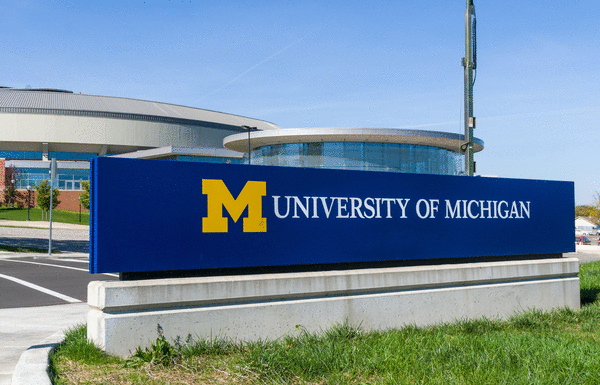
DETROIT — The U.S. Department of Homeland Security questioned a Chinese University of Michigan researcher one day before he committed suicide in March, according to a campus police report released Thursday to The Detroit News.
The report by UM Division of Public Safety & Security officers detailed how on the morning of March 18, two DHS officers spoke with Danhao Wang, a 31-year-old electrical and computer engineering research assistant outside the home he was renting in Ann Arbor. The two agents and their titles were redacted in the police report.
One of the Homeland Security agents told UM's public safety division she offered to end the interview and set up a follow-up interview with Wang because of how cold it was outside. She said Wang wanted to talk, and they continued their conversation at a local coffee shop that Wang drove separately to.
The interview lasted about a half hour, and Wang left on his accord, the Homeland Security agent said. Wang offered to answer any future questions the agents had.
What the agents and Wang talked about was not included in the police report. A message was left with the U.S. Department of Homeland Security seeking comment.
The next day, Wang met with an attorney from 9 a.m. to 11:30 a.m., according to the police report. At 1:05 p.m., Wang's license plate is read by a UM public safety plate reader in a university parking lot. What happened that afternoon is unclear in the police report, but at about 10:50 p.m., Wang arrived at UM's George G. Brown Building where he fell over the third floor balcony to the second floor.
Emergency services were then called, and Wang was taken to the Michigan Medicine emergency department. Police interviewed several witnesses, one of whom appeared to be close to Wang and to whom he was speaking before he fell.
The witness said when Wang arrived at the George G. Brown Building, he looked "weird." The witness said Wang didn't look like himself, and his eyes were red.
The witness said Wang said he was questioned by DHS and then spoke with a lawyer, who told him it was "nothing serious." The witness told police about starting to ask Wang about a research paper when "Wang ran and jumped over the glass railing on the third floor onto the second floor," the report said.
His autopsy report revealed Wang died from blunt force injury to the head, neck and lower extremities. The police investigation cited in the autopsy said a co-worker saw Wang arguing with someone on the phone late in the evening of March 19. The police report clarified that Wang was talking to someone before he fell.
Chinese officials call for investigation
Wang's death came over a year into a crackdown by President Donald Trump's administration on foreign influence at U.S. universities. UM came under particular scrutiny for misreporting the amount of money it received from the Chinese government, and at least five university students from China were charged by federal authorities with smuggling biological material into the U.S. and lying about it.
Officials with the Chinese Consulate in Chicago and the country's Ministry of Foreign Affairs released statements on X in late March about the researcher and the events that led to his death. The officials claim he took his own life after harassment and interrogation from U.S. officials about his work with the university.
Messages were left with consulate and the Chinese Embassy.
"For some time now, the U.S. has overstretched the concept of national security for political manipulation and groundlessly interrogated and harassed Chinese students and scholars," the Chinese Consulate in Chicago said on X. "These moves infringe on Chinese citizens’ legitimate and lawful rights and interests, poison the atmosphere of people-to-people and cultural exchanges between China and the U.S., and create a serious chilling effect."
The post called on the U.S. to "carry out a full investigation, give the family of the victim and the Chinese side a responsible explanation, stop any discriminatory law enforcement targeting Chinese students and scholars in the U.S., and stop imposing wrongful convictions."
'Promising and brilliant young mind'
Dean of Engineering Karen Thole told the university's College of Electrical and Computer Science staff, faculty and students about Wang's death in an email March 23.
"Dr. Wang was a promising and brilliant young mind, whose research into wide bandgap III-nitride semiconductor materials and devices published in Nature stands as a landmark, uncovering for the first time the switching and charge compensation mechanisms of emerging ferroelectric nitrides," Thole said. "His loss is felt deeply not only by those who knew him here at the University, but also everyone who understands his potential to have contributed to breakthroughs in science that would have positively impacted people around the world."
Assistant Vice President for Communications Paul Corliss said in an April email the university did not typically release "broad, campuswide communications" when an employee dies. Instead, Corliss said, communication is "directed to those most directly impacted, ensuring colleagues and close community members receive appropriate information and support."
_____
©2026 The Detroit News. Visit detroitnews.com. Distributed by Tribune Content Agency, LLC.





Comments