'Broadview Six' lawyers demand communications between US attorney's office and DC
Published in News & Features
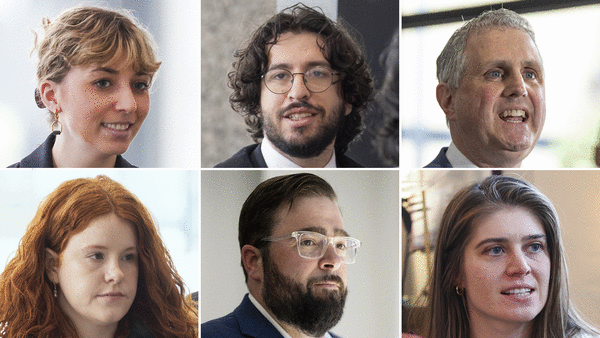
CHICAGO — Lawyers for the “Broadview Six” are urging a federal judge to order the Chicago U.S. attorney’s office to divulge any communications with officials in Washington about the controversial case, saying in a filing late Tuesday that saying responses so far have been a “clever, subjective escape hatch” from candor and transparency.
In the 61-page filing, the attorneys pointed to allegedly evasive answers from U.S. Attorney Andrew Boutros‘ office about any direction taken from Department of Justice officials when it came to bringing the charges, which collapsed in spectacular fashion in May amid allegations of prosecutorial misconduct.
The filing highlighted a recent email exchange with the top prosecutor Boutros appointed to help stave off the controversy that the defense said parsed words, saying the “front office” was not aware of any communications “in which it took direction” from anyone higher up the food chain.
The filing also called into question Boutros’ claim that he was emailed a a transcript of grand jury proceedings in October 2025 after his team had failed to secure an indictment, but that he was “quite certain” he’d never opened it.
“The fairly stunning disclosure that the U.S. Attorney himself was directly sent a presumably expedited copy of the October 9, 2025, grand jury transcript, coupled with the questionable hearsay assertion that he does not think he read it, cry out for further inquiry,” the filing stated.
The filing, which had been twice delayed by extensions and came in minutes before the midnight deadline, means the issues have finally been fully briefed nearly four months after the Broadview case melted down just a few days before trial.
That means U.S. District Judge April Perry could soon decide what, if any, relief to grant to the former defendants, who have asked for a hearing on potential sanctions as well as the possible appointment of special counsel to pursue contempt charges.
Whether Perry will make her ruling in writing or call for a hearing with arguments from the parties remains to be seen.
If Perry does go forward with public hearings, it would escalate the already unprecedented turmoil for Chicago’s storied U.S. attorney’s office, with high-level staff members, including potentially Boutros himself, being forced to answer questions under oath about their actions in the Broadview case.
Attorneys for the Broadview Six have believed since the get-go that the decision to indict the group of local Democratic activists — including then-Congressional candidate Katherine “Kat” Abughazaleh — for allegedly impeding an Immigration and Customs Enforcement agent’s vehicle during a Sept. 26, 2025 protest was politically motivated amid pressure from President Donald Trump’s administration to make an example of them.
Those beliefs have only been reinforced, the filing Tuesday said, by revelations that Aakash Singh, a top deputy for then-acting U.S. Attorney Todd Blanche, had a vested interest in the case. The filing pointed specifically to a Sept. 26, 2025, social media post by a top supporter of Singh’s that said: “Dear Chicago U.S. Attorney Andrew Boutros… where are the arrests of Kat Abughazaleh and others?”
“The record already shows that those within the Trump Administration and those closely aligned with it, including to Mr. Singh himself, specifically called for the prosecution of Ms. Abughazaleh for her involvement in protesting ICE at Broadview.
Boutros, who was first appointed in March 2025 by then-U.S. Attorney General Pam Bondi, has publicly denied bringing any cases for political reasons.
In a filing explaining their position last month, prosecutors said that while mistakes were made, corrective measures have since been taken and there is no evidence of vindictive prosecution that would warrant further hearings or sanctions.
“This case involved irregularities during a time of immense pressure, upheaval, and emotion in the district because of Operation Midway Blitz,” prosecutors said in the motion, which detailed how the office has already been publicly rebuked by the court and had experienced prosecutors put under intense “public and private scrutiny.”
The filing said “robust root-cause changes” have been implemented involving the handling of grand jury matters, including an ongoing review of minutes from as many as 1,000 grand jury proceedings dating back to 2007.
In a rare mea culpa, the U.S. attorney’s office also acknowledged in the filing that it could have been more candid with Perry when it came to redacting large portions of the grand jury transcripts handed over in the Broadview case.
Those redactions ultimately revealed what Perry described as blatant misconduct by the lead prosecutor — and a failing of the “presumption of regularity” that normally exists between the court and the government.
While defense attorneys have asked for a hearing on sanctions and the appointment of special counsel to look into possible contempt charges, the U.S. attorney’s office said in the filing that the court’s message “has been clearly heard and there is no need to do more.”
“The Office has not taken lightly this Court’s statement about losing trust. It prompted the United States Attorney to personally address the Court,” the filing said. “… The Government’s various actions are a sincere effort to endeavor to restore the judiciary’s, defense bar’s, and public’s confidence in the Office’s grand jury and other practices and proceedings.”
The filing by Boutros’ office did contain a footnote saying there was a “virtual meeting” on Sept. 26 — the day of the Broadview incident — between U.S. Justice Department lawyers in Washington, D.C., the Chicago U.S. attorney’s office and other federal law enforcement agencies to discuss issues of violence against immigration officers. In that meeting, a video of the clash in Broadview was played, according to the filing.
“Moreover, as would be expected in the normal course, there were discussions between the Office and Main Justice regarding such things as case updates, especially given the publicity the case generated after it had been charged,” the prosecution filing stated. “These privileged discussions are not only permitted but are contemplated.”
The U.S. attorney’s office filing also revealed that five days after the first grand jury session in the Broadview case on Oct. 9 — which ended with a rare “no bill” from the panel — Boutros was emailed a transcript of the proceedings, indicating that it was being closely watched in the office. But the filing said Boutros was “quite certain” he didn’t review the transcript at the time.
On Oct. 16, two days after Boutros was emailed the copy, his prosecutors went back to the same grand jury to try again, leading to at least two skeptical jurors being kicked off the panel, including one who called the case “a crock of s—.” That session again ended without an indictment being filed.
The grand jury finally approved the indictment a week later on Oct. 23, a day that began with Boutros himself appearing before the panel to remind them of their constitutional duties.
In their filing, the attorneys for the Broadview Six also called for further inquiry into why the grand jury transcript redactions, which were approved by veteran prosecutor William Hogan, were made in the first place, and why Hogan allowed Perry to maintain the “false impression” that nothing of substance had been blacked out.
“Smoke does not always mean fire, but it is always a reason to look further,” the defense filing stated.
____
©2026 Chicago Tribune. Visit at chicagotribune.com. Distributed by Tribune Content Agency, LLC.




Comments