Maryland asks agencies to model 10% cuts amid $3.1B shortfall
Published in News & Features
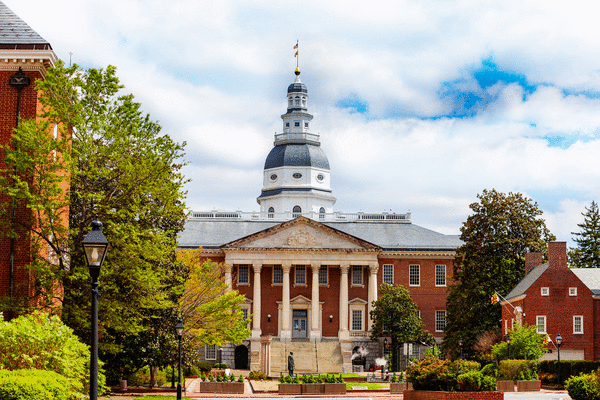
Maryland state agencies are being asked to prepare for potential budget cuts of up to 10% next year as Gov. Wes Moore’s administration looks for ways to close a projected $3.1 billion shortfall, which is nearly double the amount for fiscal 2027.
The Department of Budget and Management (DBM) asked all executive branch agencies and state colleges to submit budget proposals with a 10% reduction to their spending plans as administration officials and state lawmakers consider how to close the projected shortfall for fiscal year 2028, which begins next July. The request does not mean agencies will ultimately face 10% cuts; rather, it is intended to show the administration where reductions could be made as it develops the budget.
Maryland lawmakers are also considering tax and fee increases and changing local government authority as they confront the state’s budget pressures. State spending is projected to outpace revenue for the next five years, according to estimates from the Department of Legislative Services.
The choices Maryland makes, including whether to cut spending or raise revenue, could affect state services, household finances and the broader economy, economists said.
State law requires the governor to submit a balanced budget, and Moore’s office says the administration is focused on fiscal discipline.
“After inheriting long-standing structural budget challenges compounded by the Trump administration’s hits on Maryland’s economy, closing next year’s deficit will require a targeted look at where the state can save — and this analysis is part of that process,” Rhyan Lake, a spokesperson for the governor, said in a statement.
How big the potential cuts are
DBM told The Baltimore Sun that it has routinely asked agencies to identify potential 3% spending reductions as part of the budget process.
For fiscal 2028, the department instead asked agencies to model 10% reductions — a much larger target than in previous years — as the state confronts its fiscal pressures.
According to a copy of the memo obtained by The Sun, agency heads were required to provide information on how much they spend on operational costs and how cuts could affect staffing, grants the agency provides and the estimated impact on services and support provided to Maryland residents. Responses to DBM were due July 31, according to the memo.
“This approach will allow DBM to make targeted recommendations based on the impacts and analysis of agencies’ proposals,” DBM spokesperson Raquel Coombs said in an email to The Sun.
Coombs did not respond by print publication to questions about how the department determined the 3% reduction target or which agencies had submitted responses.
All agencies financed by Maryland’s general fund are subject to the memo’s requirements. The Maryland departments of Health, Transportation, Human Services, Education, and Public Safety and Correctional Services accounted for some of the largest shares of state spending in fiscal 2027.
What economists are saying
Economists said the effects of potential budget cuts will depend largely on where reductions are made.
Daraius Irani, vice president of business and public engagement at Towson University, said reducing spending, along with raising revenue and growing the economy, could help the state address its fiscal challenges. He said the administration’s approach will likely involve identifying areas where spending can be reduced without cutting essential services.
“[For] some agencies, they may say, ‘This is really something that is maybe more of a want and not a need,'” Irani said.
Anirban Basu, CEO of Sage Policy Group, warned that low-income residents could lose access to healthcare, food and education assistance when the government spends less on those priorities. Basu said the state also needs to find ways to attract private investment and expand its tax base to generate additional revenue.
“The state could substantially reduce its corporate tax rate, make the state more plentiful private investment, grow its tax base along its employment base, collect more in taxes, and therefore begin to grow government once again,” Basu said.
Kali Schumitz, vice president for external relations at the Maryland Center on Economic Policy, offered public schools as one example, saying a 10% funding cut could mean hundreds of teachers being laid off, larger class sizes and cuts to art and music classes, with potential long-term effects on the economy and the state’s fiscal health.
A 10% cut to office supplies, by comparison, could worsen working conditions for state employees and affect recruitment and retention, she said, but would be less visible to Marylanders and represent a smaller reduction in dollars.
________
©2026 The Baltimore Sun. Visit at baltimoresun.com. Distributed by Tribune Content Agency, LLC.



Comments