Maduro's financial front man pleads guilty in Miami federal court, agrees to cooperate
Published in News & Features
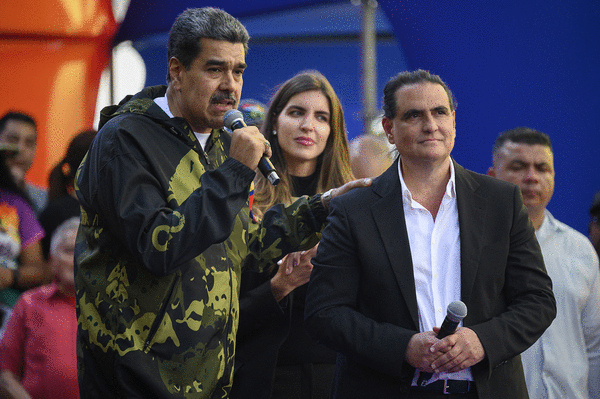
MIAMI — Alex Saab, the longtime business partner and alleged financial front man for Nicolás Maduro, pleaded guilty Tuesday to federal money-laundering conspiracy and agreed to cooperate with U.S. authorities, potentially giving prosecutors a powerful witness with intimate knowledge of the former Venezuelan ruler’s financial operations.
Under a plea agreement disclosed during a hearing in Miami federal court, Saab agreed to submit to debriefings by prosecutors and federal agents, provide truthful information and testify if called. If the government determines that his assistance is substantial, prosecutors can ask for a reduction in his eventual sentence.
The agreement could have implications far beyond the criminal case against Saab, who for years operated at the intersection of Maduro’s government and the clandestine international financial networks that helped Caracas move money, obtain food and sell oil in defiance of the sanctions imposed by Washington.
Analysts who have followed Saab’s relationship with Maduro have said his testimony could be particularly damaging if prosecutors call him as a witness at Maduro’s narcoterrorism trial in New York. Saab had extensive dealings with the Venezuelan government and has been described as Maduro’s partner and financial front man, potentially putting him in a position to provide firsthand information about transactions, intermediaries and relationships involving the former president.
Nothing in the plea agreement disclosed Tuesday specifically requires Saab to cooperate in Maduro’s prosecution, however, and neither Maduro nor his New York case was mentioned during the hearing. The agreement broadly requires Saab to cooperate with prosecutors and testify when requested.
Saab, appearing with a Spanish interpreter before U.S. District Judge Kathleen M. Williams, admitted guilt to one count of conspiracy to launder monetary instruments, a felony carrying a maximum sentence of 20 years in prison.
His plea also included significant admissions about his own role in the operation.
For sentencing purposes, Saab and prosecutors agreed that the conspiracy involved at least $195 million and that he was a leader or organizer of criminal activity involving more than five participants. The agreement also calls for sentencing enhancements because the offense involved what federal guidelines describe as sophisticated money laundering.
Saab agreed to a $195 million forfeiture judgment and to surrender additional property identified in a separate factual statement. He must also provide the government with a financial disclosure within 14 days and help authorities identify and recover assets subject to forfeiture.
The potential reach of his cooperation remains unclear. But prosecutors disclosed during Tuesday’s hearing that the names of four other defendants charged in the conspiracy remain under seal.
Saab has been given an unredacted copy of the indictment identifying those defendants and therefore knows who they are, a prosecutor told Williams. The government asked the judge to continue referring to them only as sealed defendants during the public hearing because their cases remain secret.
The guilty plea marks another remarkable turn in Saab’s dealings with the United States.
He was extradited from Cape Verde to Miami in 2021 to face an earlier money-laundering prosecution. He remained in U.S. custody until December 2023, when President Joe Biden granted him clemency as part of a prisoner exchange with Caracas. Saab was flown back to Venezuela, where Maduro’s regime publicly celebrated his return after spending years portraying him as a diplomat illegally detained by Washington.
Less than three years later, Saab was back in the same federal courthouse — this time admitting that he participated in a money-laundering conspiracy and promising to cooperate with U.S. investigators.
Venezuelan authorities deported him to the United States on May 16 amid a dramatically changed relationship between Caracas and Washington. Two days later, he made his initial appearance in the new case in Miami federal court.
The latest prosecution goes beyond the allegations in Saab’s first U.S. case, describing what federal investigators say was an evolving financial operation that began with Venezuela’s food-subsidy program and later expanded into oil trading as U.S. sanctions squeezed the country’s most important source of revenue.
According to the indictment, Saab and his associates began the conspiracy around October 2015 by bribing Venezuelan officials to secure lucrative contracts connected to the Comité Local de Abastecimiento y Producción, known as CLAP, which distributed subsidized food during Venezuela’s deepening economic crisis.
Prosecutors say the conspirators used shell companies, fraudulent invoices, falsified shipping records and other fabricated documents to divert hundreds of millions of dollars intended to buy food for vulnerable Venezuelans. Some of the proceeds were moved through U.S. bank accounts.
The operation evolved as Washington tightened sanctions against Venezuela, prosecutors say.
Beginning in 2019, Saab and his associates allegedly used their access and influence with Venezuelan officials to obtain billions of dollars worth of crude belonging to state oil company Petróleos de Venezuela S.A., or PDVSA, and sell it under false pretenses. Proceeds from those transactions were then moved to and through U.S. bank accounts to promote and conceal the underlying CLAP operation, according to the indictment.
The allegations connect two chapters of Venezuela’s economic crisis: corruption surrounding a government program intended to provide subsidized food to millions of people and the opaque oil-trading networks that emerged as sanctions increasingly isolated PDVSA from conventional markets.
Saab confirmed Tuesday that he had reviewed a seven-page factual proffer detailing his role in the crime. He told Williams that the document was accurate and that prosecutors could prove those facts beyond a reasonable doubt if the case went to trial.
Williams also asked Saab whether anyone had threatened or coerced him into changing his plea.
“No, Your Honor,” he answered.
“You wish to plead guilty, sir, of your own free will because you are in fact guilty,” Williams said.
“That is correct, Your Honor,” Saab responded.
Later, after reviewing the rights he would surrender by abandoning his earlier not-guilty plea, Williams asked Saab directly how he wished to plead.
“Guilty,” he said.
Williams found that Saab was competent, that his decision was knowing and voluntary and that there was an independent factual basis for the plea. She then formally adjudicated him guilty.
The government has agreed to recommend a three-level reduction in Saab’s sentencing calculation for accepting responsibility and to recommend a sentence at the low end of the eventual federal guideline range. Those commitments can be withdrawn if Saab is untruthful with investigators or probation officials, commits another crime or otherwise violates the agreement.
How much prison time Saab ultimately faces remains uncertain. The final guideline range will depend on his criminal history and other calculations in a presentence report that has not yet been prepared. Williams stressed that the sentencing guidelines are advisory and that she will determine his sentence later.
His cooperation could become particularly important to that calculation. The agreement leaves it entirely to prosecutors to determine whether Saab provides “substantial assistance.” If they conclude that he does, the government can ask Williams to reduce his sentence further. The judge would not be required to grant the request.
Saab’s relationship with Maduro has long been central to his importance to both Washington and Caracas.
U.S. authorities have portrayed him as a financial operator who used a complicated network of companies and international transactions to help Maduro’s regime conduct business and move money despite sanctions. Venezuela portrayed him as a diplomat persecuted because he helped the country circumvent what Caracas called an illegal economic blockade.
That dispute dominated Saab’s first prosecution after his June 2020 arrest in Cape Verde, where his plane had stopped to refuel while traveling to Iran. His lawyers argued that he was traveling as a Venezuelan diplomat and was therefore immune from prosecution.
The case never reached trial because of Biden’s 2023 clemency decision.
Now Saab’s relationship with the U.S. government has been reversed.
The government’s ability to compel him to testify could be especially significant because of his proximity to Maduro and his knowledge of Venezuela’s international financial dealings. But precisely what Saab has already told investigators — or what cases prosecutors may ask him to assist with — remains undisclosed.
His cooperation agreement could eventually provide the answer.
Saab’s sentencing is expected in mid-January. Williams directed prosecutors and defense attorneys Tuesday to submit three mutually available dates within 24 hours so the court can set the hearing and the probation office can begin preparing its presentence report.
_____
©2026 Miami Herald. Visit miamiherald.com. Distributed by Tribune Content Agency, LLC.





Comments