Massachusetts' Supreme Judicial Court reprimands Judge Shelley Joseph for 2018 courtroom ICE escape
Published in News & Features
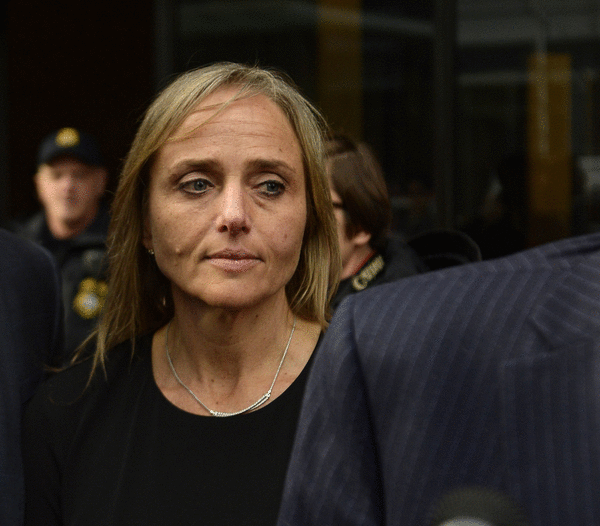
BOSTON — Massachusetts’ highest court has issued a public reprimand of state district court Judge Shelley Joseph for her part in the escape from the courthouse of a suspect wanted by ICE in 2018.
“We also acknowledge that the respondent’s conduct here was less severe than other judicial conduct for which we have issued a public reprimand or censure,” the Supreme Judicial Court added. “However, given the public nature of the proceedings against the respondent, and to ensure that there is no misunderstanding as to what she is — and is not — being reprimanded for, we conclude that the respondent should be publicly reprimanded.”
The reprimand represents an end to the legal quagmire that saw Joseph brought up on federal obstruction of justice charges during President Trump’s first term. Those charges were dropped in September 2022 after Joseph agreed to face a state judicial misconduct investigation for her actions.
On Thursday, the SJC issued the public reprimand recommended by both its own hearing officer and the state Commission on Judicial Conduct in that Joseph’s conduct “created the appearance of impropriety and failed to comply with the law.”
Joseph currently serves as a Boston Municipal Court judge at an annual salary of $207,855, according to state payroll records.
The Commission in November of last year charged Joseph with five judicial conduct violations for allegedly helping the escape of Jose Medina-Perez, a twice-deported Dominican national who appeared on April 2, 2018 in her Newton District courtroom to face state drug and fugitive from justice charges while being sought by U.S. Immigration and Customs Enforcement (ICE) based on an 8-year-old warrant out of Pennsylvania.
Joseph’s attorney argued at the commission hearing that the case had come to be distorted, with many believing that Joseph had personally “let an illegal immigrant out of the door” when that was not in fact the case, according to the findings.
Joseph had only five months on the bench and was the only judge in the courthouse during the hearing, where an ICE agent in plain clothes was waiting to take custody of the suspect after the hearing. The Commission on Judicial Conduct hearing officer concluded following his review that the “new and inexperienced judge” did not know a number of legal things she should have.
“I find that Judge Joseph did not know about — much less authorize — the escape plan, and did not mislead court authorities following the incident,” hearing officer Denis McInerney wrote in his report at the time.
McInerney did find, however, that Joseph “inadvertently created the appearance of impropriety and bias.”
The hearing
According to the SJC’s summary of events, neither prosecutor Shannon Jurgens nor defense attorney David Jellinek believed that Medina-Perez was the actual person sought by the Pennsylvania warrant. While the prosecutor suggested that they continue the case to allow the defense attorney more time to research this and work with ICE on the matter, Jellinek allegedly had different ideas.
After first approaching the ICE agent about the identity problem and getting nowhere, according to the SJC summary, Jellinek hatched a plan to have his client escape through a rear door of the courthouse before the agent could intercept him.
Jellinek asked for a sidebar, and Joseph granted it. Over the course of roughly two minutes, which about half was off-the-record against rules Joseph apparently didn’t know, the judge, Jurgens, and Jellinek discussed the ICE situation, but all witnesses other than Jellinek suggested that he did not make this plan clear.
“(T)he hearing officer found that, during the off-the-record portion of the sidebar, Jellinek did not explicitly state or implicitly suggest that Medina-Perez would be let out the sallyport exit in order to evade the ICE officer, and (Judge Joseph) did not, either explicitly or implicitly, approve of such a plan,” the SJC wrote.
Jurgens during the CJC hearing, the SJC wrote, “expressed discomfort with the sidebar discussion, describing it as ‘weird or sketchy,’ and she characterized (Joseph)’s behavior during the proceeding as a ‘misguided attempt … to do what she thought was right.’”
_____
©2026 MediaNews Group, Inc. Visit at bostonherald.com. Distributed by Tribune Content Agency, LLC.






Comments