Long-sought 9/11 toxin documents show NYC knew within weeks how dangerous the air was
Published in News & Features
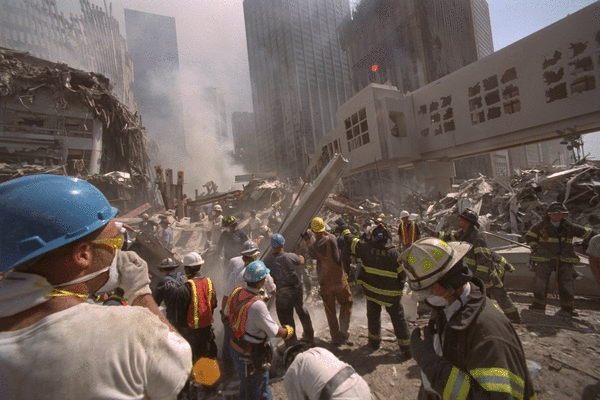
NEW YORK — Long-sought pivotal documents about the toxins swirling around ground zero after 9/11 were released to the general public Tuesday, showing NYC officials knew within weeks of the towers’ collapse that the air quality in lower Manhattan was hazardous to those living there and who responded to the terror attacks 25 years ago.
“There are clear indications (that the city) knew there was problem with air quality,” City Corporation Counsel Steven Banks said Monday in a press briefing ahead of the documents release via an online portal. “City officials knew there was a problem with the air quality and there are records that demonstrate that and have not been released for years.”
Not only did the city know about the dangers, but within three months of the attack the city had collected, scanned and archived documents pertaining to the terror attack and the aftermath, including records about air quality — documents that have become the centerpiece in a long-running battle. Those documents were then sent to an insurance company called Captive for safe keeping in case of any potential litigation, Banks said.
Sending the documents to Captive gave the city cover to argue they didn’t have the documents when responding to Freedom of Information requests.
The “missing” air quality reports were potentially critical pieces of information as people who lived and worked around ground zero became ill. An estimated 6,000 first responders, survivors and volunteers have died of a 9/11-related illness over the last two and a half decades — double the number who died in the initial terror attack. More than 145,000 people have enrolled in the World Trade Center Health Program. Out of that number, about 81,000 have a certified medical condition linked to the toxins that hung above ground zero.
The opening of the online portal comes four days before the city marks the 25th anniversary of the Sept. 11 terror attacks and three years to the day when 9/11 Health Watch submitted a Freedom of Information Law request to the Adams administration for the documents. The city’s claims that they had no documents to share led to a lawsuit filed by Benjamin Chevat, the executive director of 9/11 Health Watch and his attorneys Andrew Carboy and Matthew McCauley. That lawsuit was settled Tuesday.
About 170,000 of the documents were set to be released publicly through the online portal Tuesday. Most of them will be the hard copy documents found in 68 boxes in the city’s Department of Environmental Protection that were discovered as the city battled 9/11 Health Watch’s lawsuit.
The documents indicate that city agencies were still finding evidence of asbestos in lower Manhattan within 10 months after the terror attack — long after Mayor Giuliani and federal officials said that the air quality around ground zero was safe, according to the New York Times.
More documents will be coming now that the city has recovered them from Captive, Banks said.
While applauding the “fresh commitment to transparency” by Banks and the Mamdani administration, Carboy said the “city’s reversal is no reason for celebration.”
“The September 11th community expects the government to obey the law, and not willfully defy it for a quarter century,” Carboy said. “Our lawsuit demonstrated city staffers behaved more like members of an authoritarian regime than public servants.”
“Career officials ‘forcibly disappeared’ the archive, resisting its disclosure and denying its existence,” Carboy said. “Not even sitting members of the City Council or the U.S. Congress could access these records.”
The documents released Tuesday include the long sought-after “Harding Memo” written in October 2001 that proves the city was worried that thousands of first responders and survivors could potentially suffer from “toxic exposure” at ground zero. Additional documents will be added on a rolling basis in the coming months, Banks said.
“For too long, New Yorkers have had to fight for access to records that should have been available to them in the first place,” Mayor Mamdani said in a statement. “This portal is part of our administration’s enduring commitment to honor those we lost, care for those living with lasting health consequences and give thousands of New Yorkers the answer they’ve been asking for.”
As part of the settlement. the city will pay 9/11 Health Watch’s court costs, fully support the ongoing DOI investigation to find out what the city knew about the deadly toxins floating above the destroyed Twin Towers and improve access to records needed by those enrolled in the World Trade Center Health Program and September 11th Victim Compensation Fund — federal programs that provide health care and compensation for those with a 9/11 illness — to establish their presence at ground zero.
The city has also agreed to promote awareness and participation in the upcoming World Trade Center Health Program’s Youth Research Cohort, which will study illnesses that may have developed among those who were minors or in utero during the aftermath.
Chevat, Carboy and McCauley will be meeting with the city monthly for the next year to make sure that the portal is still producing the correct documents and fine tune the search parameters. If any disputes arise on how the documents are being disseminated, they have the right to bring their concerns to New York Civil Court Judge James Clynes, who will be able to reopen the case.
“For 25 years, four different Mayoral administrations kept from the public, the U.S. Congress, and the City Council documents showing what the city actually knew about the danger of the toxic chemicals in Lower Manhattan and Western Brooklyn after the World Trade Center collapse, even as city officials continued messaging to the public that the air was ‘safe and acceptable,'” Chevat said Tuesday. “I want to thank Mayor Mamdani for being the Mayor, after 25 years, who finally begins to answer the question, ‘What did the City know about the dangers from the toxic cloud at ground zero and when did it know it?'”
“It just shouldn’t be this hard,” McCauley said about the fight to get these pivotal documents. “(But) our team is formidable and backed by an unbeatable and relentless 9/11 Community. It is clear the city saw that and took the path that respects the community, rather than stonewalling it like previous administrations.”
----------
©2026 New York Daily News. Visit at nydailynews.com. Distributed by Tribune Content Agency, LLC.



Comments