Climate change is taking some of the shine out of Pure Michigan summer
Published in News & Features
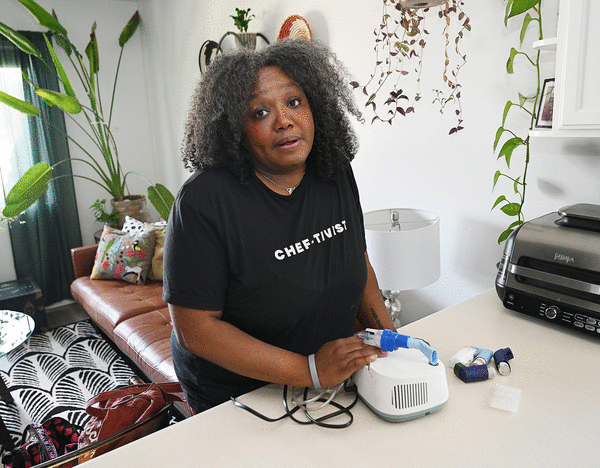
DETROIT — The mid-summer heat dome kept Oak Park resident Chi Walker stuck in her house, fearing the extreme temperatures would trigger her asthma and land her in the hospital.
Wildfire smoke that rained ash onto the Upper Peninsula city of Marquette turned the popular Blackrocks Brewery patio into "a ghost town" during what should have been a busy weekend in mid-July, brewery founder and "brewsician" Andy Langlois said.
The floodwaters that rose across Michigan's northern Lower Peninsula this spring never dropped outside of Shellie Watters' house on Lake Manuka near Gaylord. If the lake rises any higher, she could lose her home.
On Sept. 3, a severe storm swept through southern Michigan, causing power outages for 350,000 households, downed power lines, uprooted trees and widespread damage.
Hot temperatures, fires, powerful storms and flooding are hallmarks of a warming climate in the Great Lakes region, brought on by humans burning fossil fuels and releasing heat-trapping greenhouse gases into the atmosphere. With the rising temperatures come increasing tick populations, stronger storms that leave whole regions without power, thick clouds of smoke and lots of canceled plans.
Climate change is taking the shine out of "Pure Michigan" summer.
"It absolutely is a thing," said Walker, a Detroit-area chef, of global warming ruining her summers. Her severe asthma is triggered by heat waves and poor air quality.
"My quality of life is poorer because I literally cannot go outside," she said. "If I go outside, I stand a chance of having an asthma attack, which in some cases have been fatal. That's the reality of what I'm dealing with. You have to be able to breathe."
Summer weather has noticeably changed since Omar Gates' childhood growing up in Detroit. Gates, 35, is a climatologist with GLISA, the National Oceanic and Atmospheric Administration Great Lakes Regional Integrated Sciences and Assessment team. When he was an elementary school student, days over 90 degrees were rare compared to recent summers.
"It wouldn't be as consecutive compared to what we have today," Gates said of scorching summer weather. "Having those conditions with wildfire smoke, that wasn't too much of an issue in the '90s or early 2000s. It's something that now has become more relevant, especially with what's going on up north ... the drier conditions that can lead to the environments where wildfires unfortunately occur."
United Nations scientists recently concluded the Earth had warmed 1.4 degrees Celsius above preindustrial temperatures, the Associated Press reported on Sept. 2, which means warming will exceed what countries set as the "safe threshold" for temperature rise at the 2015 Paris Climate Accord. They warned humans' fossil fuel burning is setting the planet on a catastrophic course that will continue without major efforts to stop burning fossil fuels and suck carbon out of the atmosphere.
By the 2050s, Gates said climate models predict the region will have even more summer days above 90 degrees, more severe storms as well as changes to rainfall patterns that could lead to floods or droughts.
Gates is particularly concerned about increasing nighttime temperatures. The models show there will be more nights above 70 degrees, which means people without air conditioning won't be able to cool off, he said. That can lead to high blood pressure, dehydration and other health issues, according to the Mayo Clinic.
"That's something that can cause a lot of stress for people who don't have access to cooling centers or air conditioning," Gates said. "People who have that energy burden or inability to access cooler environments are at most risk."
'I'm almost afraid to leave the house'
Walker, of Oak Park, developed asthma when she was 30. She was living in Washington, D.C., at the time but moved home to Detroit a few years later, expecting the climate to be easier on her breathing.
Instead, her asthma symptoms have continued. She combats the illness with air purifiers and daily medications. She is cautious about avoiding asthma attacks, having spent days in the hospital recovering from previous attacks.
That's why she didn't go outside much the week of July 13, when the National Weather Service issued extreme heat warnings and advisories for communities across the state. Heat — like pollen, pollution and wildfire smoke — triggers Walker's asthma.
"When it gets extremely hot and humid and you combine that with the air pollution in the city, I was literally sitting here thinking the other day, 'am I going to have to move?'" Walker said. "It's incredibly difficult just to breathe."
Staying home to stay healthy and avoid the heat hurt Walker's finances. She is self-employed as a chef. She is the owner and founder of Wild Flower Hospitality and co-owner of pop-up restaurant Fried Chicken and Caviar.
Walker can't work if she can't go outside, and if she can't work, she can't buy locally sourced ingredients from nearby farms to serve to customers. She also can't hire chefs to help her prepare and serve meals.
"I want to be able to (support) other small businesses, be able to employ people," Walker said. "If I don't have the work, I can't hire people. There's many layers to this."
Lake Manuka
Watters, of Hayes Township near Gaylord, used to have a sand beach, a gently sloped lawn and an array of summertime flowers at her home on Lake Manuka.
That was last year. Now it's all water, a wet, swampy mess.
"Something has definitely changed," Watters said. "For 70 years, our house sat perfectly fine 200 yards away from the water. Now we can fish off our deck right out our front door."
The northern Lower Peninsula was inundated with water this spring when a downpour hit at the same time snowpack was melting. Dams and roadways were washed out and homes were soaked with water.
Lake Manuka is a spring-fed lake with no outlet, Watters said. It rose dramatically and hasn't receded, unlike other years when it reached a similar height because of flooding.
Watters and her husband, whose parents built the house in the late 1960s, have lived in the Hayes Township home since 1990. They run a sump pump to keep their crawlspace from flooding and can't get affordable flood insurance.
"If it comes higher it's very scary because, like I said, we'd lose our house and we would just be out the money and have to start from scratch at 60 years old," she said. "That is the fear. That's what keeps me up at night."
Warm air can hold more moisture, which can lead to heavier rain and snowfall. That's why climate change has brought stronger storms to the Great Lakes region, according to climate change models published by GLISA, which says the amount of precipitation falling in the heaviest 1% of storms increased by 36% in the U.S. Great Lakes region between the 30-year periods of 1951-80 and 1991-2020.
Blackrocks Brewery
Blackrocks Brewery's outdoor space has expanded significantly since the brewery opened in 2010. Outdoor seating now represents roughly two-thirds of the popular downtown business' overall seating capacity.
When two days of 100-degree Fahrenheit weather butted up against the unprecedented wildfire smoke that descended on the Great Lakes region in mid-July, it took that seating option off the table.
"It was kind of a lost week for us," Langlois said. "It was a ghost town. People were either staying home in the air conditioning or inside. It basically looked like a winter evening at our place."
The July wildfire smoke cost Michigan's economy approximately $4 billion, according to an analysis by the East Lansing-based Anderson Economic Group. Blackrocks Brewery's revenue for that week was down approximately 30%, Langlois and co-founder David Manson estimated.
"There’s always a concern when you have a pretty key earning time cut almost in half," Langlois said. "Even if it's only a week, you kind of build on all those weeks to carry you through."
Marquette businesses rely on summer revenue to make it through the rest of the year, they said. The heat and smoke came at an especially bad time, as it caused the Marquette Downtown Development Authority to cancel its Music on Third event, which typically draws a crowd.
In general, Marquette is gorgeous in the summer, Manson said. It's the envy of downstaters who suffer more frequent extreme heat and can't cool off with a dip in Lake Superior.
But he worries smoky, 100-degree days might become more common.
"It's almost like you have to plan for it. Is this the new normal?" Manson said. "Are we going to be looking at this again come June, July next year and for longer periods of time?"
©2026 The Detroit News. Visit detroitnews.com. Distributed by Tribune Content Agency, LLC.






Comments