Assateague added horse-safety measures. National Park Service says their effect remains unclear
Published in News & Features
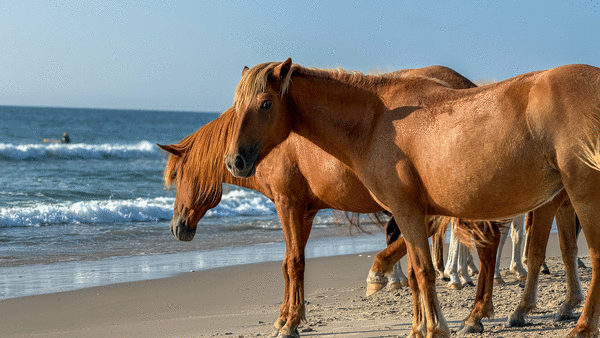
BALTIMORE — The deaths of two Assateague horses by vehicle strikes 12 days apart in August may have seemed sudden. But the danger posed by traffic to the island’s wild horses has been building for decades.
National Park Service records show that vehicles have killed 36 horses on Assateague since 1982. This summer, Dune Dancer Jolt and Susi Solé were killed, while a third horse, Miracle, was injured.
All three collisions occurred in clear weather during the late afternoon or evening, according to the NPS. No drivers were cited. The agency said there was “no evidence of high speeds,” noting that no airbags deployed in the crashes.
Records compiled by horse advocates show that visitors and park planners have raised concerns about traffic and the horses for years.
A visitor survey cited by NPS found that seeing horses was a primary reason for visiting Assateague for 80% of respondents. During public planning in 2009, commenters proposed separating horse-watching motorists from through traffic, creating small viewing pull-offs and enforcing no-stopping rules.
A 2012 NPS safety bulletin warned that feeding changes horses’ behavior and attracts them to roads, “increasing the risk of being injured or killed by a vehicle.” At the time, it said the average road death toll was one horse per year.
By 2016, the agency’s draft General Management Plan identified “pony jams” and motorists searching for parking as Assateague’s two main circulation problems. NPS said jams formed when horses entered roads or visitors stopped to watch them. The plan suggested that designated wildlife-viewing pull-offs might improve traffic flow.
NPS also received 268 pieces of correspondence during its 2016 review, filling 385 pages on issues ranging from wilderness and beach driving to ferries, hunting and visitor access.
In response to questions from The Baltimore Sun, NPS listed several actions. The agency created roadside pull-offs, installed two electronic speed signs and added horse-safety signs. Maryland placed speed bumps and no-stopping signs on the Route 611 causeway.
NPS lowered portions of Bayberry Drive to 15 mph in 2021, citing congestion and the mix of vehicles, pedestrians, bicycles and wildlife. Bayside Drive followed in 2023, primarily for bicyclist safety. The agency also created its Horse Management program in 2021.
Traffic increased considerably that year and remains much higher than before COVID, NPS said. It also recorded substantial growth during March, April, October and November — months outside the regular Horse Management patrol season.
Officials said they cannot determine how much the measures changed driver behavior or improved horse safety.
“It is unclear whether these are a net positive or negative, as they sometimes create their own traffic jams,” NPS said of the pull-offs.
The agency said it has no comprehensive data on pony jams or roadside stopping. Its internal 2026 handbook calls roadways “a low priority overall” for Horse Management staff. Regular patrols run from 9 a.m. to 4 p.m. between mid-May and mid-September. Major traffic jams are assigned to law-enforcement rangers.
NPS is now evaluating nighttime speed restrictions and additional traffic-calming measures. As for pony jams and roadside stopping, the agency said, “anecdotally we believe that there has been very little change.”
_____
©2026 The Baltimore Sun. Visit at baltimoresun.com. Distributed by Tribune Content Agency, LLC.





Comments