Lindsay Clancy jury can't agree, mistrial risk deepens
Published in News & Features
PLYMOUTH, Mass. — For the second day in a row, jurors in the Lindsay Clancy triple murder trial told the judge in the case they couldn’t come to a consensus.
Despite the notes, jurors will return to Plymouth County Superior Court Thursday morning to continue their deliberations.
Just after the lunch break Wednesday, around 2 p.m., jurors brought a note to Judge William Sullivan that read, “After much deliberation, we are still unable to come to a unanimous decision.”
The report of an impasse came about 10 hours of deliberation after the jury had initially told Judge William Sullivan they were deadlocked.
The nine women and three men have been charged with finding whether or not Clancy is guilty of murdering her three children, Cora, 5, Dawson, 3, and Callan, eight months, in January 2023.
The Duxbury mom didn’t dispute that she killed the kids, instead, her attorney Kevin Reddington argued that she was suffering from postpartum psychosis at the time.
Sullivan instructed the jurors on the requirements the Commonwealth had to meet to prove that Clancy was criminally responsible when she strangled them.
Prosecutors needed to show, beyond a reasonable doubt, that Clancy didn’t have a mental disease or defect, and if she did, that it didn’t stop her from appreciating the difference between right and wrong and prevent her from obeying the law at the time.
In addition to the criminal responsibility instructions, jurors were read the elements for first-degree murder, second-degree murder, and manslaughter.
On Wednesday, after the second note reporting a deadlock, Sullivan also read the jury the Tuey-Rodriguez charge.
The special instruction is used for when jurors disagree on a verdict. After it’s issued, the judge is limited in the number of times he can read it again and send the jury back to deliberate.
How many times appears to be in dispute.
According to Reddington, it’s up to the judge and can be twice before he needs their consent to send them back.
But when asked on his way out of the courthouse, Plymouth District Attorney Tim Cruz said the charge could only be read once.
Retired Superior Court Judge Jack Lu agreed with Cruz.
“Unfortunately, this turns up the pressure because if the jury again notifies the judge that they are unable to agree to a unanimous verdict the judge may not send them out to deliberate,” Lu told the Herald, unless the jury asks a legal question or consents to being sent back.
Lu said he hates to disagree with Reddington but noted that the dispute “illustrates the difficulty of trying murder cases.”
The retired judge also noted that cases in this situation do end up with a verdict, rather than a mistrial, which would be declared if the judge finds the jurors are deadlocked.
“Plenty of cases that are just like this one end up with a unanimous verdict,” he said. “The work of this conscientious jury is difficult.”
Even if the jury is hung, he still said they should be proud of the work they’ve put in.
“Justice is a complicated thing. A mistrial due to a hung jury is every bit as much justice as a unanimous verdict,” Lu said. “The jury speaks even if they are unable to agree. That inability to agree speaks volumes.”
After being told to go back to deliberate a second time, one juror looked down and shook her head.
The special instructions Sullivan read said that “absolute certainty” can’t be attained or expected in criminal proceedings.
The jurors shouldn’t expect that if the case is tried again, another jury would be more intelligent or capable of making a decision, he went on. “It is your duty to decide this case if you can do so conscientiously.”
Deliberations continued for about two more hours before Sullivan sent them home around 4 p.m. Going into their sixth day with the case, jurors have deliberated almost 30 hours.
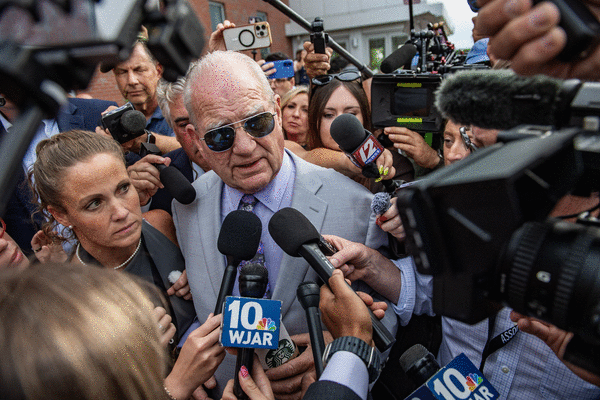
“They obviously have worked so hard in the case,” Reddington told reporters after playing a game of chicken with the dozens gathered at two different exits to the court.
Once he chose his door, journalists swarmed, some running after him.
“Let him move, let him move,” someone had to shout.
“Big Red,” someone else called out, “we love you.”
_____
©2026 MediaNews Group, Inc. Visit at bostonherald.com. Distributed by Tribune Content Agency, LLC.






Comments