Once under investigation, Venezuelan tycoon now at center of massive US oil deal
Published in News & Features
A decade ago, Venezuelan tycoon Alejandro Betancourt stood in the crosshairs of a federal investigation in Miami into the theft of more than $1 billion from Venezuela’s state-owned oil company that authorities say was laundered through bank accounts and real estate investments in the United States and Europe.
Today, Betancourt, who was not charged with a dozen others in the Miami case but remains under investigation in Europe, stands in the limelight of a recently announced oil deal between the Trump administration and the Venezuelan interim government of Delcy Rodriguez. With the Trump administration’s approval, she replaced former President Nicolás Maduro on an interim basis after the U.S. military seized him in January to face drug-trafficking charges in the United States.
Since the massive oil agreement was announced on Friday, major news media have described how the U.S. government pressured Swiss authorities to drop their request to extradite Betancourt from England so he could help broker the agreement with Venezuela – a country that collapsed under the socialist leadership of Maduro and his predecessor, the late Hugo Chavez.
The agreement would give the U.S. 55% of the joint venture’s oil output from fields covering more than 65 billion barrels of Venezuela’s reserves. President Donald Trump called it “the biggest oil deal in the world” when he announced the agreement Friday on social media. As part of the deal, the Betancourt family’s company, North American Blue Energy Partners, would play a leading role in operating multiple oil fields in Venezuela.
Betancourt’s emergence as a key player in the unorthodox U.S.-Venezuela oil deal struck many who have followed his business investments as stunning, given that he was under intense scrutiny by federal authorities in Miami and still faces ongoing fraud, tax and money-laundering investigations in Switzerland and Spain. Betancourt, 46, who came from a prominent Venezuelan family and attended Suffolk University in Boston, gained stature in the 2010s when he and others cut highly profitable electric and oil deals with the Venezuelan government amid allegations of bribery.
Critics of the deal expressed astonishment that the Trump administration, including Secretary of State Marco Rubio and Defense Secretary Pete Hegseth, would collaborate with Betancourt – described as a poster boy for corruption under the socialist regime — in the negotiations with Rodriguez.
Pedro Burelli, a former member of the board of Venezuela’s state-owned oil company PDVSA and a longtime supporter of the Venezuelan opposition, said “the U.S. government is trying to correct the original mistake, which was recognizing Delcy Rodríguez, who has no legitimacy.
“That has generated very little appetite for investing in Venezuela,” Burelli told the Miami Herald. “And now they are trying to address that problem with a structure that directly involves the U.S. government in the operations of someone who is arguably even more disliked in Venezuela than Delcy Rodríguez, because he is the poster boy for Chavista corruption.”
The criticism of Betancourt’s new role comes against a long history of scrutiny by law enforcement authorities in the United States and Europe.
Betancourt’s defense
Although the Trump administration has not acknowledged the federal investigation into Betancourt in Miami dating back to 2016, multiple sources have told the Herald that he was not charged in the $1.2 billion Venezuelan money-laundering case because prosecutors could not prove he and his company, Derwick Associates, knowingly received tainted funds stolen from Venezuela’s national oil company. Betancourt also didn’t move any of his money into U.S. banks or real estate, unlike several others charged in the money-laundering conspiracy case, which was filed in 2018.
Betancourt kept his investments largely outside the U.S. banking system and real estate market and invested the vast majority of his wealth in companies set up in Spain, Switzerland and Luxembourg.
Betancourt’s lawyer, Jon Sale, told the Herald that his client has been investigated by U.S. and Swiss authorities for more than 10 years, leading nowhere.
“Not only has he not been convicted, he hasn’t been charged with anything,” said Sale, a prominent white-collar defense attorney in South Florida.
“He has a long history of assisting the U.S. government,” he added, noting that Betancourt has been an anti-Maduro advocate for years.
Joseph DeMaria, a former federal organized crime prosecutor who represented Derwick and one of its principals in several Florida and New York civil actions at the time these allegations were first raised, said the racketeering cases were all dismissed for a fundamental reason.
“There has never been a finding that Derwick, or its principals, violated any U.S. laws,” DeMaria said. “When a businessperson keeps their money outside the U.S. banking system, then there is no violation of U.S. money laundering laws. That is why Mr. Betancourt can freely travel to the United States and do business with the Trump Administration on this new Venezuelan oil deal.”
Venezuelan money-laundering case
According to an indictment and other court records filed in Miami, the Venezuelan money-laundering conspiracy began in late 2014 when a group of Venezuelan businessmen set up a shell company to make a sham loan to Venezuela’s national oil company. The $42 million loan was repaid through a lucrative government currency-exchange scheme, resulting in a windfall of $600 million.
The dozen defendants were accused of stealing the $600 million from the state-owned oil company’s coffers, according to the indictment. By 2015, the embezzlement from PDVSA had doubled to $1.2 billion.
The accused ringleader of the scheme was Venezuelan businessman Francisco Convit Guruceaga, Betancourt’s cousin and former partner at Derwick. According to the indictment, Convit plotted with influential business people with access to the highest levels of government, including top PDVSA lawyers and executives accused of accepting bribes.
In late 2024, a politically connected Venezuelan, Raúl Gorrín, owner of the Globovisión network in Caracas, was also charged with conspiring with Convit and others to launder the $1.2 billion that they were accused of stealing from Venezuela’s government and investing in Europe and the United States, including in luxury real estate in South Florida.
Both Convit and Gorrín are at large and considered fugitives.
According to a key Homeland Security Investigations affidavit in the Operation Money Flight case, here is how $600 million of the stolen Venezuelan government funds were distributed by the defendants between 2014 and 2017:
—$272.5 million went to Gorrín. In turn, he kept about $72.5 million for himself — wiring some money to pay for aviation, yacht and brokerage services in Miami — and gave the balance, $200 million, to a Malta bank, Portmann Capital Management, for the benefit of Maduro’s three grown stepsons from his marriage to Cilia Flores.
—$272.5 million also went to Convit, who shared a chunk of that money with Betancourt. In the Homeland Security affidavit, Betancourt is described as “Conspirator 2” but he has not been charged. Sources have said Convit used the money to pay back Betancourt for a business loan, but he didn’t know the funds came from the sham loan to Venezuela’s national oil company.
A half-dozen defendants, including former senior PDVSA officials and lawyers, have been convicted so far in the Miami case.
Swiss extradition request
Although Betancourt was not charged in the money-laundering case, Swiss authorities launched a broader investigation into Betancourt and Derwick Associates stemming from the original allegations of embezzling more than $1 billion from the Venezuelan government and funneling the profits through Swiss banks and luxury real estate.
Swiss prosecutors froze Betancourt’s assets and issued an international arrest warrant and extradition request for him. In November 2025, police officers arrested him in London. He had to post a $2.5 million bond as he awaited his extradition trial.
After the U.S. military seized Maduro in Caracas in early 2026, the Trump administration sought Betancourt’s assistance and the Justice Department began pressuring Swiss authorities to drop their extradition request and criminal case against him, according to reports in The Washington Post and The New York Times. Top U.S. officials wanted to use Betancourt in their negotiations to restructure Venezuela’s beleaguered oil industry and secure a stake for the Pentagon as part of the deal.
Top Justice Department officials, including former Attorney General Pam Bondi and her successor, Todd Blanche, led the pressure campaign. Although Swiss prosecutors resisted, they dropped their extradition request in May, allowing Betancourt to travel with a visa in a private jet to Washington and Caracas for oil meetings with Rodriguez.
Enormous oil reserves
It is against that complicated history that Betancourt has now emerged at the center of Washington’s ambitious plans for Venezuela’s oil industry.
The Trump administration’s emerging oil strategy in Venezuela could give Washington something it has sought for decades: substantial influence over the country’s enormous petroleum reserves.
But the unusual structure being assembled to achieve that goal is also raising questions about who stands to benefit from the redistribution of some of Venezuela’s most valuable assets — and why Betancourt, a businessman whose rise began during the Chávez era, has become one of Washington’s most important partners.
Under an arrangement announced by Trump, the U.S. is expected to back development of 17 Venezuelan oil fields, with Betancourt’s North American Blue Energy Partners playing a major role, according to people familiar with the deal cited by The New York Times. The Pentagon’s Office of Strategic Capital is expected to participate in the financing, while the State Department has said the structure would effectively give the United States 55% of the joint venture’s output.
The arrangement is part of a broader push to bring American capital back into Venezuela’s battered petroleum industry after the removal of Maduro and Washington’s decision to work with Rodríguez, the acting Venezuelan president.
Bloomberg reported that Betancourt has been helping the administration identify promising oil assets, evaluate operational problems and connect potential U.S. investors with opportunities in Venezuela. Preliminary agreements have involved smaller American companies, including Lionheart Capital and Pacific Coast Energy.
Venezuelan analysts with knowledge of the negotiations said the structure reflects a fundamental problem confronting Washington: Major American oil companies remain reluctant to make large new investments in Venezuela.
ExxonMobil and ConocoPhillips are among the companies that remain wary after previous expropriations and because of continuing questions about contracts, sanctions and political stability.
The administration has therefore explored ways of bringing in smaller American operators and private investors willing to assume risks that the oil majors will not, the analysts said.
Betancourt offers something those companies do not: an existing operation inside Venezuela, experience dealing with the country’s oil industry and the ability to navigate its political and commercial environment.
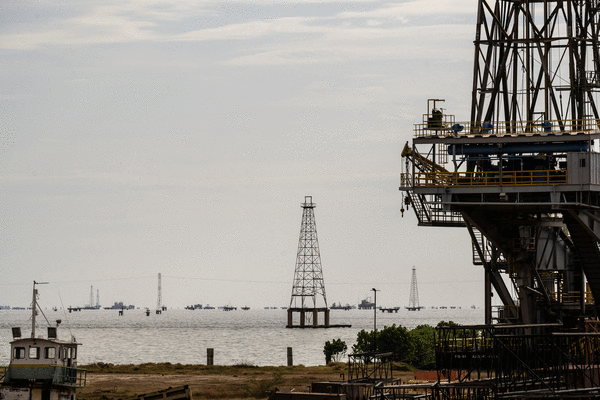
His Blue Energy Partners currently produces about 200,000 barrels of oil per day from fields around Lake Maracaibo and the Orinoco Belt, according to Bloomberg, making it Venezuela’s second-largest private producer behind Chevron.
The company reportedly plans to borrow as much as $5 billion to increase production to 1 million barrels a day within five years — nearly equivalent to Venezuela’s current total production.
Analysts familiar with the negotiations said Washington’s participation is designed to do more than finance additional production. By embedding American interests directly into the ventures, they said, the administration could make the agreements more difficult for a future Venezuelan government to undo.
The Pentagon would not be operating oil wells, according to the analysts. Rather, U.S. government participation would give Washington a financial interest in the ventures and potentially provide them with a degree of political protection unavailable to conventional private investments. One analyst described the strategy as an attempt to “lock in” the agreements across future political transitions.
That could be especially important in Venezuela, where abrupt changes in government policy, nationalizations and confrontations with Washington have repeatedly upended foreign investments.
But critics of the emerging arrangement see a different risk: that Washington could effectively redistribute valuable Venezuelan oil assets through a process lacking the transparency and competition normally expected for transactions of such magnitude.
Bolivarian entrepreneurs
Betancourt has long been a controversial figure in Venezuela. He was a co-founder of Derwick Associates, which received billions of dollars in emergency power contracts during Chávez’s government, making him one of the businessmen commonly referred to as “bolichicos” — young entrepreneurs who amassed fortunes during the Chavez’s Bolivarian Revolution.
Derwick and Betancourt later came under scrutiny in investigations in Venezuela, the United States and Europe involving allegations of corruption and money laundering. Betancourt has denied wrongdoing and has never been charged with a crime.
His personal bank accounts have also been investigated for more than a decade by prosecutors in Zurich, according to the Times, although he has not been formally charged in Switzerland.
Despite that history, the Trump administration has increasingly embraced Betancourt as a useful partner. U.S. officials, including Rubio, viewed favorably his record of increasing production in an industry otherwise marked by steep decline, according to a person close to the administration cited by the Times.
The newspaper reported that the administration ultimately looked past the corruption allegations surrounding Betancourt because of his operational record.
For Washington, the potential payoff extends beyond Venezuela.
The administration believes substantially higher Venezuelan production could strengthen U.S. energy security, reduce the influence of Middle Eastern oil producers and eventually help stabilize global oil prices. But any significant increase would take years, meaning the strategy is unlikely to produce an immediate reduction in U.S. gasoline prices.
For Venezuela, the potential rewards are also substantial. Rodríguez has said the agreement could eventually produce more than $200 billion in tax revenue for the government, although that projection has not been independently verified. Rehabilitating the country’s deteriorated fields could bring billions of dollars in investment, increase exports and government revenue, create jobs and reconnect Venezuela more fully with U.S. energy markets.
Betancourt and Blue Energy Partners could be among the biggest private beneficiaries. U.S. government backing could make financing and equipment easier to obtain despite continuing sanctions and provide protection against Venezuela’s notorious political volatility.
The administration’s strategy may also be intended to pressure the major U.S. oil companies. Venezuelan analysts familiar with the negotiations said Washington is effectively signaling that companies unwilling to accept the risks of returning now could find that some of the country’s most attractive oil fields have already been allocated when they eventually reconsider.
But Burelli, the former PDVSA board member, said distributing Venezuelan petroleum assets through a small group of politically connected intermediaries carries dangers reminiscent of the chaotic privatizations that followed the collapse of the Soviet Union.
“Now the idea is: Let’s create another structure, hand the contracts to these guys and put them in charge of distributing them,” Burelli said. “But that is extremely dangerous. It resembles the Soviet-style privatizations of the Yeltsin era, when state assets were transferred supposedly in the name of reform, but ended up in the hands of well-connected insiders. That is how you create a new generation of oligarchs overnight.”
That tension may ultimately define the new U.S. approach to Venezuelan oil. Washington sees an opportunity to bring enormous reserves into the American strategic orbit while attracting the investment necessary to rebuild an industry devastated by years of mismanagement, corruption, sanctions and underinvestment.
The unanswered question is whether the structure being created to accomplish that will produce a competitive Venezuelan oil industry — or concentrate some of its most valuable assets in the hands of a new group of politically connected companies and businessmen.
_____
©2026 Miami Herald. Visit miamiherald.com. Distributed by Tribune Content Agency, LLC.





Comments