UCLA disciplined a pro-Palestinian protester behind closed doors. Now he's suing
Published in News & Features
LOS ANGELES — In a prolonged case that offers a rare look into the fiercely private student discipline process, a UCLA computer science doctoral student is suing the University of California, asking a judge to reverse his two-quarter suspension and release a master's degree withheld for more than 600 days.
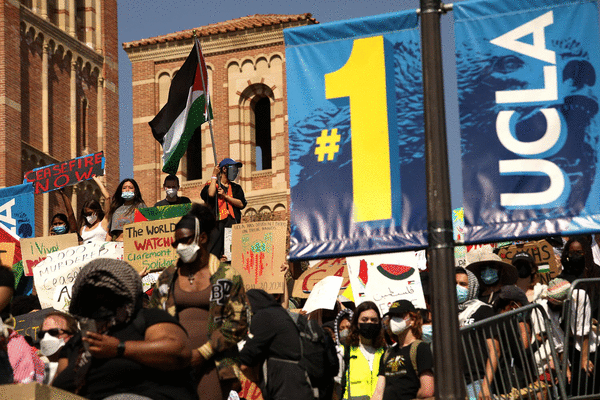
The case centers on one of the most volatile chapters in UCLA history — the 2024 pro-Palestinian protests that racked the university, culminating in a violent spring attack at a campus encampment. The demonstrations helped fuel a relentless Trump administration campaign against UCLA and other elite universities over their handling of antisemitism allegations.
The campus turmoil divided UCLA and the nation. Protesters demanded UC divest from companies tied to the Israeli military's war in Gaza. Some Jewish students and faculty called the demonstrations antisemitic, though others joined them.
Dylan Kupsh, 27, emerged as a vocal UCLA protester and an outlier in the campus movement. He did not mask his identity at rallies and has gone public about the discipline against him, while hundreds of others in similar proceedings have stayed anonymous.
He filed the civil lawsuit last week in Los Angeles Superior Court against the UC Board of Regents, two UCLA student conduct administrators and a UCLA police captain. Los Angeles-area civil rights lawyers and attorneys from the American-Arab Anti-Discrimination Committee represent him.
The suit alleges viewpoint discrimination and due process violations, including a lack of meaningful notice of cases against him.
A UCLA spokesperson said the university "will respond to this lawsuit as appropriate in court."
The university, like campuses nationwide, is barred by federal privacy law from discussing individual discipline cases or internal deliberations, even when a student goes public.
How the case unfolded
Kupsh's case grew out of the protests that followed UCLA's spring 2024 encampment — which some pro-Israel Jewish students alleged blocked them from part of the campus. That claim was cited in a civil rights case that cost UC $6.45 million in a settlement and set the stage for a Justice Department lawsuit. Kupsh's charges stem not from the encampment itself but from a year of smaller protests that came after it.
He originally faced 14 campus citations — issued between August 2024 and June 2025 — for blocking pathways, disrupting campus and defying orders at five demonstrations from June 2024 to May 2025, the suit said. The charges were later amended twice, most recently in April 2026.
The allegations are university conduct violations, not crimes. Kupsh was arrested at a June 2024 demonstration but never criminally charged. Campus police still urged the university to act, the suit said.
In a May 2025 email, UCLA police Capt. Jeff Chobanian told Steve Lurie, UCLA's chief safety officer, that Kupsh was "a known organizer and public face" of the suspended Students for Justice in Palestine, and urged "firm and immediate action," the suit said. Within half an hour, Lurie forwarded the email to two student conduct administrators, saying, "perhaps Jeff's narrative can help us make a determination on an interim suspension."
Chobanian and Lurie declined to comment about the suit to the Los Angeles Times. Bryan Murotake, a defendant and former UCLA assistant dean of students who signed charging notices against Kupsh, did not respond to a request for comment.
The university issued an interim suspension in June 2025, barring Kupsh from campus for 291 days as the disciplinary process proceeded, the lawsuit said. The ban lifted in March 2026.
Beyond emails included in the suit, the court documents do not show how UCLA weighed its decision.
The lawsuit alleges Kupsh was not told what evidence the university had against him before it imposed interim suspension. Under university policy, a student can be barred from campus once a conduct case is open, without any finding that the student broke the rules.
On the day the interim suspension took effect, UCLA filed new citations from a May 2025 protest alleging obstruction, disorderly conduct and failure to follow orders, the suit said. Kupsh, who taught a class online, was allowed on campus Monday afternoons for lab meetings.
"I felt like half my life was basically ripped off," Kupsh told the Times. "I was not even able to visit my next-door neighbor, who lives on university property."
Student conduct proceedings unfold behind closed doors, and college campuses typically decide cases on a "more likely than not" standard — a far lower bar than criminal proceedings. Three-member UCLA panels of faculty, staff and students heard Kupsh's cases.
Over five hearings between June 2025 and May 2026, panels dismissed all but two of the citations, the suit said. UCLA had shown Kupsh was present at most of the demonstrations, they ruled, but not that he organized them, gave orders or blocked access.
The university did find him responsible for violations at two separate protests, one for not showing his student ID to authorities and another for failing to move out of a walking student's path. An appeal of a June finding was denied July 31.
In the lawsuit, Kupsh acknowledges attending most of the demonstrations but denies being a ringleader, blocking anyone from campus walkways or refusing orders.
"He was disciplined for what he believes, not what he did," Thomas B. Harvey, one of the lawyers representing Kupsh, alleged in an interview with the Times.
The two-quarter suspension runs through Dec. 11, 2026, barring him from classes, teaching duties and pay, the suit said. His master's degree in computer science, submitted for conferral in December 2024, remains unawarded.
Under UCLA policy, he cannot resume his doctorate when the suspension lifts. Kupsh must apply for readmission.
The suit alleges his punishment threatens a doctorate seven years in the making and two quarters from completion. It values his lost pay at more than $17,000. He is seeking unspecified damages, including punitive damages against two administrators and the police captain, and attorney fees.
Campus discipline by the numbers
Last year, city and county prosecutors declined to charge all but two of the nearly 350 people arrested at UCLA and University of Southern California pro-Palestinian protests. UC reported more than 400 protest-related internal discipline cases from spring 2024 alone.
A May 2025 UC systemwide review of hundreds of spring 2024 cases found those reaching a hearing took 225 days on average — three times as long as those settled without one. The longest, at UCLA, ran 361 days.
Overall, UC campuses issued 14,231 sanctions in 2023-24 — most unrelated to protests. Suspensions accounted for 3%. They were reserved, the review said, for the most serious cases such as violence and repeated drug offenses. Interim suspensions, imposed before any hearing, numbered 131 systemwide.
Most students received milder penalties — warnings, probation or requirements to attend counseling or workshops, which together made up 93% of sanctions.
Two years later, the demonstrations have largely disappeared from UC amid strict enforcement of campus protest rules.
Protest-related pressure continues
UCLA has faced some of the Trump administration's toughest sanctions on any university: a $584 million funding freeze a federal judge later lifted, a $1.2 billion settlement demand the university refused and multiple Justice Department antisemitism investigations and lawsuits growing out of the protests.
Some faculty have praised the university for not settling. Others say it has cracked down on free speech to fend off further federal action.
Several Jewish community or faculty groups say UCLA has not gone far enough to discourage anti-Israel protests. The AMCHA Initiative argues that UC campuses, including UCLA, have been too lenient with pro-Palestinian activists. The nonprofit tracks anti-Jewish bias on college campuses. Kupsh and pro-Palestinian activists have rejected the antisemitism charge.
The UCLA Jewish Faculty Resilience Group has complained that the university has unevenly enforced rules, such as those against masking and blocking walkways, and must "hold those that break them accountable."
Members of the UCLA Task Force on Anti-Palestinian, Anti-Muslim and Anti-Arab Racism and Faculty for Justice in Palestine accuse leaders of using the discipline process to quash pro-Palestinian voices. This year, 148 Jewish faculty signed an open letter critical of "insinuation and misdirection" that painted student activists as antisemitic. The professors expressed fear of UC responding to government actions over protests with "draconian limits on academic freedom and free speech."
Kupsh said he sued because he had run out of options.
"I do want to attain a Ph.D., and UCLA is trying to take that away from me," he said.
_____
©2026 Los Angeles Times. Visit latimes.com. Distributed by Tribune Content Agency, LLC.

Comments