NASA's cosmic mystery hunter launches atop SpaceX Falcon Heavy
Published in News & Features
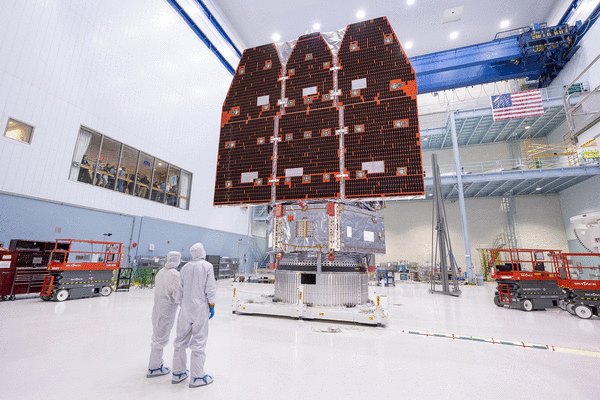
KENNEDY SPACE CENTER — The skies cleared and NASA’s Nancy Grace Roman Space Telescope launched on a SpaceX Falcon Heavy rocket hurtling past a rising sun, headed for a mission to unravel some celestial mysteries.
The powerhouse rocket lifted off from KSC’s Launch Pad 39-A at 7:26 a.m. with the $4.3 billion telescope that’s off on a trip to a point 1 million miles from Earth.
“Roman is going to revolutionize the way we look at our universe,” said Nicky Fox, the associate administrator for NASA’s Science Mission Directorate.
Its primary mission is to tackle cosmic mysteries called dark matter and dark energy, which have only been discovered in the last 30 years but have challenged existing models of how the universe is expanding.
Fox said dark matter is like “the fabric of the universe. It’s the thing you can’t see, but we know it’s there.” And she said dark energy “kind of powers the universe.”
Roman’s wide-field lens will be able to capture evidence of both by viewing and measuring their effects on things like supernova and black holes.
“They have that sort of a cosmic struggle between dark matter that wants to pull things together and dark energy that wants to push things apart,” she said. “That will allow us to finally kind of explain our universe and understand our place in it.”
The telescope also has a secondary job scanning billions of galaxies, tens of billions of stars, and the potential to discover as many as 100,000 new planets during an initial five-year mission.
“One of Roman’s surveys will be to look out into our own Milky Way galaxy,” said Dominic Benford, a NASA program scientist on the Roman mission. “Looking into the plane of our galaxy, we can see with Romans’ infrared vision all the way to the center of our galaxy and beyond, and from the inside. That’s a part of our own home galaxy that we’ve never seen in detail before. We will find 10s of billions of stars, young stars, old stars, stars all the way across. It’ll be the largest astronomical catalog in the history of astronomy.”
Roman will complement the likes of the Hubble Space Telescope, which launched in 1990, and James Webb Space Telescope, which launched in 2021, as it is armed with different instruments, including a 300 megapixel camera, and will cast a much wider net using infrared light when viewing the sky.
The telescope’s namesake, Nancy Grace Roman, was NASA’s first astronomer and was known as “The Mother of Hubble.”
NASA Administrator Jared Isaacman called the observatory one of the agency’s marquis missions, and one that managed to launch nine months ahead of schedule and within budget.
“This is a mission absolutely worth getting up for,” he said ahead of liftoff.
In a post-launch briefing, he took a call from President Trump and put him on speaker.
“Boy, it looked beautiful on television,” Trump said. “I just called Jared to find out, is there anything negative that I should know about? Like it will never be able to return. Little things like that, he said. No, it’s looking great. It couldn’t be better, and it was another great success.”
The spacecraft has a three-month trip to a spot called Lagrange Point 2, putting the Earth between it and the sun. It’s where the James Webb and other space telescopes are parked, giving them a pristine view of the galaxy.
“It’s five years to be able to do everything that we want to do, but we are going to be looking, making the first direct measurements of exoplanets around distant stars,” said Fox during a prelaunch briefing Saturday.
Compared to the Hubble Space Telescope, Roman will have a 100 times wider view, even though the lens is the same size, and it will gather data 1,000 times faster. It has a primary instrument that will take wide-view images of the universe.
“We’ve never been able to do that in the way that Roman is going to do it. We’ll look at swaths of the sky that we’ve never looked at before,” she said. “You think Hubble has done this incredible science. It’s looked everywhere. It’s looked at these amazing things. But there’s so much of the sky that we haven’t ever looked at, and that’s what Nancy Grace Roman is going to do for us.”
There is also a secondary coronagraph that will get chances to home in on specific stars to try and find details about exoplanets that orbit them.
The primary mission of answering unknowns about dark matter and energy, though, could redefine how astrophysicists view the universe.
“We have a model of the universe, and with the data we’ve been taking with the other telescopes, it’s showing that the model isn’t quite correct,” Fox said. “When we launch this mission, we will have an actual model of the universe that, not just for a single moment, but something for years that we can study how it’s changing.”
As far as the launch goes, a forecast of dicey weather was not a factor and the Falcon Heavy using its 5.1 million pounds thrust had an unobstructed path out over the Atlantic.
Two of the Falcon Heavy’s boosters made their way back to nearby Cape Canaveral Space Force Station for a landing, with touchdowns at Landing Zones 2 and 40. This was the first flight for one of the boosters while the other supported two previous Falcon Heavy launches.
Their return meant Central Florida was subject to some early morning sonic booms.
This was only the 13th time Falcon Heavy has flown since its debut in 2018, when it launched Elon Musk’s Tesla roadster into deep space.
_____
©2026 Orlando Sentinel. Visit orlandosentinel.com. Distributed by Tribune Content Agency, LLC.






Comments