At least 1,200 still missing as flood devastates Nepal and China
Published in News & Features
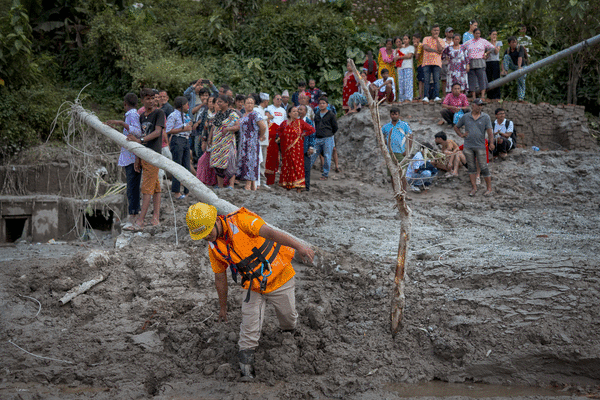
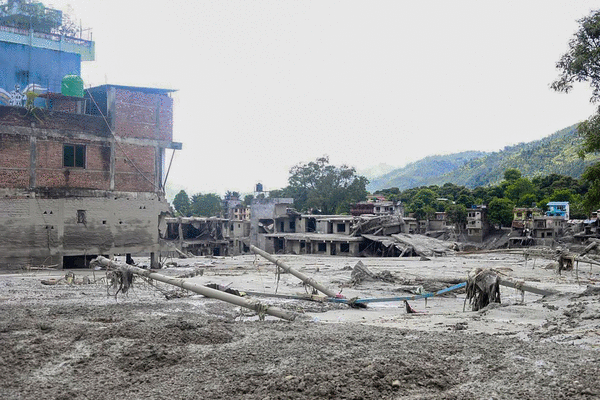
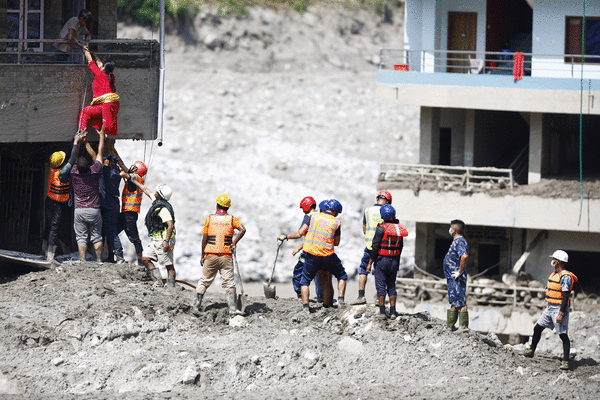
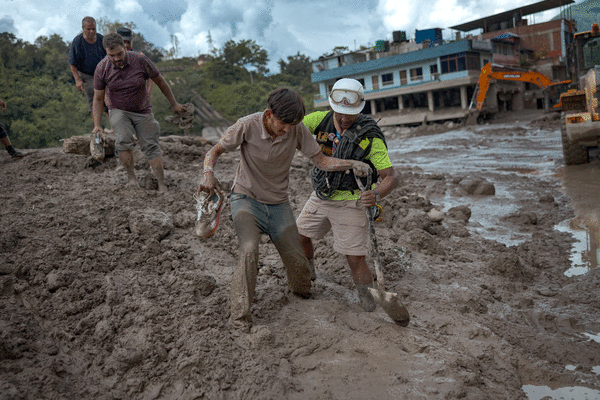
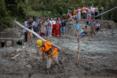
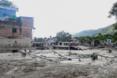
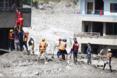
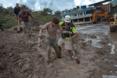
A flash flood in a Nepalese valley near the Chinese border unleashed waves of devastation that inundated villages and swept away buildings, killing at least 389 and leaving more than 1,200 still missing, including hundreds of foreign tourists.
Visitors from countries including India, Malaysia, Australia, the United Kingdom and the United States are unaccounted for more than 24 hours after the disaster, which washed away roads and bridges in Nepal’s mountainous Rasuwa district and prompted widespread evacuation alerts.
Images and video capturing the catastrophe showed walls of water and rock smashing into villages in the heavily visited mountain valley. In one widely circulating video, a wall of debris overtook a border complex in Tibet at Gyirong Port, China’s main gateway to Nepal, washing away buildings and sending people fleeing for their lives.
“Nobody knows anything,” said Paribesh Chiluwal, a Kathmandu resident whose 28-year-old wife and 2-year-old son were missing after the disaster. His wife, who is eight months pregnant, worked at the local health post in Timure in Rasuwa district. He described the last several hours as “traumatic.”
The flood wave was so intense it reached as high as 9 meters, or early 30 feet, in 30 minutes, according to the International Center for Integrated Mountain Development. Initial assessments based on seismic and satellite data indicate the flood was triggered by the collapse of a glacier in the Himalayan region between Nepal and Tibet on Wednesday, causing a 5.2-magnitude seismic event that sent water, ice, rock and debris downstream.
A lake had formed roughly 18 kilometers (11 miles) above the Rasuwagadhi checkpoint at the Nepal-China border as the flow of the Lhende Khola River has been obstructed, according to the Nepal National Disaster Risk Reduction and Management Authority. “The risk still remains that the natural dam of that lake could burst and cause another major flood,” the agency wrote in a post on X.
As the valley remains unstable, further rock slides or heavy rainfall could be “quite catastrophic” and cause significant flooding, said Simon Allen, a research associate at the University of Zurich who has studied Himalayan glacial hazards. Allen said scientists have identified two lakes that have recently formed, with one directly above where the initial avalanche started.
Nepalese authorities said Thursday evening that 389 had died. Nepal Police said 644 people were missing, including 517 foreign nationals. Among those unaccounted for are 65 Americans, 53 from Ukraine, 51 Malaysians, 35 Australians and 33 from the U.K. India’s Ministry of External Affairs said 290 of its citizens are not contactable.
China’s state broadcaster CCTV said as of Thursday morning there were at least three deaths and 558 missing — including 260 foreigners — on the Chinese side of the border. China has now evacuated 555 people from the Tibet area hit by the mudslide, according to Chinese state media, which reported that no travelers are stranded anymore.
‘All-Out Rescue’
The death count is widely expected to climb as rescue efforts get underway. For Nepal, the disaster may be the deadliest since the 2015 earthquake that flattened villages across the country and left nearly 9,000 dead.
It also presents one of the biggest challenges yet to the Himalayan country’s new government led by Balendra Shah, a former rapper and Kathmandu mayor, who took over as prime minister last year following a massive Gen-Z protest movement that toppled the previous leadership.
That movement was fueled by widespread youth discontent over corruption and unemployment in a nation that is one of the region’s poorest. Nepal’s economy is highly dependent on foreign remittances and on tourism, which has been squeezed in the years since the COVID-19 pandemic. The disaster could add further strain.
Shah traveled to Bidur, a riverside town north of Kathmandu, on Thursday to inspect areas hit by the disaster and meet with those affected, Nepalese media reported. The disaster-hit area includes parks and trekking routes popular with tourists.
In China, President Xi Jinping called for an all-out rescue effort in Tibet after what could become one of the country’s deadliest natural disasters this year. China’s Western Theater Command Air Force has sent a guidance team to organize joint rescue operations in Gyirong county, according to Xinhua News Agency.
Xi dispatched his second-in-command, Premier Li Qiang, to Tibet to inspect emergency rescue and relief operations on Thursday afternoon, visiting first responders and people displaced into temporary shelters, Xinhua News Agency reports. Li’s visit underscores the seriousness of China’s response to the disaster.
As dawn broke Thursday, the scale of the devastation became more apparent, and reports of missing tourists from countries around the world began to trickle in.
Rishabh Jain, who is from New Delhi, said his uncle and aunt remain unaccounted for after traveling to Nepal for a religious pilgrimage known as Kailash-Mansarovar. Jain said the family was told by their travel agency that the group’s handler was last contacted Wednesday morning. Since then, the family has been “trying frantically” to obtain information.
“Just a confirmation, official confirmation that they are alive, they are accounted for, is OK for us at this point,” Jain said, adding that hopes have gone up since spotting a woman resembling his aunt in rescue footage online. “Not all hope is lost.”
Thirty Bengali tourists who were traveling on a pilgrimage were missing along with two guides, said Yashojit Basu, project manager at the Kolkata-based Chalo Jaai Travel Club.
The group is estimated to have reached an immigration office at around the same time the mudslide hit. Video footage showed people running for their lives ahead of a deluge that toppled structures and sent debris flying.
“No contact has been made yet,” Basu said by phone from Egypt, where he is running a different tour. A local team attempted a search-and-rescue operation several hours later, he said, but was unable to land a helicopter due to the extreme conditions.
“What they told us is, based on the devastation, the chance for survival is very thin,” Basu said.
As many as 80 bridges and 40 kilometers (25 miles) of paved highway were damaged or swept away, Nepal’s Disaster Risk Reduction and Management Authority said in a post on X. There are 89 security personnel missing, including members of the police and armed forces, it later added.
The U.S. State Department said it’s working closely with local authorities to assist Nepal and is providing $500,000 in emergency funding.
_____
(With assistance from Adrian Leung, Jin Wu, Robin Paxton, Phila Siu, Brandon Harden, Jon Herskovitz, Laura Millan, Yasufumi Saito, Emma Haidar and Emma Clark.)
_____
©2026 Bloomberg L.P. Visit bloomberg.com. Distributed by Tribune Content Agency, LLC.






Comments