'Meritless': Judge rejects Ghislaine Maxwell's claim to toss her prison sentence
Published in News & Features
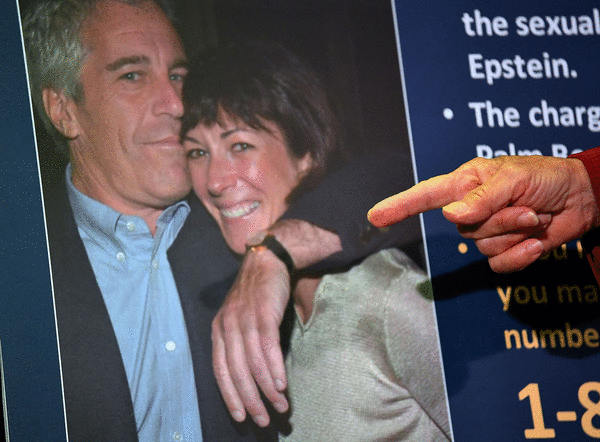
A New York federal judge Tuesday denied convicted child sex trafficker Ghislaine Maxwell’s last-ditch effort to throw out her 20-year-sentence, calling her self-filed legal petition “lengthy,” “rambling” and “meritless.”
In a brutally worded 67-page order, U.S. District Judge Paul Engelmayer further warned Maxwell against continuing her quest to overturn her conviction, noting that her arguments were filled with misinformation and “falsehoods” and further efforts to appeal would be in bad faith.
Maxwell, 64, filed the habeas corpus petition in December 2025, asking the court to vacate her sentence, claiming a number of constitutional and legal errors had deprived her of a fair trial. A habeas corpus is not an appeal, but a request — in Maxwell’s case — from a prisoner to consider the lawfulness of a conviction.
Maxwell, a former British socialite and associate of Jeffrey Epstein, was convicted by a jury in December 2021 on five felonies, including sex trafficking of a minor. She was sentenced in June 2022.
Englemayer’s order outlined her crimes, noting that “the Government’s evidence established that Maxwell had been instrumental in an approximately decade-long scheme with Epstein to entice, groom, transport, and traffic numerous young women and underage girls to engage in sexual activity with Epstein.“
The 2nd Circuit Court of Appeals upheld her verdict in 2024 and the U.S. Supreme Court declined to hear her appeal in October 2025.
By that time, Maxwell had been moved from a federal women’s facility in Tallahassee to a lower-security prison camp in Bryan, Texas. Maxwell’s lawyer had indicated she was angling for a pardon from President Trump, whom she and Epstein had associated with in the 1990s and early 2000s.
Her transfer came with controversy: She was moved just one week after she met in person with then-deputy attorney General Todd Blanche. Blanche, who was recently confirmed by the Senate as U.S. attorney general, has said it was for security reasons.
Then in November 2025, Congress passed the Epstein Files Transparency Act, which led to the release of approximately 3.5 million pages of Justice Department documents involving Epstein and Maxwell.
One of the arguments Maxwell made in her petition was that evidence released under the Epstein Files Transparency Act (EFTA) showed that she was not given a fair trial. Some of that evidence, she claimed, had been withheld from her at trial.
Englemayer rejected all of Maxwell’s claims, however, noting that the DOJ’s files further incriminated her in the sex trafficking of underage girls.
“The purported ‘new’ evidence to which Maxwell points, principally materials released under the EFTA, is largely irrelevant to the charges against Maxwell and does not support her claims of error,” Englemayer wrote. “On the contrary, to the extent it is relevant, far from exculpating her, it incriminates her or reinforces the correctness of the legal rulings Maxwell challenges.”
Among other things, the files revealed several interviews with other victims who told the FBI that they were not only recruited by Maxwell, but also sexually abused by her, along with Epstein.
FBI complaints mention Maxwell
One interview reviewed by the Miami Herald was from a victim who told the FBI in 1992, when she was 16 or 17, and visiting her grandfather in New York, she was approached by Maxwell in a park. Maxwell was walking her dog and offered her a dog-walking job. Within days, she called the girl and invited her to Epstein’s Manhattan mansion, where Maxwell offered her an orange juice during what she believed was a job interview.
She suddenly became groggy, and then lost consciousness, according to an FBI report written in 2020. When she awoke, she was in a bedroom and had vaginal bleeding and burning. She said Maxwell and a housekeeper helped her shower and then Maxwell paid her $300.
The FBI report noted that they found the woman to be truthful and that she was still traumatized by the event.
Several other women who were not part of the DOJ’s criminal case also filed FBI complaints that mentioned Maxwell, the Herald has found.
“As the trial showed, the case against Maxwell was based on abundant admissible evidence establishing her knowing participation in enabling a notorious child sex abuser to carry out historically heinous crimes,” Englemayer wrote. “Far from being discriminatory or unjust, this was the epitome of a virtuous prosecution.”
_____
©2026 Miami Herald. Visit miamiherald.com. Distributed by Tribune Content Agency, LLC.





Comments