DHS boasts it returned gang leaders, sexual offenders to an unstable Haiti
Published in News & Features
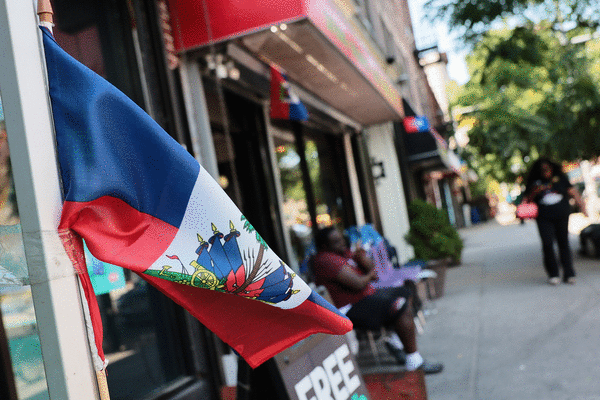
The Department of Homeland Security said Monday several people with serious criminal records, including gang members and men convicted of sex crimes involving minors, were among more than 160 people deported to Haiti last week.
The Immigration and Customs Enforcement charter flight was the first deportation flight to Haiti since the U.S. Supreme Court allowed the Trump administration to end Temporary Protected States for more than 300,000 Haitians who had been permitted to legally live and work in the United States because of instability in their homeland.
Another deportation flight is scheduled for this Thursday, the Miami Herald has learned.
The flights, which DHS has warned will increase, pose a looming challenge for Haiti, which woke up on Monday reeling from another deadly gang massacre in the hills above Port-au-Prince. With the recent end of deportation protections for Haitians, the Trump administration is targeting not only once hard-working and law-abiding Haitians, but also people with violent criminal records who have completed prison sentences or have longstanding removal orders.
Their return to an unstable Haiti comes as gangs continue to expand their territory beyond the capital and as the country’s security forces, justice and prison systems remain under severe strain.
“The timing of these deportations could undermine the multiple efforts the United States has undertaken to defeat Haitian gangs and ensure a minimum level of stability in the country,” said Diego Da Rin, Haiti analyst at the International Crisis Group, an independent nonprofit that works to prevent and resolve deadly conflicts around the world.
Da Rin said while the U.S. humanitarian protections were meant to be temporary, there appeared to have been a miscalculation over when to terminate them.
The new Washington-backed Gang Suppression Force, whose one-year mandate from the United Nations is up for renewal before the Security Council next month, still has not reached its target deployment of 5,500 personnel. It also does not yet have a broad presence even in Port-au-Prince, where dozens were killed in attacks on Sunday.
With a stronger mandate for offense and more reliable funding than its predecessor, the Kenya-led Multinational Security Support mission, the new force has a better chance of weakening the gangs’ grip, Da Rin said.
“But this won’t happen overnight,” he added. “The mission is expected to reach its full strength by the end of the year, and the offensive operations against the gangs that are expected to begin soon will take time to dislodge them from areas where they have maintained very tight control for years.”
Da Rin and others worry that gangs, which already recruit children as well as impoverished Haitians, could exploit deportees from the U.S. who arrive with few resources. “They are likely to exploit the hardships faced by deportees, offering them a role in their criminal activities that would at least get them two hot meals a day,” he said.
“Many of these individuals could seek to join criminal networks that collaborate with gangs or the gangs themselves,” Da Rin added. “Haiti’s judicial system is currently extremely dysfunctional."
Struggle to track criminal deportees
Haiti has long struggled with how to handle deportees with criminal histories in the U.S. At one point, they were jailed upon their return to Haiti, drawing criticism from human-rights groups that argued they had not committed any crimes in Haiti and were being punished twice.
Another protocol required deportees to periodically report to the offices of Haiti’s Central Directorate of the Judicial police in Port-au-Prince.
“The problem I have currently is they are deporting a lot of people and not providing the specific reason for why they are deporting someone,” Justin Marc, the head of the judicial police, told the Herald.
DHS said 162 individuals were sent to Haiti, though Haiti’s Office of National Migration confirmed to the Herald that it received 161, all of whom were given the equivalent of $76 and released.
“I have the list of people they sent,” Marc said. “But they did not include the reasons. DHS, in its file, could have the reasons, but in the list we have, it’s not there.”
Marc said U.S. authorities previously provided criminal histories, allowing Haitian police to determine which individuals needed follow-up. Now, he said, “they’ve put me in a very difficult position where a lot of times we assume that people are being sent back due to illegal migration.”
DHS touts deportations
In a statement released on Monday, Homeland Security Secretary Markwayne Mullin took pride in publicly highlighting some of the deportees returned to Haiti.
“On the latest deportation flight back to Haiti, we deported dangerous criminals including pedophiles, gang members, drug traffickers and violent assailants,” Mullin said.
“Despite the best efforts from activist judges, the Supreme Court reaffirmed what we already know: the T in TPS stands for TEMPORARY,” he added. “TPS was never designed to be permanent, yet previous administrations have used it as a de facto amnesty program for decades. Under the strong leadership of President Donald J. Trump, we are putting America first again.”
DHS identified 15 individuals with criminal histories. Five had convictions for sex-related crimes, with four explicitly involving minors. Among then was Bermann Desty, a former Florida resident convicted of unlawful sexual activity with a minor. DHS said he also had arrests for cruelty toward a child, assault, failure to register as a sex offender, probation violation and public order crimes.
Desty was admitted to the U.S. in February 2001 and became a legal permanent resident. An immigration judge issued him a final order of removal on July 23, 2026, DHS said.
Another deportee, Mc Guyverson Jetin, was one of three gang members returned to Haiti. DHS identified him as a member of Zo Pound, a well-known gang that operated in the Miami area. His criminal history included convictions on four counts of lewd or lascivious battery with a victim between the ages of 12 and 15 and sexual battery, DHS said.
Jetin had been a lawful permanent resident since 2007, after arriving in Florida the previous year. An immigration judge ordered his removal in June 2018.
Other deportees had convictions or arrests involving violent assault, domestic violence, drugs, burglary and theft, weapons offense alien smuggling and other crimes. One had also been arrested for failing to register as a sex offender.
No legal protocol
Unless someone is accused of wrongdoing in Haiti, legally Haitian authorities cannot hold them in prison. They can, however, hold them up to 72 hours while taking steps to establish their identities, family connections and how to track their whereabouts once released., Marc said.
That happened in July after Haitian police conducted their own internet searches and transferred 32 of the 111 who had been sent back to Haiti to holding cells, releasing them only after relatives had signed for them. That did not happen with last Thursday’s deportees, Justin and others said, because police were operating with limited information.
Marc said the arrival of deportation flights in Cap-Haïtien, where the Haitian police has a limited presence, has created additional challenges for his agency, which is responsible for investigating crimes and processing deportees.
The ongoing gang clashes and the lack of a permanent addresses among the nearly 1.5 million who have been uprooted from their homes, further complicates matters, he said.
In July 2025, Haiti’s justice minister, Patrick Pélissier, announced that the government had adopted a new protocol governing the judicial processing of Haitian nationals deported or extradited to the country. But the protocol was aimed at individuals accused of financial crimes or complicity with criminal or terrorist groups in Haiti.
The official document stipulated that individuals would be “placed in custody in the premises of the Central Directorate of the Judicial Police, or in any other appropriate place of detention, depending on the nature of the case and the circumstances.”
Lack of prisons
Even if Haiti were to broaden that protocol, the government would face another practical problem: It has almost nowhere to put additional prisoners.
Gangs destroyed three of Haiti’s main prisons in early 2024, and those still operating are severely overcrowded. In Port-au-Prince, CERMICOL, a juvenile detention facility built for 90 boys, now holds over 700 men, women, girls and boys.
“I have visited the prisons in Les Cayes, Jérémie, Cap-Haïtien and Fort-Liberté,” said William O’Neill, the U.N.’s independent human rights expert on Haiti. “They are all tremendously overcrowded, varying from three times capacity up to seven times capacity.”
There “is no room,” he said describing squalid and inhumane conditions with severely limited access to toilets, showers and clean water, insufficient food and almost no medical care.
“Communicable diseases are rampant, especially skin diseases,” he said. “Detainees have died due to inadequate nutrition and from diseases that would not have been fatal but for the weak physical conditions.”
Advocate warns of risk
This is the second time since July that Homeland Security has boasted about sending individuals with criminal histories to Haiti — a country the State Department warns Americans not to visit and where Washington is spending millions of dollars to support the deployment of the new foreign ant-gang force.
That force faces its own questions over what to with the armed gang members and leaders it hopes to capture.
Guerline Jozef, co-founder of the advocacy group Haitian Bridge Alliance, warned that the deportation of known U.S.-based gang members to Haiti will further contribute to the destabilization of the country. She highlighted the recent massacre in Kenscoff, once one of the most peaceful areas in Haiti, now a killing ground, leaving the community and surrounding neighborhood in terror.
“Our hearts are broken for Haitians both in Haiti who are going through these extreme violences at home and Haitians at risk here in the U.S. whose lives are also at risk,” said Jozef, whose organization is among the groups that have sued the administration over the termination of TPS.
Jozef called on the Trump administration to halt all deportations to Haiti, echoing demands from Democratic members of Congress who recently visited Port-au-Prince and said conditions are too dangerous for Haitians to be returned.
A young woman she recently spoke to, she said, “really expresses the reality, as she shared, ‘I am afraid to be kidnapped by armed groups and gangs in Haiti and at the same time, I am afraid to be taken by ICE and deported to the same violence that I was forced to flee.’”
_____
©2026 Miami Herald. Visit miamiherald.com. Distributed by Tribune Content Agency, LLC.






Comments