Bessent's Iran D-Day threat hinges on willingness to hit China
Published in News & Features
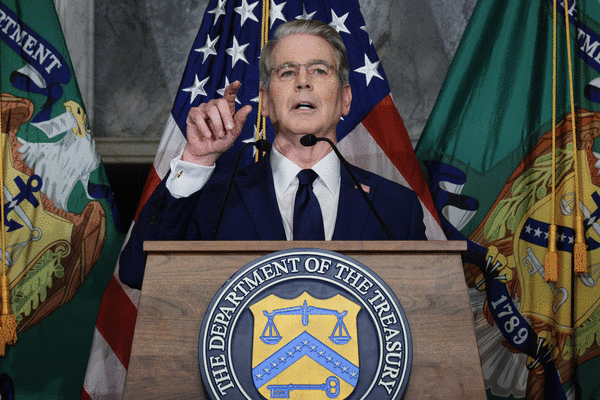
WASHINGTON — Treasury Secretary Scott Bessent’s threat to unleash an “economic D-Day” against Iran risks setting the U.S. on a collision course with China, its main trading partner.
That’s only if Bessent actually follows through on a threat the Trump administration has made before. And many are skeptical he will, especially when it comes to China — which buys around 90% of Iran’s oil — as Washington tries to maintain a fragile trade truce with Beijing and avoid a global economic shock.
On Monday, Bessent promised an “economic onslaught against Iran’s financial connections around the globe” as President Donald Trump tries to wind down his unpopular war in the Middle East.
Bessent unveiled dozens of new sanctions on entities, individuals and vessels, but the main thrust of a high-profile press conference was threatening so-called secondary sanctions against companies and countries that continue doing business with Iran.
China is by far the biggest buyer of Iranian oil and serves as a crucial link to the global economy for Tehran. That means any effort to truly choke off the regime’s remaining revenue streams would be extremely difficult without targeting Chinese companies. Trump has previously said the U.S. would impose secondary sanctions on any nation or company buying Iranian oil — and never followed through.
The move marks a pivot from threats of further military escalation toward a renewed focus on economic pressure. A campaign that excludes China isn’t likely to have a substantial impact on Iran, but focusing on Chinese firms could prompt retaliation — and potentially more pain for the global economy.
That’s partly because blacklisting Chinese companies risks opening a new economic confrontation with Beijing. Doing so now would fracture U.S.-China ties just weeks before Trump and Chinese President Xi Jinping are set to meet in September. Asked directly about hitting China with new economic measures on Monday, Bessent said “no one is above the reach of U.S. sanctions” but that he preferred “quiet diplomacy,” adding “we’re not going to name names.”
“Bessent largely deflected questions about China,” said Craig Singleton, a senior fellow at the Washington-based Foundation for Defense of Democracies. “That makes tactical sense ahead of next month’s summit, but strategically it risks reinforcing Beijing’s view that Washington is reluctant to impose serious costs on major Chinese actors.”
China has long maintained that U.S. unilateral sanctions on Iran are illegitimate. And while China’s state sector has largely complied with restrictions — to limit economic fallout and preserve access to the U.S. financial system — Beijing has allowed private “teapot” refiners to use workarounds to import and process Iranian crude.
In May, China ordered domestic companies not to comply with U.S. sanctions on five refiners, while its biggest banks were caught between Beijing’s directive and the risk of losing access to the U.S. financial system.
“Sanctions and pressure tactics do not help in resolving issues,” China’s Foreign Ministry spokesperson, Lin Jian, told reporters Monday. “They will only lead to escalation that serves no one’s interest.”
If the U.S. were to hit China meaningfully — say, by targeting a Chinese bank — Beijing would view it “not only as destabilizing and as insulting, but also as a breach of” the trade truce previously agreed by Trump and Xi, said Michael Sobolik, a senior fellow at Hudson Institute. That could spur China to retaliate in ways that could hit the U.S. hard, including with further export restrictions on critical minerals crucial to global manufacturing or limiting crucial pharmaceutical exports to the U.S., he said.
More broadly, Bessent’s new sanctions effort risks expanding the enormous economic disruption caused by the war against Iran. Already, the conflict the US and Israel launched in late February has rippled through the global economy, disrupting energy supplies and shipping through the Strait of Hormuz, one of the world’s most important trade chokepoints.
The resulting oil and gas shock has driven up transportation, fertilizer and other input costs, fueled global inflation and squeezed consumers and businesses around the world. Higher freight and insurance costs have put additional pressure on global supply chains.
Bessent acknowledged the risks of moving too aggressively, suggesting the administration would first give countries and companies a chance to cut their ties with Iran before imposing penalties that could reverberate through global markets.
“We are giving everyone the opportunity to remedy bad behavior,” he said. “Why would I want to blow up the global financial system?”
The previous Biden administration faced a similar challenge after Russia invaded Ukraine in 2022, assembling a coalition of more than 30 countries to freeze Russian assets, cut banks off from the global financial system and restrict Moscow’s access to technology.
The measures imposed costs but failed to cripple Russia’s economy, which adapted by redirecting trade toward countries including China and India, while the broader disruption from the war sent energy and food prices soaring and hit developing economies particularly hard. U.S. efforts to curb Russian energy revenues also needed to be balanced against sanctions that would raise energy prices — and Russian revenues — with western nations eventually settling on a price cap that still failed to end the war.
Secondary sanctions on countries doing business with Tehran would greatly expand the conflict with economic damage not just to China but also India, Turkey and nations across the Gulf, according to Vali Nasr, a professor at the Johns Hopkins School of Advanced International Studies and a former adviser to the U.S. State Department.
“The U.S. is essentially expanding its war in the Gulf to a much greater war between itself and other global actors around the world,” Nasr said.
_____
(With assistance from Jing Li, Sonya Dymova and Michelle Jamrisko.)
_____
©2026 Bloomberg L.P. Visit bloomberg.com. Distributed by Tribune Content Agency, LLC.



Comments