Human error, gaps in FAA oversight seen as possible factors in last year's Philly medical jet crash
Published in News & Features
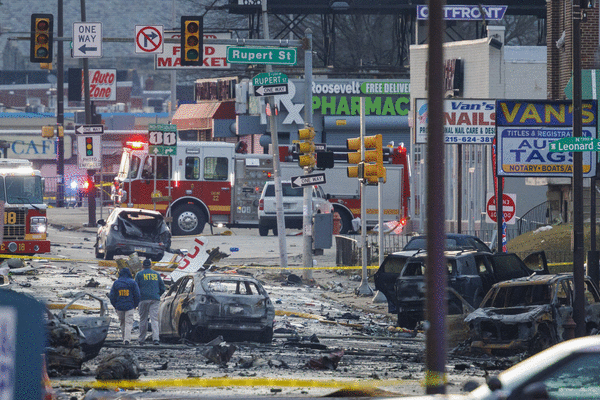
PHILADELPHIA — A series of human and oversight failings is being eyed by federal investigators as possible contributors to the fatal crash of a medical jet in Northeast Philadelphia last year, according to documents filed by the National Transportation Safety Board.
The federal agency does not identify a cause of the Jan. 31, 2025 crash of the Mexican-owned medical transport that crashed near Roosevelt Mall just after takeoff, killing all six people onboard and one on the ground.
But among the factors it has found during a year and one half probe are possibly fatigued pilots who had never flown in or out of the airport, an improper setting on the Learjet tail’s elevators, and a lack of FAA safety checks on a workhorse foreign-owned carrier.
Upon impact, the 1982 Learjet 55 erupted into flames that spread to homes and cars in the heavily populated area. At least 24 people were reportedly injured. The jet had taken off just after 6 p.m. that Friday night, and within a minute began a swift nosedive into the sidewalk near Cottman Avenue and Roosevelt Boulevard.
On board were 11-year-old Valentine Guzmán Murillo, who had just received care at Shriners Children’s Hospital before returning home to Mexico; her mother; a pilot; copilot; flight physician; and paramedic.
Potentially fatigued pilots and potential training weaknesses
As investigators try to piece together what may have gone wrong in the cockpit, they are focused on the two pilots.
One factor that could have played a role was their workload in the days leading to the fatal crash. They had flown multileg trips all four days before the accident.
NTSB investigators also looked into the effects of “spatial disorientation,” a phenomenon pilots experience when their perception of motion and relation to the earth’s surface becomes mismatched.
During the ascent from Northeast Philadelphia Airport, the pilots rolled the plane to the right by 12 degrees. Air traffic controllers then communicated with the pilots, and the pilots responded just as the plane began to rotate back to zero degrees. According to NTSB, within 10 seconds of their last communication with the air traffic tower, the plane continued rolling to the left at a rapid speed until the plane stopped climbing.
“Pilots who are properly trained and current in instrument flying can normally use instrument information to overcome misleading sensations, however, even well-trained pilots experience sensory illusions from time to time,” wrote NTSB investigators.
When there is a delay, it can take a few seconds or more for a pilot to regain spatial awareness. But during that delay, a pilot may make inappropriate control inputs that place an airplane in “an unrecoverable trajectory.”
In interviews with the pilots’ most recent training instructors at Flight Safety International in Tucson, the pilot in command demonstrated a “tendency to react before thinking through a problem.” The instructor noted that the same pilot would select modes of operation when the auto pilot system was off, something the pilot in command is supposed to delegate to the second-in-command pilot.
“That allows the pilot to concentrate on actually flying the aircraft. So what happens is, if the Autopilot’s off and the pilot flying goes to select modes of operation, it’s distracting him from flying the aircraft, which typically results in deviations of altitudes, speeds, and headings,” said the flight instructor who was not identified in the report.
The second-in-command pilot’s training report also showed that his lack of recent experience in flying a similar model Learjet “was evident.”
A spokesperson for Jet Rescue Air Ambulance, the Learjet 55’s operator, could not be immediately reached Wednesday afternoon for comment on the new release of documents.
Jeff Guzzetti, a former NTSB investigator, wondered if the low visibility that night, made more hazardous by overcast and lightly choppy weather conditions, could have exacerbated a phenomenon called somatogravic illusion.
That’s when rapid acceleration or deceleration, or other changes in gravity, can cause pilots to falsely believe a plane is pitching up or down when it is not.
“When you look at those four things — the low cloud ceiling, nighttime conditions, high velocity descent, less than a minute after takeoff — that could be consistent with spatial disorientation,” he said. Add in other distractions, like changing radio frequencies, and even experienced pilots have lost their bearings while relying solely on their instruments to navigate, Guzzetti said.
Investigators search the jet
The extreme impact and a debris field scattered across more than a dozen city blocks and a shopping center has hampered the investigation. Nearly all parts of the plane, from its engines to the mechanical and electrical systems that controlled the jet were found in damaged condition.
Even so, the NTSB has reported that the jet’s pitch trim, which would have aided the angle of flight and airspeed, was not in optimal position. That meant the pilots would have had to exert up to 50 pounds of force against the controls during takeoff and 12 pounds for level flight, investigators said.
Arthur Alan Wolk, a Philadelphia-based aviation attorney and pilot, was dubious. “They blame the pilot for the trim,” he said. “I don’t think you can rely on that record” because the impact makes interpreting the damaged parts difficult.
Wolk also said the pilot could have corrected for this by hitting an electrical trim switch. “Could it have happened? Yes. Is it a factor in my opinion, I don’t think so.”
The investigation devoted extensive research into gas tanks the medical jet had on board, which could have led to a fire or impaired the flight crew. Investigators said cameras that caught the airplane’s decent did not show trailing smoke or any visible internal fire.
In all, 11 gas cylinders were recovered with various states of damage. In previous incidents, investigators noted, flight crews had become incapacitated by carbon dioxide exposure. The Learjet’s carbon dioxide tank was found with it valve stem fractured, though the NTSB did not say if it believed there was a leak prior to the crash.
Jet Rescue Air Ambulance told the NTSB that they had no record of the raft for this jet and believed it was installed by a crew member without authorization.
Despite the NTSB stating in March 2025 that the cockpit voice recorder had not worked in years, investigators were able to repair its analog tape and listen to the audio. But the recordings were of a prior landing.
The report did not say why it failed to record the final takeoff. This jet was not required to carry or maintain a cockpit voice recorder, though it was listed on the preflight checklist.
The NTSB also examined the Learjet’s logbooks and maintenance reports and found they were largely in order, though, they couldn’t determine if any new maintenance was done prior to the final flight.
Lack of FAA oversight
A major piece of the investigation rests on the FAA’s Dallas International Field Office, which oversaw the U.S. operations of the medical jet operator.
Because the operator flew unscheduled, non-U.S. registered flights, FAA personnel said they were limited to performing “ramp checks,” or unannounced inspections of the aircraft and crew on the ground, as its safety measure. But when investigators searched the FAA’s safety assurance system for any record of ramp checks, they found none prior to the fatal crash.
Asked by NTSB investigators if there was a requirement to perform ramp checks or other surveillance on operators like Jet Rescue Air Ambulance, the primary inspector stated, “Oh, I’m not sure.”
The primary inspector continued that there was no surveillance plan in place before the time of the crash and that FAA staff in charge of Jet Rescue Air Ambulance’s operations had no knowledge of the operator’s previous crashes. The operator experienced a fatal accident in November 2012 in Fort Lauderdale, a non-fatal accident in February 2019 in Toluca, Mexico, and a fatal accident in November 2023 in Cuernavaca, Mexico.
Jet Rescue Air Ambulance was not on the FAA’s Heightened Surveillance List, which would have flagged the operator for additional inspections.
Unscheduled operators like Jet Rescue Air Ambulance are required to notify the Dallas FAA field office before operating in the U.S., which the FAA would determine when inspections are needed. But Jet Rescue Air Ambulance did not notify the office of its operations before the accident flight, according to the NTSB findings.
The NTSB release of evidence comes as federal probers finalize their investigation phase and prepare their final report, followed by a review process that can take up to 6 months.
_____
©2026 The Philadelphia Inquirer. Visit inquirer.com. Distributed by Tribune Content Agency, LLC.






Comments