Cocaine crackdown opens a new era of jungle warfare in Colombia
Published in News & Features
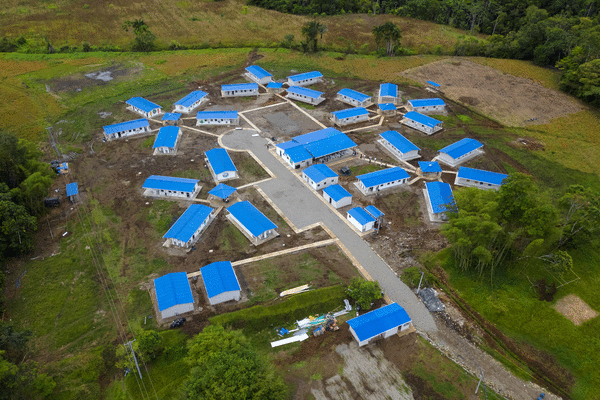
In a clearing in the fiercely contested jungles of southern Colombia, former members of a feared militia are waiting to learn whether President Abelardo de la Espriella will let them build civilian lives, or force them back on the run.
The 86 men and 13 women are the only fighters to demobilize under the previous government’s four-year “Total Peace” initiative, an effort to persuade members of Colombia’s cocaine-funded armed groups — estimated to number about 29,000 — to lay down their weapons. They are still living in a cluster of low-slung buildings, where they were promised six months of job training, medical treatment and other support before going home to begin new lives.
De la Espriella and the Trump administration have dismissed the peace process as a sham, and the new president is now dismantling the approach of his leftist predecessor, Gustavo Petro, leaving the former militants in limbo. Since taking office Aug. 7, De la Espriella has begun what could become Colombia’s biggest offensive against illegal armed groups in more than a decade.
“We showed the state we were able to put down our weapons,” said Darwin Cuajiboy, 32, who has lived at the site a few miles north of the Ecuador border since June, alongside other former members of the Comandos de la Frontera militia. “We’re worried the government that’s taking power might say it’s all over.”
In its first days in office, the new government ordered operations against at least three illegal armed groups. In a raid near the Venezuelan border Aug. 10, the armed forces said they killed two alleged members of the ELN guerrilla force. Days later, the rebels struck back with a drone attack in the same region, killing at least one soldier and injuring others.
Investors, meanwhile, are trying to gauge whether De la Espriella’s crackdown is good news for the oil industry and other sectors held back by the conflict, and how much support Colombia can expect from the U.S. The government was cash-strapped even before the nation’s strongest earthquake in half a century caused an estimated $10 billion of damage last week.
De la Espriella’s narrow victory raises doubts about how far he can pursue his agenda. Almost half of voters backed his rival, who wanted to continue peace negotiations, and resistance to the crackdown could also make it harder for the president to advance his pro-business reforms.
Depleted military
The criminal groups operating in rural Colombia are flush with cash from record cocaine production, increasingly adept at drone warfare and capable of striking far beyond their jungle strongholds through sleeper cells in major cities.
Colombia’s armed forces, by contrast, start on the back foot. The army lost much of its senior leadership during Petro’s administration, while fraying international alliances cut access to equipment, training and intelligence.
That leaves De la Espriella trying to rebuild the military even as he deploys it against illegal groups that spent years boosting their capacities. Many formed out of the remnants of the FARC, the guerrilla group that spent a half-century fighting the government, and signed a peace agreement a decade ago.
“The security situation faced by the new government is deplorable,” said former general Alberto José Mejía, who was head of the nation’s armed forces from 2017 to 2018. “They’re going to have to do the equivalent of fixing the plane while it’s in the air.”Groups such as the ELN are likely to react violently to having their safe havens and criminal economies attacked, and have the potential to carry out terror attacks in major cities, Mejía said.
It’s unclear what will happen to the ex-fighters at the camp in Putumayo, Colombia’s second-biggest cocaine-producing province, or whether they’ll be branded as insurgents once home. Since his election, De la Espriella has said he will bring the full weight of the law against criminals, without specifically addressing the fate of those who recently agreed to disarm. A spokesperson for the president didn’t respond to a request for comment.
The prospect of an intense military campaign stirs memories of the nation's violent recent past, when the armed forces suffered several hundred combat deaths every year and thousands of civilians were displaced.The active groups have already pulled back to mountain and jungle strongholds to prepare for De la Espriella’s offensive, according to one member of the military who asked not to be identified because he wasn’t authorized to talk to journalists.
But if the military can weaken the criminal groups, there’s potential for a peace dividend from the return of investors who were scared away by soaring rates of extortion and kidnapping.
Diego Orozco Gómez, a 75-year-old cattle rancher in Putumayo, says he expects the country to endure intense fighting during De la Espriella’s crackdown, but supported him because he believes he will ultimately make the country safer and more prosperous. He said many ranchers have been paying extortion for years.
“The armed forces will act authoritatively in the region, and we know that means there’ll be a difficult period,” he said. “But after that time, I hope we can live in peace.”
Remington rifle
At the ex-fighters’ rehabilitation center, residents pass the time by taking classes, playing football and lifting makeshift concrete weights at the site on a former coca farm. The site was unaffected by the massive earthquake that struck Colombia on Aug. 10.
The former militants are trying to stay optimistic that they’ll get the help they were promised: cash payments, as well as funds to help start a business, buy a home or go to school. Some recently wrote a letter to the new president begging him to hold up the state’s end of the bargain.
Cuajiboy served in Colombia’s military before he dropped out to work on farms, then joined the Comandos de la Frontera three years ago to earn more money. He carried a Remington rifle, which he turned over to the state in June, hoping that at the end of the year he’d be allowed to go home. He said he never fired his weapon at the military, but did skirmish with other illegal groups fighting for control of territory.
Another ex-combatant at the camp, Tatiana Parra, 20, said she left school at 13 and as a teen worked picking coca leaves, the raw material for cocaine, before joining the Comandos to support her two kids, earning 2 million pesos ($646) a month. It allowed her to pay for her older son’s school, uniforms and supplies.
She had hoped to be in her hometown by Christmas with a plan to open up a barber shop with her husband, who also decided to leave life as a combatant.
“We’re waiting to see if they throw us out,” Parra said. “The plan was that the president would help us.”
High-profile clients
De la Espriella, a former lawyer for high-profile clients including accused traffickers, built his campaign around the idea that he was the only candidate tough enough to defeat the armed groups, which he linked to increased crime in cities in addition to violence in the countryside.
Wealthy Colombians in cities mainly backed the right-wing candidate. But in the area around the rehabilitation center, 80% of citizens voted for Petro’s party in the hope of avoiding a return to the worst of the violence.
President Donald Trump explicitly endorsed De la Espriella after accusing Petro of being in league with drug dealers. He also cut military and other types of aid, slashing resources for a country that had been the biggest recipient of U.S. foreign assistance in the Western Hemisphere.
De la Espriella has enthusiastically aligned himself with the U.S. president and a cohort of Latin American leaders who emphasize security above all else. He’s promised to create a base for Trump’s regional security alliance, the Shield of the Americas, in Medellín. U.S. Defense Secretary Pete Hegseth said last week that Colombia is partnering with Washington to “destroy terrorists and terror networks.”
De la Espriella said improving the security situation will unleash economic growth if the country boosts fossil-fuel production and allows fracking. It’s a sharp turnaround from Petro, who blocked new oil exploration permits and raised taxes on the sector.
But residents of remote regions in Putumayo, where there are often few options for earning a living that aren’t tied to the drug trade, say they are worried their area will once again be a battleground. De la Espriella has threatened to bomb “narcoterrorist” camps, shoot down planes carrying drugs and renew aerial spraying of herbicides to destroy coca crops.
“A president comes and says that he wants more war, when what people want is to rest,” said Alirio Goyes, 46, who lives near La Hormiga, the town closest to the ex-fighters’ camp, and previously worked as a day laborer on coca farms. “He wants to finish off everything that we have in Putumayo in the coca areas, where it’s the only source of income.”
—With assistance from Oscar Medina.
©2026 Bloomberg L.P. Visit bloomberg.com. Distributed by Tribune Content Agency, LLC.






Comments