Minnesota Gov. Walz officially brings Boundary Waters mining fight to the state level
Published in News & Features
AFTON, Minn. — For a decade, presidential administrations have traded the prospect of a copper-nickel mine on the doorstep of the Boundary Waters Canoe Area Wilderness like a hot potato: One administration blocks it, the next finds a way to resurrect it.
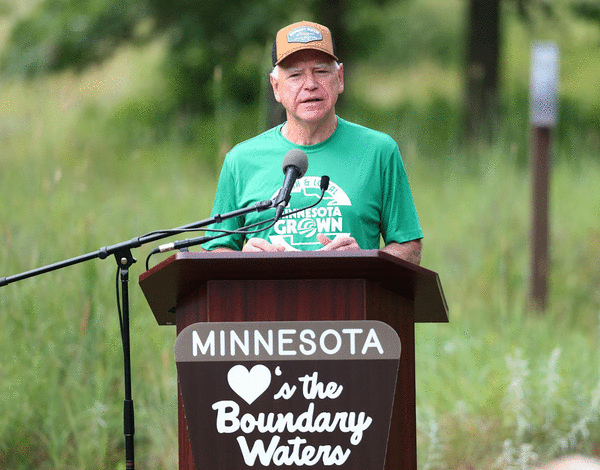
On Tuesday, Gov. Tim Walz made clear that for now, the future of the Twin Metals mine will be decided in Minnesota.
In an executive order, Walz directed state agencies to pause any work on permitting or reviewing copper-nickel mines in the Boundary Waters watershed while a lawsuit on where to site them is pending. He also barred any new nonferrous mineral leases there and said the Department of Natural Resources would closely reexamine old leases.
The order will automatically expire 90 days after Walz leaves office, meaning next April. By creating this precedent, Walz has immediately put the issue before his would-be successors. The next governor could extend the mandate, rescind it, or let it lapse.
“I think lawmakers will find that the reality of it is they’re not going to be able to escape this issue or avoid this issue,” said Ingrid Lyons, executive director of the Campaign to Save the Boundary Waters.
House Speaker Lisa Demuth, the Republican candidate for governor, has signaled her support for new mines multiple times. She would rescind Walz’s order if elected, said her spokesman Hank Long.
Sen. Amy Klobuchar, the Democratic candidate, didn’t directly address the order when asked for comment. She often cites her grandfather’s experience working underground in an iron mine, but she also opposed a federal effort to re-open mining near the Boundary Waters earlier this year. That federal bid was ultimately successful on Congress.
“Senator Klobuchar has made clear she has serious concerns about a project so close to the Boundary Waters,” a spokesman wrote in an email. “She has long supported mining and workers in northern Minnesota and believes there are mining projects, including the soon-to-be-open Mesabi Metallics, which can be done in a safe and responsible manner consistent with science after appropriate environmental reviews and permits.”
During a Tuesday event in Afton, Walz said the Boundary Waters “exists because of God’s plan and the decision of mortals to protect it. Each generation has done its part, knowing that although these waters feel eternal when you’re there, they are not invulnerable.”
For decades, the specter of copper-nickel mining has hung over America’s most visited wilderness, with the risk that sulfide minerals could create toxic mine drainage. All the while, mining proponents argue that a modern mine could provide jobs, critical minerals and keep the wilderness safe — if only given the chance.
Kathy Graul, a spokeswoman for Twin Metals, said the Walz order “unnecessarily hinders the responsible development of Minnesota’s natural resources. Minnesota’s regulatory framework already requires proposed mining projects to prove they can meet some of the world’s most rigorous environmental and labor standards before they are allowed to proceed.”
Conservationists thought they had notched a durable win in the Biden administration, when officials enacted a 20-year ban on mining federal minerals in the BWCAW watershed. But in a novel move, Congress and President Donald Trump repealed that moratorium earlier this year, and a future president cannot reinstate it.
That led anti-mine advocates to turn their sights to Minnesota as the last hope for protective action. On Tuesday, Walz took up the call.
“This is a victory for everyone who loves the Boundary Waters,” said Chris Knopf, executive director of Friends of the Boundary Waters Wilderness. “For the people who spoke up, stood up and reached out to the governor.”
Many DFL lawmakers, members of local Ojibwe tribes and wilderness guides applauded the decision.
“What happens upstream eventually makes its way downstream,” said Carlos Hernandez, chair of the Bois Forte Band of Chippewa. “That is why protecting the Boundary Waters means protecting the watershed that feeds it.”
But at least two DFLers said they opposed the governor’s move: State Sen. Grant Hauschild of Hermantown, and Aaron Kania, who is running to unseat Republican state Rep. Roger Skraba of Ely.
Republicans, business groups and representatives of trade unions decried the decision. Nonferrous industry group MiningMinnesota said the mandate was “a political decision dressed up as an environmental one.” Skraba called the order a “slap in the face” for northern Minnesotans. Rep. Tom Emmer called Walz a “lame duck loser.”
Al King, the steelworkers’ union president for the idled Minorca Mine in Virginia, said Walz’s announcement felt like another blow for laid-off miners. Minorca, owned by Cleveland-Cliffs, has stalled production for 16 months.
“It’s frustrating to say the least,” he said, “to continue seeming like this is all just a game to people, in my opinion, than actual lives at stake here, and our industry.”
In his order, Walz also directed the DNR to draft legislation that would permanently bar the mining of state minerals in the watershed of the Boundary Waters.
That is viewed as a more permanent solution, but a difficult one to achieve. Previous efforts to legislate mine limitations have stalled, even under DFL control.
Friends of the Boundary Waters, Knopf’s group, has long campaigned for a set of mine standards called “Prove it First,” but the measure has never been heard. Neither has the permanent protection bill boosted by Save the Boundary Waters, which would codify a state mine ban in the same area Walz’s order covers.
There has not been a hearing on any copper-nickel mining issue in the Legislature since 2009, Knopf said. But Walz has pushed the issue to the forefront.
“I think the governor is putting his hand on the scale, and I think it makes a difference,” he said.
_____
Star Tribune reporters Jana Hollingsworth, Allison Kite, Walker Orenstein, Sydney Kashiwagi and Ryan Faircloth contributed to this article.
_____
©2026 The Minnesota Star Tribune. Visit startribune.com. Distributed by Tribune Content Agency, LLC





Comments