Earthquake deepens Colombia leader's push to empower remote regions
Published in News & Features
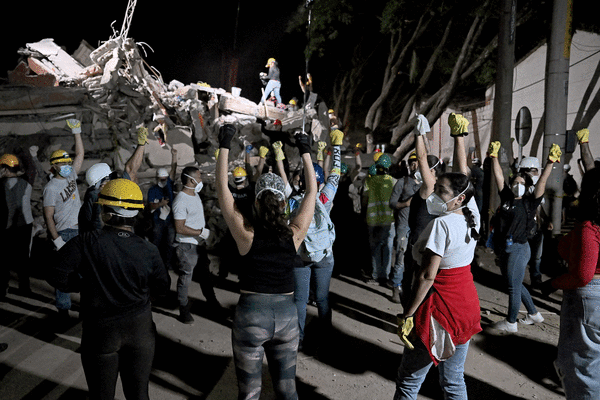
Yeiner Mena had only recently finished building a new home with his wife in the remote Colombian city of Quibdo when the strongest earthquake in 50 years reduced it to rubble.
“We lost everything,” Mena, 30, said. “We are alone.”
The challenge facing new President Abelardo de la Espriella is to prove to families like Mena’s that they’re not.
A conservative lawyer and political outsider, De la Espriella took office last Friday pledging to bring Colombia’s government closer to places like Quibdo that have long felt neglected by the country’s political and economic elite in Bogota, the sprawling capital city of 8 million people.
De la Espriella staged his inauguration in Cali, not the capital, and painted his government as one for “los nunca” — those who’ve never had power. He held transition meetings with governors and mayors, rather than his predecessor, Gustavo Petro. He’s floated the idea of an alternative capital in Barranquilla.
But the 7.4-magnitude quake has added urgency to his push to loosen Bogota’s grip on power and resources, while intensifying scrutiny on whether De la Espriella can deliver — both in the face of tragedy and across a presidency that’s only just begun.
“This earthquake is a stark reminder that Colombia’s problems have to be addressed in the territories outside Bogota, not just from the capital,” said María Isabel Ulloa, executive director of ProPacífico, a nonprofit focused on development in Colombia’s Pacific region.
The death toll had risen to 281 as of Thursday evening, with 3,971 injured and 379 missing, according to Colombia’s national disaster management agency.
Although fatalities are higher in bigger cities like Cali, it’s places like Quibdo, capital of the Choco province, that exemplify the need to bring more Colombians into the fold and the logistical challenges of doing so.
Home to some 500,000 people, a majority Afro-Colombian or Indigenous, Choco had a poverty rate of 65% in 2025, the highest in Colombia and nearly four times that of Bogota, according to government data.
The province, which extends from Panama halfway to Ecuador along the Pacific coast, is one of the country’s most isolated. With little major infrastructure, many of Choco’s communities are reachable only by river, jungle routes or air.
After initially flying to Bogota, De la Espriella made Quibdo the site of his first visit after the quake. There, he pledged rental assistance for affected families, medical transfers for the injured and more attention for a region he said should “never again be the land of the forgotten.”
Colombian leaders have spent two centuries since independence from Spain trying to incorporate the nation’s most remote regions into its political and economic fabric. A 1991 constitution declared Colombia a decentralized republic with autonomy for territorial governments, but making that a structural reality has eluded presidents ever since.
Under Petro, lawmakers approved a constitutional amendment to gradually increase the share of national revenue that goes to regional and local governments after the nation’s first-ever leftist leader similarly pledged to deliver for voters outside Bogota.
But Congress still needs to pass another law to implement that overhaul by redefining what responsibilities will remain with the national government, and which will fall to territorial and municipal authorities. De la Espriella’s administration has already announced plans to scrap Petro’s proposal in favor of one it will draft alongside governors and mayors, arguing that regional leaders need more input.
That process is rife with challenges. Large swathes of Colombia remain under control of armed rebel groups involved in drug trafficking, and they have strengthened amid increased production of coca, the raw material for cocaine. Political and economic corruption, meanwhile, runs rampant in Colombia’s local governments.
Delivering immediate aid to regions like Choco will be difficult. Damaged roads, bridges and transmission lines are making it even harder to reach those parts of the country that already had fewer public services to help absorb the shock of a natural disaster.
As much as 85% of the population in Choco didn’t have electricity in the days after the quake, according to Camila Gómez, deputy director of Colombia and Venezuela programs at the International Rescue Committee.
“The delivery of assistance in Choco is 10 times more difficult than places outside of the Pacific region,” said Gimena Sánchez-Garzoli, director for the Andes at the Washington Office on Latin America.
Trying to decentralize power amid a costly — and likely years-long — recovery effort may be even harder. De la Espriella was outside the capital on his first full working day as president. Although he posted on social media shortly after the earthquake hit, it took him more than five hours to appear on camera and address Colombians directly.
He spent the morning weighing whether to fly directly to the region at the epicenter of the quake or return to Bogota. He ultimately chose the capital, where officials had already begun gathering at an emergency command center.
It was an early reminder that, at least for now, coordination begins in Bogota, and that most of the regions De la Espriella wants to prioritize lack the administrative ability to respond on their own.
“One thing is traveling to different parts of the country, governing from there, and calling it decentralization,” Sánchez-Garzoli said. “Another is actually building the capacity of the institutions in those parts of the country.”
Utiliano Dojirama Chanapicama lost his home and the school where he works in Chano, a community on an Indigenous reserve in the Choco province. The 42-year-old rigged a makeshift shelter where he, his partner, their seven children and two grandchildren could sleep temporarily.
Dojirama heard on the radio that De la Espriella had promised aid during the visit to Quibdo. He hopes the government will help rebuild both, but isn’t sure his community will benefit.
“He didn’t mention our Indigenous reserve,” Dojirama said.
©2026 Bloomberg L.P. Visit bloomberg.com. Distributed by Tribune Content Agency, LLC.





Comments