'A bit more bark than bite': Wednesday storms less severe than Tuesday for Illinois areas battered by weather this week
Published in News & Features
CHICAGO — Parts of Cook and Will counties were hit by another round of dangerous weather Wednesday, just a day after two tornadoes tore through Chicago’s southern suburbs.
The back-to-back storms this week are the latest in an unusually volatile year that has already brought a record-breaking number of tornadoes to Illinois. And with meteorologists warning that up to 4 inches of rain could fall between Thursday afternoon and Friday morning, the region may not get a reprieve anytime soon.
“We’re kind of in an unsettled weather pattern right now,” said Scott Baker, a meteorologist and program leader with the National Weather Service’s Chicago office. “It’s just another, ‘oh well, here we go again.’”
Portions of Illinois and Indiana were under a severe thunderstorm watch until 1 p.m. Wednesday, with forecasters warning of lightning, hail and winds exceeding 60 mph. Torrential downpours prompted a flood advisory through 1:30 p.m.
Compared to previous storms, Wednesday’s were “a bit more bark than bite,” the National Weather service said in a social media post. The storms were moving out of the area by the afternoon, though forecasters said they suspected pockets of wind damage had occurred across the region.
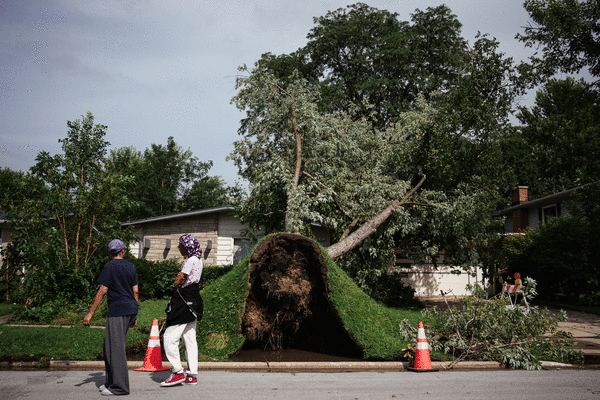
But in some communities, the day was spent cleaning up damage from Tuesday’s storms, which toppled trees and damaged homes across the region. Weather officials confirmed that two tornadoes had touched down during the storms Tuesday, one in southern Cook County and another in eastern Will County.
Roughly 20 miles south of downtown Chicago, staff members at Glenwood Academy had returned to the residential school for training when tornado warnings sounded Tuesday. The 120-acre campus had lost 33 trees to tornadoes just two weeks earlier, making the warning especially unsettling for employees as they took cover.
“And then when we came out, it was just devastating,” Glenwood Academy President and CEO Colleen Carter said.
By Wednesday, Carter said fallen branches had punched several holes through roofs across the campus, including the administration building. Winds ripped gutters from cottages where staff members live during the school year and tore the face from a clock tower that has stood at the school since its founding more than a century ago.
More than 127,000 homes and businesses across Illinois remained without power Wednesday afternoon, according to ComEd. Cook and Will counties accounted for the vast majority of outages, with roughly 72,000 and 48,000 customers affected, respectively.
Several south suburban residents said another outage came as little surprise after a summer of repeatedly losing power. In Homewood, Mary Beth Uretz went without electricity for 10 days in late May, then again for five days after high winds pummeled the town on July 27.
Down the street, Irv Anderson said the first storm of July left utility lines dangling across the neighborhood. Town trucks brought in to clear debris later snagged the wires and pulled them down completely, and a few weeks later, Anderson said, it happened again.
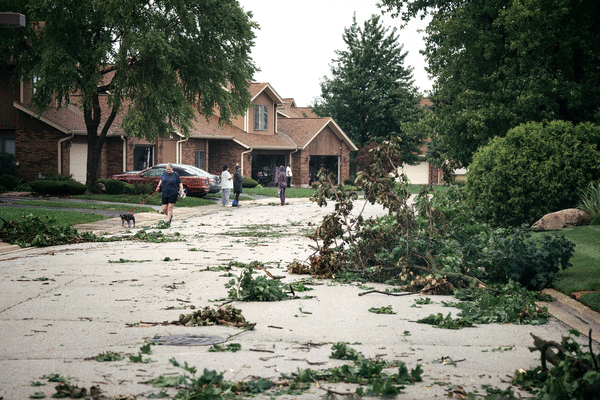
Near Anderson and Uretz’s homes, damage from this week’s storms has become difficult to distinguish from the wreckage left by storms past. Piles of brush have been growing along lawns since Memorial Day weekend, some nearly five feet tall as fresh branches and leaves are heaped atop weeks-old debris.
“It’s this constant reminder and we just can’t get ahead of it,” said Uretz, who has lived in the neighborhood for nearly two decades. “We have nowhere else to put anything.”
On Tuesday, officials reported “significant storm damage” in Homewood, where downed power lines, large trees and debris blocked roads and nearly 70% of the village lost power, the Tribune reported.
Wind gusts reached 99 mph in Gary, 97 mph at Aurora Municipal Airport and 70 mph in DuPage County near Lemont, according to Mike Bardou, a meteorologist with the National Weather Service. Hundreds of thousands of ComEd customers lost power, and thousands of flights were delayed at the city’s airports.
“Thunderstorms can happen suddenly,” the state’s emergency management agency said in a statement Wednesday. “It is important to be prepared to take precautions and shelter to avoid the impacts of these conditions.”
Residents in affected areas were advised to seek shelter, and motorists were asked to avoid driving through flooded streets, according to the statement. Officials also reminded residents that outdoor warning sirens could be used to alert people outside to seek shelter.
In Northwest Indiana, public transportation remained significantly disrupted Wednesday, according to the Gary Public Transportation Corporation. Passengers were warned of major delays as crews worked to repair storm damage and restore power along transit routes.
Extreme weather is nothing new to the region, but Illinois has already recorded more than twice as many tornadoes this year as any other state. On July 3, winds estimated at more than 80 mph led to the drownings of three suburban children at Lake Geneva. And in Portage, one person died in a structure fire Tuesday after police said hazardous weather conditions delayed the emergency response.
Air in the Midwest is becoming more saturated with humidity as human activities release heat-trapping gases into the atmosphere, providing a key ingredient for strong thunderstorms that can produce tornadoes. A warming climate generally makes storms more frequent and severe, Illinois State Climatologist Trent Ford told the Tribune last month, and with so much moisture in the air, severe storms could continue through the summer.
“I’m no scientist, but the data’s clear,” said Uretz. “This is our future, and it’s outrageously scary.”
_____
The Daily Southtown reporter Olivia Stevens Post-Tribune freelancer Doug Ross contributed.
_____
©2026 Chicago Tribune. Visit chicagotribune.com. Distributed by Tribune Content Agency, LLC.






Comments