Pakistan says deal is close even as Iran, US harden stances
Published in News & Features
WASHINGTON — Pakistan’s defense minister said the U.S. and Iran are “close to some sort of arrangement” over the Strait of Hormuz, even after both sides appeared to toughen their positions in the long-deadlocked negotiations.
“Things are shaping up in favor of peace,” Khawaja Asif told reporters in Islamabad on Tuesday, without giving details of any breakthrough. Pakistan’s Interior Minister Mohsin Naqvi will shortly arrive in Tehran to hold talks with his Iranian counterpart, the Islamic Republic’s semi-official Fars agency reported.
Talks between Iran and Oman about reopening Hormuz to some maritime shipping have reached an advanced stage, Al Jazeera reported earlier, citing a Qatari Foreign Ministry spokesperson. Pakistan has been mediating the conflict, alongside Qatar.
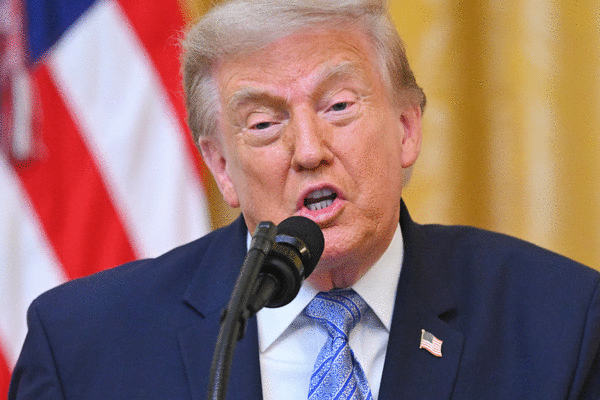
The upbeat assessments, however, came after U.S. President Donald Trump toughened his stance on Monday, saying Tehran should pay reparations for those killed in attacks linked to the Islamic Republic as well as in domestic protests. His comments came in response to a series of demands laid out by Iran over the weekend, including compensation for U.S. violations of a now-lapsed interim peace deal agreed by the sides in June.
While Iranian officials have signaled that Tehran and Oman may be nearing an agreement, it remains unclear whether such a deal would lead to an immediate and full reopening of the Strait of Hormuz, or what conditions Iran may seek to impose on traffic through the waterway.
Mohsen Rezaee, the newly appointed secretary of Iran’s Supreme National Security Council, appeared to underscore that distinction, saying any agreement with Oman on control over the waterway would remain separate from the closure of the strait, according to a report by state-run IRIB.
Iran conveyed additional conditions to Washington through intermediaries, alongside demands that the U.S. end the war and unfreeze blocked Iranian assets, IRIB cited Rezaee as saying. The comments followed a meeting with China’s ambassador to Iran, Cong Peiwu, in Tehran.
Oil edged up on Tuesday as traders assessed the latest developments in the Middle East and the prospect that a deal to re-open the strait to shipping may not be imminent. West Texas Intermediate traded near $83 a barrel, after rising by as much as 3% earlier in the session. Brent for October settlement was trading 1% higher at $88.80 a barrel.
“The mediators are trying to put things on the right track again, but it’s easier said than done,” said Ali Vaez, a deputy program director at the International Crisis Group.
“The danger is that Washington may see Iranian compliance as the prerequisite for implementing the MoU, while Tehran sees American implementation as the prerequisite for resuming negotiations — recreating precisely the sequencing trap that helped unravel the agreement in the first place,” he added.
Iran will almost certainly reject Trump’s latest demands, which the U.S. leader said will be included “firmly into any, and all, future negotiations.” The back-and-forth appeared to reduce the chance that the warring parties will be able to agree to any immediate pact on the waterway, where around a fifth of the world’s oil and liquefied natural gas flowed before the conflict began on Feb. 28.
In a sign of ongoing tensions, a U.S. Navy helicopter fired missiles at a Panama-flagged cargo ship that attempted to run the American blockade of Iranian ports early Tuesday, U.S. Central Command announced. The shot aimed at the vessel’s engine room was intended to disable its steering, Central Command said.
The UK navy said it received a report on Tuesday of an incident involving a container ship and military forces in the Gulf of Oman, without providing further details. It was also informed of an incident off Yemen’s Red Sea coast in which a cargo vessel reported being hit by an unknown projectile, resulting in casualties.
European diesel futures surged more than 10% as refineries in Libya and Russia came under attack, further tightening the market for the fuel considered the workhorse of the global economy. Saudi Arabia extinguished a fire at its Jazan oil refinery early Sunday, the country’s energy ministry said, with Yemen’s Houthi militants claiming an attack on the facility hours later.
“The region cannot remain indefinitely in a state of neither war nor peace,” Anwar Gargash, senior diplomatic adviser to the president of the United Arab Emirates, wrote in a post on X. “Its stability and the future of its peoples require clarity in vision and direction.”
Trump signaled over the weekend that he was prepared to let economic pressure on Iran build rather than launch fresh military strikes to force a reopening of Hormuz. The Islamic Republic’s economy has taken a hammering from the war, with much of its industrial capacity destroyed and crude exports severely curtailed by a U.S. blockade. Central bank data shows year-on-year inflation recently reached 77%.
The currency, meanwhile, has fallen more than 10% from its prewar level, adding to the economic pressure on Iranians. A depreciation of the rial sparked violent nationwide protests that peaked early this year, leading to a crackdown by authorities that left thousands dead. There have been no signs of the anti-government demonstrations resuming.
Tehran’s demands for a full reopening of Hormuz include the U.S. lifting its naval blockade on Iranian ports, the release of frozen assets and compensation for war damages. It has also called for a permanent end to attacks on militant groups it backs in Lebanon, Iraq, Yemen and Gaza. Trump said on Monday that Iran should be held responsible for damages stemming from conflicts in these countries.
_____
With assistance from Alex Longley, Carla Canivete, Eric Martin, Murat Oztaskin, Meghashyam Mali, Devika Krishna Kumar and Jordan Fabian.
_____
©2026 Bloomberg L.P. Visit bloomberg.com. Distributed by Tribune Content Agency, LLC.






Comments