Discarded SpaceX rocket crashes into Moon
Published in News & Features
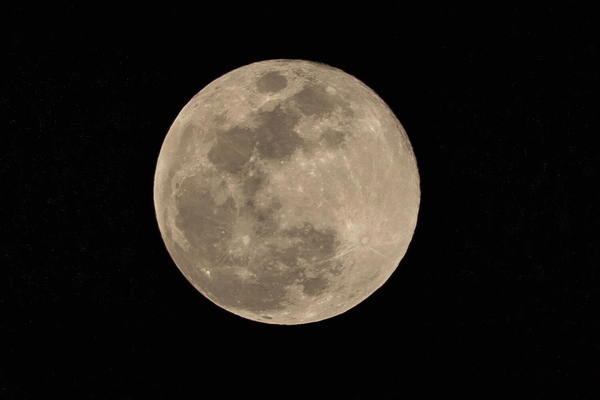
Part of a SpaceX rocket, about the size of a school bus, is believed to have collided with the moon, independent scientists said Wednesday.
The rocket carried two lunar landers into space earlier this year, one for NASA and another from a Japanese company. After the lunar landers separated from SpaceX’s Falcon 9 rocket, the team sought to maneuver the expended rocket away from the moon, in line with best practices.
However, “a mixture of solar activity and gravity forces” pushed the spacecraft’s trajectory toward the lunar surface, Julianna Scheiman, director of human spaceflight and NASA science at SpaceX, said at a Monday news conference.
Independent astronomers combing through public NASA data first discovered the rocket was on a collision course with the moon, NASA said. The agency’s Jet Propulsion Laboratory in La Cañada Flintridge confirmed the calculations, determining the rocket had a “100% chance of impacting the Moon.”
The collision of the rocket’s second stage — about 12 feet wide and 45 feet long — was expected to create a 60-foot-wide crater. While the rocket’s larger and re-usable first stage is responsible for carrying payloads out of the thick atmosphere the smaller second stage places payloads in their final orbits.
SpaceX typically lands its first stages on barges in the ocean and lets its second stages burn up in the atmosphere; however, carrying the lunar landers into a trajectory for the moon meant the second stage was traveling too fast to turn it around and bring it back to Earth.
The impact was too small to see with the naked eye or amateur telescopes, but — to the excitement of many scientists — NASA said it would attempt to observe the collision with ground telescopes at its Marshall Space Flight Center in Huntsville, Ala., and with its Lunar Reconnaissance Orbiter, which has been circling the moon since 2009.
NASA did not immediately confirm whether it had spotted the collision.
However, scientists at the European Southern Observatory’s Very Large Telescope in Chile caught the nighttime show.
With a scientific instrument that separates light into its different colors to identify unique chemical signatures, scientists saw sodium and lithium gases emanating from the impact site for five to ten minutes, the observatory confirmed in a statement to The Times.
The sodium likely originated from the lunar soil, the observatory said. Meanwhile the lithium may have come from the rocket itself.
©2026 Los Angeles Times. Visit at latimes.com. Distributed by Tribune Content Agency, LLC.






Comments