Trump holds off Iran strikes on pledge a Hormuz deal is close
Published in News & Features
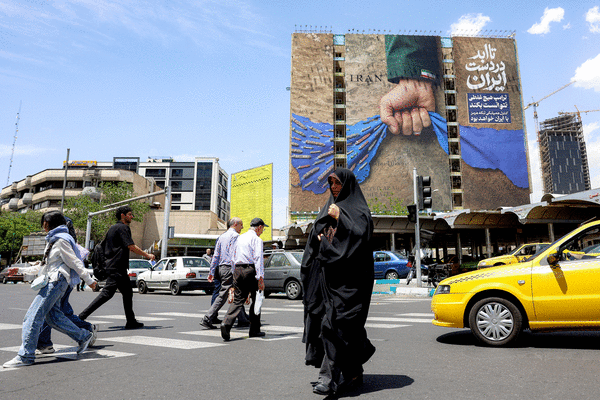
U.S. President Donald Trump said he’s holding off from new strikes on Iran, after Tehran and other Middle Eastern powers told him they’re working on an agreement that might quickly reopen the Strait of Hormuz.
Trump said he’d agreed to cancel the attack, “subject to being able to rapidly make a DEAL,” according to a post on Truth Social. “Get to work, everybody, and get it DONE.”
The announcement marks a moment of potential respite after days of escalating tensions that saw Trump preparing to hit the Islamic Republic “very hard” in a bid to bring an end to a conflict that’s now in its sixth month. Neither Iranian media nor officials have indicated a deal is close.
Waves of tit-for-tat Iranian attacks on American allies have targeted countries across the Middle East, while Tehran’s effective closure of the Strait of Hormuz — a global shipping chokepoint — has driven sharp swings in energy prices.
The U.S. was asked “to hold off any attack in that the perimeters of a deal has been agreed to,” Trump said in his post on Saturday. “This would include the Immediate, Complete, and Total OPENING OF THE HORMUZ STRAIT, and an end to Iran’s nuclear threat.”
Iran’s semi-official Fars news agency, which is affiliated with the Islamic Revolutionary Guard Corps, said Trump’s claim of halting attacks was a “repeated retreat from threats.”
Axios reported earlier that Saudi Arabian Crown Prince Mohammed bin Salman had urged Trump to refrain from new strikes. The official Saudi news agency said Sunday the kingdom’s de facto ruler had stressed to Trump the need for dialogue to deescalate tensions.
Israel, which launched the war alongside the U.S. but wasn’t party to an initial Washington-Iran peace deal in June, is waiting out the latest diplomatic push, according to a member of Prime Minister Benjamin Netanyahu’s security cabinet, Zev Elkin.
There’s “some kind of vector toward an agreement between Iran and Oman,” he told local Army Radio on Sunday. The two nations held discussions last month that sought to reopen the Hormuz strait.
Elkin expressed skepticism: “We’ll all wait to see if this vector really does become a full agreement, and whether it will be implemented and where it’s all leading.”
Trump held talks with Netanyahu at the White House last week, their first meeting since the Iran war began in late February. The Israeli premier said they’d discussed options for pursuing the campaign.
The prospect of yet more attacks had ratcheted up worries in the region, where Iranian attacks have previously threatened energy facilities in countries including Saudi Arabia, Qatar and Kuwait.
Brent crude ended last week above $90 a barrel, compared with below $72 a barrel at the start of July.
Major OPEC+ nations on Sunday agreed in principle to another token increase in their production quotas for September. The move would complete the theoretical revival of supplies halted in 2023 and give scope to add more barrels once the Middle East war ends.
U.S. embassies across the region on Saturday warned Americans to be prepared for flight cancellations, periodic airspace closures and other travel disruptions as tensions remained elevated.
A U.S.-Iran truce brokered in June collapsed last month, though the two sides paused strikes again in late July to give diplomacy another chance. That lull ended Tuesday night when Tehran carried out what Trump described as a surprise attack, firing multiple ballistic missiles at a U.S. military base in Jordan.
Iranian Foreign Minister Abbas Araghchi held separate calls with his Saudi and Turkish counterparts and Pakistan’s army chief before Trump’s announcement on Saturday. He warned against any “adventurous actions by the U.S. military,” saying Iran was “fully prepared” to respond “decisively.”
Araghchi also told Saudi Foreign Minister Faisal bin Farhan Al Saud any regional cooperation with the U.S. would draw a decisive and appropriate response from Iran’s armed forces, according to a Telegram post from the Islamic Republic’s Foreign Ministry.
Iranian-backed Houthis rebels in Yemen have recently opened a new front in the war, threatening shipping in the Red Sea near the Bab el-Mandeb, another shipping bottleneck.
_____
(With assistance from Salma El Wardany and Chelsea Mes.)
_____
©2026 Bloomberg L.P. Visit bloomberg.com. Distributed by Tribune Content Agency, LLC.






Comments