Kansas appeals court upholds 3-day grace period for mail-in ballots
Published in News & Features
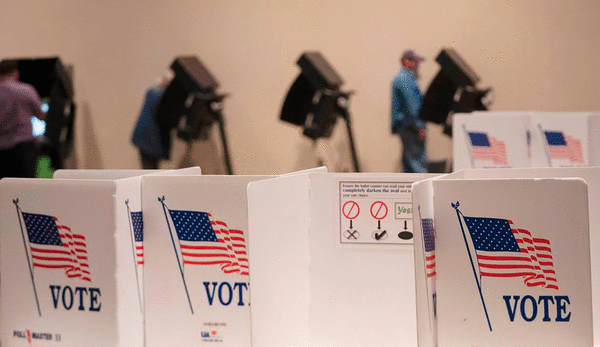
Mail-in ballots in Kansas will have three days after Election Day to arrive at election offices after the Kansas Court of Appeals upheld an earlier decision halting the new law that would remove the grace period.
Kansas for years has allowed election officials to collect mail ballots for three days after the election as long as they were postmarked by Election Day. But lawmakers last year passed Kansas Senate Bill 4, which removed the grace period.
A group of Kansas advocacy groups sued the Douglas County District Court Judge Carl Folsom earlier this month granted an injunction halting the new law and restoring the grace period, at least temporarily.
Secretary of State Scott Schwab, a defendant in the lawsuit, asked the Kansas Court of Appeals to quickly review Folsom’s injunction, saying ballots for the August primary had already gone out informing voters there was no grace period.
The appeals court said granting the stay, which would have removed the grace period again, could create voter confusion.
“This very real and irreparable harm — that the votes of well-meaning Kansans, acting in good faith based on a judicial decision, would not be counted — outweighs the administrative burden of counting the mail-in ballots received within three days after Election Day,” said Sarah E. Warner, chief judge of the Kansas Court of Appeals, in the decision.
Folsom’s order keeping the grace period in effect concluded that plaintiffs are likely to succeed in their constitutional challenge of the law because arbitrarily disenfranchise voters due to mail delays beyond their control.
Neither the injunction nor the decision by the appeals court is a final ruling on the lawsuit’s claims. They allow the grace period to remain in effect until the lawsuit is resolved.
Supreme Court declines to hear appeal
After the injunction was granted earlier this month, Schwab immediately asked the Kansas Supreme Court to act on the matter.
This week, after the appeals courts rejected his motion, Schwab again asked the Kansas Supreme Court to evaluate the appeal.
But the Kansas Supreme Court declined both requests, saying Schwab failed to convince the court it needed to bypass the traditional appeals process.
“We respect our colleagues’ sense that the highest court has a duty to issue the final word on important constitutional questions, but any decision we render now will not finally resolve the case,” said Chief Justice Eric S. Rosen. “For this and other reasons, we view the exercise of judicial restraint under these circumstances not as an abdication of duty but as a form of institutional humility.”
Attorney General Kris Kobach, in a social media post, lambasted the high court’s decision not to evaluate the matter, arguing it showed why Kansans should vote for an elected Supreme Court next week.
“This is a matter of huge statewide importance, but the court walked away from its responsibility to make a decision,” Kobach said. “They know that no justice has ever been removed from office under the current system. As a result, they feel no need to resolve this matter quickly for the people of Kansas. An elected court would have served the people of Kansas better.”
_____
©2026 The Kansas City Star. Visit kansascity.com. Distributed by Tribune Content Agency, LLC.




Comments