UN reports sharp rise in rapes in Haiti as country braces for end of TPS
Published in News & Features
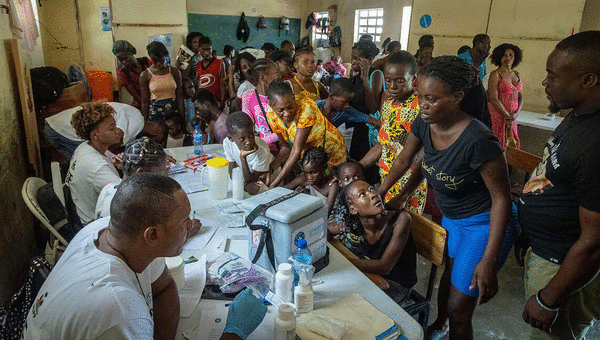
The United Nations has issued a warning about an alarming surge in women and girls being raped in Haiti, many of them homeless after being forced out of their homes and neighborhoods by armed gangs.
The U.N. Office for the Coordination of Humanitarian Affairs said local partners recorded more than 3,000 incidents of gender-based violence between April and June, including more than 1,000 reported in June alone.
“This brings the total number to 5,500 in the first half of the year, representing a sharp rise in numbers since last year, when partners recorded just over 8,000 incidents,” Farhan Haq, deputy spokesman for Secretary-General António Guterres, said.
Haq said nearly 70% of the cases in the last six months involved rape, many reportedly perpetrated by armed groups. More than half of the survivors were women and girls who had been forced to flee their homes.
The figures underscore the worsening conditions amid a surge in gang attacks and the growing vulnerability of Haiti’s gang refugees, many of whom have no choice but to live in makeshift encampments with no doors, lighting or basic security.
Congressional visit
On Tuesday, rural farmers in Kenscoff, located in the hills above the capital, and St. Michel-de-l’Attalaye, in the Artibonite region, reported attacks by heavily armed men. In the Artibonite, gangs attempted to take control of the rural commuuity of Marmont-Paul. The attacks are part of the latest wave of gang assaults and kidnappings that continue to grip the country, which earlier this week welcomed its first visit by a U.S. congressional delegation to Port-au-Prince since 2019.
The bipartisan visit was led by House Foreign Affairs Committee Chairman Brian Mast, a Florida Republican, who landed in Port-au-Pince via helicopter after visiting Venezuela. He was joined by fellow Florida Republican Kat Cammack, and Democrats Rep. Ami Bera, California, and Jonathan Jackson, Illinois.
During the visit the delegation met with Haiti’s senior government officials including Prime Minister Alix Didier Fils-Aimé, Foreign Minister Raina Forbin, Defense Minister Mario Andrésol, Justice Minister Patrick Pélissier, and the acting director deneral of the Haiti National Police, André Jonas Vladimir Paraison.
The delegation also visited the Vertières military base, where they attended a presentation of a class of recruits from the Armed Forces of Haiti and met with the special representative of the U.N. authorized Gang Suppression Force..
Discussions focused on the challenges facing the country, as well as necessary steps to improve security. Ahead of the visit, Mast was also concerned about the well-being of a six-year-old girl, a U.S. citizen who was been held by armed gangs for over 45 days. The girl’s father, James Boyard, is a Haitian national police officer and the chief of staff to the minister of defense. The family was kidnapped while Boyard was taking his daughter to see a doctor. Despite the payment of multiple ransoms, gang members have refused to release the two, sources told the Miami Herald.
The deteriorating security situation and visit coincides with last month’s U.S. Supreme Court ruling clearing the way for the Trump administration to revoke deportation protections for more than 300,000 beneficiaries of Temporary Protected Status.
Gang-fighting force operational
-During a roundtable discussion on Haiti’s security crisis organized by the Center for Analysis and Research in Human Rights, the Special Representative of the gang-fighting force, Jack Christofides said the mission, which began operations last month, had taken the necessary steps to begin sustained anti-gang operations.
The remarks were Christofides’ first public comments in Haiti since arriving in Port-au-Prince on April 1, although he has twice addressed the U.N. Security Council, most recently this month.
“We are moving into the early stages of action,” he said.
Christofides added that the force has established its headquarters and rules of engagement, as well as some of the first command-and-control arrangements and intelligence structures. It also deployed its first forward operating base inside a strategic area for expansion, established continuous patrol patterns and begun operations against gang infrastructure.
Two days after the Security Council briefing, the gang-fighting force reported that one of its units was involved in a hostile encounter with armed gang members while conducting a routine security patrol in Tabarre, a Port-au-Prince suburb controlled by the Kraze Baryè gang.
Three suspected gang members were killed during the incident, and no civilians were injured. The force, which is still operating below its target of 5,500 personnel, also recently conducted operations in Delmas where it was also confronted by armed groups.
Christofides said the mission has finalized key legal agreements governing its deployment. One agreement is with the justice ministry and establishes procedures for the handing over of individuals arrested by the force to Haitian authorities. A second agreement, concluded Monday with the Minister of Foreign Affairs, grants the mission specific legal status and protections.
In his Security Council briefing, Christofides cautioned that the political and humanitarian environment in Haiti “remains extremely challenging.”
“Armed gangs are likely to adapt their tactics to stay in control. Meanwhile, humanitarian needs continue to soar. Political uncertainty remains one of the most caustic variables affecting the success of the GSF,” he said.
Gang violence has killed more than 2,000 Haitians this year and nearly 1.5 million remain internally displaced after being forced to flee their homes.
The sharp increase in sexual violence, especially among displaced women and girls, echoes concerns Haitians raised last month with Guterres when he visited a makeshift tent city.
Haq said some survivors have been able to get medical, psychosocial and protection services, but the needs continue to far exceed the U.N.’s current capacity.
“Our partners also note that the situation is unfolding against a backdrop of mass displacement and forced returns,” he said noting that more than 140,000 Haitians have been forcibly returned to the country between January and June of this year. “Many return without identity documents or resources.”
©2026 Miami Herald. Visit at miamiherald.com. Distributed by Tribune Content Agency, LLC.






Comments